
Best Pickleball Paddles for Beginners (2026): 8 Tested

Quick Answer: The best pickleball paddle for beginners in 2026 is the Vatic Pro Prism Flash. It features a plush 16mm core and raw T700 carbon face that provides the massive sweet spot beginners need, while offering enough spin to grow with your game. If you are outfitting two players on a strict budget, the MTEN Fiberglass Set is the best value bundle.
Top 3 Beginner Paddles at a Glance:
- Best Overall Beginner Paddle: Vatic Pro Prism Flash (Raw Carbon Fiber)
- Best Value Bundle (2-Pack): MTEN Fiberglass Set (Widebody)
- Best Lightweight Pick (7.6 oz): Diadem Hero V2 (Composite)
Jump to: 13mm vs 16mm Quick Comparison Paddle Reviews What to Avoid How to Choose Final Verdict FAQs
Finding the right starter paddle is critical—a paddle that is too heavy will strain your shoulder, and a core that is too thin will make your dinks pop up uncontrollably. After 400+ hours of testing 80+ paddles, I found the 8 models that actually help new players improve. To build this list of the best pickleball paddles for beginners, I didn’t just test these myself; I handed them to real 2.5 and 3.0-rated players during open play to see which paddles actually reduced their unforced errors.
Every recommendation here comes from rigorous swing feel evaluations, spin testing, and real match play through late 2026—a minimum of five hours per paddle. See how these compare to my complete testing lineup in my master guide to the best pickleball paddles of 2026.
Transparency: Some links on this page are affiliate links—I earn a small commission if you purchase through them, at no extra cost to you. No brand paid to appear on this list, and every paddle here was purchased with my own money and tested on my own courts.
Testing Notes: 8 paddles | 400+ hours of testing across my full 80+ paddle library | minimum 5 hours of dedicated play per paddle, more for flagship picks | every paddle purchased at retail — zero free samples, zero paid placement. Full methodology in my How I test pickleball paddles guide.
The best beginner paddle typically weighs 7.2–8.2 oz with a core between 8mm and 16mm — thicker cores add more dwell time and forgiveness, while thinner cores on this list trade some of that for a lighter swing and quicker hand speed. Most paddles on this list sit in the $50–$100 range, offering durable cores and textured faces built for regular rec play.
Pro tip: once you pick your paddle, protect your investment and improve your handle traction by wrapping it with a quality layer from my best pickleball grip tape guide.
Beginner’s Paddle Formula: What to Look For
Skip the spec-sheet overwhelm. If you’re brand new, here’s the range I’d actually shop in — and every paddle on this page falls somewhere inside it:
| Spec | Recommended Range | Why |
|---|---|---|
| Static weight | 7.2–8.2 oz | Light enough to control on reaction volleys, heavy enough to still feel drives |
| Core thickness | 8–16mm | A 16mm core adds dwell time and forgiveness — the right call for most beginners. A few lighter, thinner-core picks on this list (8–10mm) trade some of that for a much lighter swing, which is why I’ve flagged exactly who each one fits. See my 13mm vs 16mm breakdown below. |
| Face material | Fiberglass or raw carbon fiber | Fiberglass is more forgiving out of the box; raw carbon (like the Vatic Pro Prism Flash) is just as playable if the core is soft enough to absorb mishits |
| Shape | Widebody, hybrid, or standard | Elongated shapes have a smaller sweet spot — save those for once your contact point is consistent |
| Swing feel | Balanced to head-light | Easier on the arm, easier to react at the net |
Is a 13mm or 16mm Pickleball Paddle Better for Beginners?
Get the 16mm. If you’re standing in a shop wondering whether a 13mm or 16mm pickleball paddle is better for beginners, that’s your answer — a 16mm core gives you a bigger sweet spot, softer touch on kitchen dinks, and real vibration protection for your arm.
Here’s why three millimeters matters more than it sounds like it should. I’ve watched new players struggle for reasons that had nothing to do with athleticism or practice — the paddle was working against them. Nine times out of ten, it was a thin 13mm core a friend handed down because it’s what they play.
- 13mm cores are thinner, snappier, and send more energy straight into the ball. Great for players with developed touch. Brutal for beginners — a dink hit a fraction too hard rockets up into a sitter; too soft and it dies in the net.
- 16mm cores absorb more of that energy. The sweet spot is physically larger and more forgiving on the off-center contact every beginner makes constantly — and the added material meaningfully cuts down vibration that would otherwise travel into your wrist and elbow.
| Metric | 13mm Core | 16mm Core |
|---|---|---|
| Primary attribute | Explosive power, fast pop | Plush control, vibration absorption |
| Sweet spot | Compressed — needs precise contact | Expanded — highly forgiving |
| Dwell time | Minimal | Maximum |
| Vibration dampening | Low | High |
| Ideal skill level | 4.0+ aggressive/singles players | Beginners, intermediates, control players |
Three picks on this page — the Diadem Hero V2 (8mm), niupipo (10mm), and ONESHOT X (10mm) — run thinner cores than the 16mm I’m recommending here. That’s a deliberate lightweight trade-off for arm sensitivity, budget, or faster hand speed, not a contradiction of this advice. If none of those apply to you, stick with 16mm — it’s what the Vatic Pro Prism Flash and Ronbus R Series both run, and why they’re my top two overall picks.
Once your dinking is automatic and your third-shot drop is a weapon rather than a prayer — usually around the 4.0 level — the 13mm power options are worth a look. Not before. For the full breakdown, see my 14mm vs 16mm pickleball paddle comparison.
Best Pickleball Paddles for Beginners: Quick Comparison
| Product | Recommendation | Tech Specs | Dylan’s Rating | Shop |
|---|---|---|---|---|
| Best Overall Beginner | Hybrid / 16mm / 5.3″ Grip Raw T700 Carbon Fiber |
9.6 |
View on Amazon | |
| Best Value Bundle | Widebody / 16mm / 4.88″ Grip Fiberglass Face / 7.8 oz |
9.2 |
View on Amazon | |
| Best for Spin | Elongated / 16mm / 5.5″ Grip Raw T700 Carbon Fiber |
9.4 |
View on Amazon | |
| Best Under $60 | Wideface / 8mm / 4.5″ Grip Composite HMT / 7.6 oz |
8.3 |
View on Amazon | |
| Best Trusted Brand | Dynamic / 15mm / 4.25″ Grip Fiberglass CHS / 8.1 oz |
9.0 |
View on Amazon | |
| Best Budget Group Set | Widebody / 10mm / 4.72″ Grip Fiberglass / Honeycomb |
8.7 |
View on Amazon | |
| Best Value Lightweight | Traditional / 10mm / 4.25″ Grip Fiberglass Face / 7.8 oz |
6.0 |
View on Amazon | |
| Best Pro Starter | Standard / 12mm / 4.75″ Grip Reinforced Fiberglass / 8.2 oz |
9.1 |
View on Amazon |
Best Pickleball Paddles for Beginners: A Closer Look
Vatic Pro Prism Flash
Best Overall Beginner
| Shape | Hybrid |
| Dimensions | 16.3″ L x 7.7″ W |
| Weight | 7.9 – 8.2 oz |
| Grip Length | 5.3″ |
| Core Thickness | 16mm |
| Core Material | Polypropylene Honeycomb |
| Face Material | Raw T700 Carbon Fiber |
| Thermoformed | No (Cold-Molded Unibody) |
| USAP Approved | Yes |
I’d been hearing about Vatic Pro from players at my local courts for months before I finally bought the Prism Flash to test myself. The reputation turned out to be earned.
The Toray T700 raw carbon fiber face is the real differentiator here — the same material you find in paddles costing twice as much, and the texture grabs the ball for genuine spin. Vatic uses cold-molding instead of thermoforming, which gives you a plush, controlled feel rather than a stiff, punchy one.
The foam-injected walls deaden vibration and widen the sweet spot noticeably. I tested this back-to-back against a standard fiberglass paddle at the same price, and the difference in dwell time is immediate — you feel the ball sit on the face a split second longer, which is exactly what you want when you’re developing a soft game.
The 16mm core soaks up pace and makes third-shot drops more forgiving. At around 8 oz, it’s light enough to move quickly at the net without feeling flimsy. Nothing at this price point competes with it in terms of control. One flag: the 5.3-inch handle runs short if you hit a two-handed backhand, so look at the Ronbus R Series below if that’s you. Read my full Vatic Pro Prism Flash review →
Buy if:
The non-thermoformed cold-mold construction gives you a softer, more controlled feel than thermoformed paddles — I found it noticeably easier to reset and drop from the kitchen.
Raw T700 carbon fiber face with real surface texture generates high-tier spin rotation that outperforms standard fiberglass builds.
Pass if:
Because it isn’t thermoformed, it lacks the “pop” and easy power of stiffer, more aggressive paddles.
It’s a serious investment if you are just trying the sport for the first time this weekend.
MTEN Fiberglass Set
Best Value Bundle
| Shape | Widebody |
| Dimensions | Standard |
| Weight | 7.8 oz |
| Grip Length | 4.88″ |
| Core Thickness | 16mm |
| Core Material | Polypropylene Honeycomb |
| Face Material | Fiberglass |
| Thermoformed | No |
| USAP Approved | Yes |
The MTEN Fiberglass set solves the beginner’s dilemma: quality gear without the premium price tag. It includes two USAP-approved paddles, four balls, and a carrying case — everything needed to hit the courts immediately.
Unlike heavy, dead-feeling budget bundles that stall your mechanics, MTEN delivers real performance. The fiberglass face offers lively “pop” for drives, while the 16mm honeycomb core provides the dwell time necessary to develop your soft game at the kitchen line. At 7.8 oz, the weight sits in the perfect sweet spot to prevent arm fatigue.
In my testing with 3.0–3.5 level players, the feedback was consistent: the response feels highly predictable, which builds early confidence. Plus, having matching paddles ensures you and your partner develop the same swing mechanics.
The catch: the spin ceiling. Fiberglass is incredibly forgiving, but it won’t generate the heavy RPMs of raw carbon fiber. If you’re already focused on developing a spin-heavy serve or a cutting slice, you’ll outgrow this face material quickly.
Buy if:
USAP-approved for official play, this bundle includes balls and a case — everything you need to hit the courts immediately.
The 16mm honeycomb core and wide fiberglass face create a massive, highly forgiving sweet spot for off-center mishits.
Pass if:
Fiberglass inherently limits your spin ceiling. If you plan to rely on heavy topspin or slices, you need raw carbon fiber.
If you only need one paddle, your budget is much better spent on a single higher-tier option (like the Vatic Pro) rather than a starter two-pack.
Ronbus R Series
Best for Spin
| Shape | Elongated (R1/R3) |
| Dimensions | 16.5″ L x 7.5″ W |
| Weight | 8.0 – 8.2 oz |
| Grip Length | 5.5″ |
| Core Thickness | 16mm |
| Core Material | Polypropylene Honeycomb |
| Face Material | Raw T700 Carbon Fiber |
| Thermoformed | No |
| USAP Approved | Yes |
If you’re a player who wants to develop a controlled, spin-heavy game without spending premium money on a paddle, I’ve found that the Ronbus R Series delivers pro-level features at a cost that actually makes sense.
The raw carbon fiber face grabs the ball the way textured surfaces should — I was getting heavy topspin serves that actually kick on the bounce, and slices that died low. That’s not common at this price. The 16mm core gives it a soft, predictable feel with a sweet spot that’s genuinely forgiving on off-center hits. Dinks land where I aimed them, which, for a beginner, is more valuable than any spec on the box.
The 5.5-inch handle is a real differentiator if you use a two-handed backhand — finally enough grip for both hands without cramping. Spin potential landed in the top tier across my testing setup; during on-court playtesting, this paddle consistently produced heavy, dipping topspin drives, the highest spin performance I recorded in this beginner group. If you’re a tennis player transitioning over and want to bring your spin game with you, this is the one. For more paddles built around rotation, see my best pickleball paddles for spin.
Buy if:
The 5.5″ elongated handle provides plenty of room for players who prefer a two-handed grip for stability.
The 16mm core and carbon fiber face make dinks and resets exceptionally predictable — it’s one of the strongest soft-game paddles in this group.
Pass if:
If you prefer the wide, square shape of a standard paddle, the elongated reach of the R-series may feel “head heavy.”
Like the Vatic Prism, this is a control-first paddle and won’t satisfy players looking for explosive ball speed.
Diadem Hero V2
Best Under $60
| Shape | Wideface |
| Dimensions | 16″ L x 7.6″ W |
| Weight | 7.6 oz |
| Grip Length | 4.5″ |
| Core Thickness | 8mm |
| Core Material | Polymer Honeycomb |
| Face Material | Composite HMT Fiberglass |
| Thermoformed | No |
| USAP Approved | Yes |
I’ve had my eye on Diadem as a brand for a while — they’re legit in tennis and have brought that same energy to pickleball. The Hero is their entry-level offering, and honestly, it’s perfect for exactly who they’re targeting.
Right out of the gate, the weight is the headline here. At 7.6 oz, it’s light enough that kids, juniors, or anyone with arm sensitivity can swing it all day without fatigue. The HMT fiberglass face has genuine pop for its weight class — more responsive than I expected from an 8mm core, and controllable enough that new players won’t be spraying balls everywhere while they’re still figuring out their swing.
The slightly coarse texture helped me catch the ball cleanly and start experimenting with spin earlier than I expected. I also appreciated how little vibration made it up to my hand; that lower-density core really does smooth out off-center hits. And if you’re shopping for a kid or a total beginner, durability matters — the edge guard is solid, and this thing can absolutely take the abuse of learning without falling apart.
Buy if:
With its light weight and smaller grip, this is the perfect first “real” paddle for kids and teenagers.
At 7.6 oz, it’s incredibly easy on the joints, making it a good fit if heavier paddles leave your arm sore. I’m not a doctor, so see one if pain persists.
Pass if:
The 8mm core is very thin and lacks the depth and stability required for high-level tournament play.
Lightweight paddles struggle against heavy wind; you may find yourself getting pushed around on outdoor courts.
HEAD Radical Elite
Best Trusted Brand
| Shape | Dynamic / Ergo |
| Dimensions | 16″ L x 7.8″ W |
| Weight | 8.1 oz |
| Grip Length | 4.25″ |
| Core Thickness | 15mm |
| Core Material | Polypropylene Honeycomb |
| Face Material | Fiberglass (CHS) |
| Thermoformed | No |
| USAP Approved | Yes |
When I see “HEAD” on a piece of sports equipment, I immediately think, “They know what they’re doing.” Decades in tennis and skiing give them serious engineering cred. The Radical Elite is their entry-level pickleball offering, and it’s exactly what you’d expect from a brand that’s been perfecting racquet sports for generations. Worth noting: HEAD markets this paddle toward intermediate players, but in my testing it played forgiving enough to earn a spot on a beginner list.
The sweet spot is the first thing you notice. The core is thick enough to absorb mishits without going mushy — I was catching off-center dinks that would have popped up awkwardly on a thinner paddle. For someone still building consistency, that forgiveness matters more than any spec on the box.
The Ergo grip is legitimately comfortable stock. Foam-based, slightly contoured, and it didn’t slip once during extended play, even when my hand was sweating. I have average-sized hands, and it fits well without an overgrip — players with larger hands should be fine too, given the grip diameter.
What bugs me is the face texture. It’s smooth enough that generating heavy topspin takes real effort — you’re relying on swing mechanics rather than surface bite. If spin is part of your game, that’s a limitation worth knowing upfront.
For someone stepping up from a budget starter set, this is exactly the right next paddle. The feel is predictable, the build quality is solid, and it’ll carry you through your first year of real play without feeling like you’ve already outgrown it.
Buy if:
If you want a paddle designed by the same engineers who make world-class tennis racquets, this is it.
The foam Ergo grip is one of the most comfortable stock grips I’ve used at this price — no overgrip needed out of the box.
Pass if:
The face is relatively smooth, meaning you’ll have a hard time generating the heavy topspin needed for “dips.”
Unlike MTEN or niupipo, this is usually sold as a single paddle without balls or extra accessories.
niupipo Bundle
Best Budget Group Set
| Shape | Widebody |
| Dimensions | 15.4″ L x 7.8″ W |
| Weight | 7.6 – 8.0 oz |
| Grip Length | 4.72″ |
| Core Thickness | 10mm |
| Core Material | Polypropylene Honeycomb |
| Face Material | Fiberglass |
| Thermoformed | No |
| USAP Approved | Yes |
The niupipo set is the answer I give whenever someone asks for a starter setup that won’t waste money. I’ve put it through enough court time to know it punches above what the price suggests — and at this price, that matters more than any sales ranking.
It’s the one exception on this list to my usual thicker-core recommendation — the 10mm core is thinner than most others here, but the bundle value and price make it worth flagging for casual players who aren’t ready to invest in a single paddle yet.
The value is hard to argue with. Two USAP-approved paddles, four balls, and a bag for what most brands charge for a single paddle — if you’re buying for you and a partner, this is the obvious starting point.
The paddles are lighter than I expected at 7.6–8 oz. I played a two-hour session without any arm fatigue, which at this price point isn’t a given. The fiberglass face has genuine pop — more than graphite at the same thickness — which matters for beginners who haven’t developed the swing mechanics to generate pace on their own yet.
What I didn’t expect was how quiet these are. The polypropylene core dampens sound noticeably compared to other entry-level paddles I’ve tested. On indoor courts, especially, that’s a courtesy to everyone around you.
What bugs me is the core thickness. At 10mm, it’s thinner than I’d normally recommend — you’ll feel more vibration on off-center hits than you would with a thicker paddle, and the control ceiling is lower. These are fine while you’re learning the basics, but a player who improves quickly will outgrow them.
For the price, the grip feels decent in hand, and the edge guard held up through my testing without any chipping. It’s not built to last five years of serious play, but it doesn’t need to be. This is a first-year paddle, and for that job, it’s as good as anything at this price.
Buy if:
Perfect for families who only play once a month and want reliable gear without spending over $50.
Often available in 4-paddle sets, it’s the most cost-effective way to get an entire group on the court.
Pass if:
This is basic honeycomb and fiberglass technology; it won’t have the edge-grid or carbon textures of modern paddles.
The thinner core can transfer more vibration to the wrist than thicker options.
ONESHOT X
Best Value Lightweight
| Shape | Traditional (slightly oversized head) |
| Dimensions | 15.7″ L x 8.2″ W |
| Weight | 7.8 oz |
| Grip Length | 4.25″ |
| Core Thickness | 10mm |
| Core Material | Polypropylene Honeycomb |
| Face Material | Fiberglass |
| Thermoformed | No |
| USAP Approved | Yes |
On my scale, the ONESHOT X came in at 7.8 oz — noticeably heavier than the 7.2–7.3 oz Amazon lists for it, and heavier than the Diadem Hero V2, the other lightweight paddle on this list. It’s still light enough to move fast at the net, but it’s not the featherweight option the listing suggests.
What surprised me is the pop. A 10mm core and fiberglass face shouldn’t have much trampoline effect, but this paddle gets more zip on drives than I expected for its weight class — noticeably livelier than most starter paddles in this range.
The trade-off shows up at the two ends of the court differently. At the baseline, the light frame means you have to swing harder to get real depth — it won’t do the work for you the way a heavier paddle will. At the kitchen, the thin core occasionally lets the ball pop up on you if your soft-game touch isn’t dialed in yet, which cost me a few easy put-aways against me in testing.
Amazon lists this as an “Intermediate” paddle, and after testing it, that tracks more than it did with the HEAD Radical Elite. The 8.2-inch width does expand the sweet spot enough to feel forgiving on off-center contact, but the lively, poppy response on hard blocks and resets will trip up a true first-time player. I’d call this a better fit for an advanced beginner or low intermediate than someone picking up a paddle for the first time.
Against the Diadem Hero V2 — your other lightweight option on this list — the ONESHOT X wins on hand speed and value for casual, budget-conscious play. But the Hero takes the crown for stability and predictable touch, which matters more if you’re still building consistency.
Buy if:
More pop off the face than most paddles in its weight class, at a lower price than the premium picks.
Light enough for quick net reactions and rapid-fire exchanges, even if it’s not the lightest paddle on this list.
Pass if:
The lively response on blocks and resets rewards some existing touch — true beginners may find it less forgiving than the Diadem Hero V2.
The Diadem Hero V2 is lighter (7.6 oz vs. 7.8 oz) and more stable if minimizing weight is your top priority.
JOOLA Ben Johns Set
Best Pro Starter
| Shape | Standard |
| Dimensions | 15.7″ L x 7.9″ W |
| Weight | 8.2 oz |
| Grip Length | 4.75″ |
| Core Thickness | 12mm |
| Core Material | Response Honeycomb |
| Face Material | Reinforced Fiberglass |
| Thermoformed | No |
| USAP Approved | Yes |
When JOOLA entered pickleball, I was skeptical. Table tennis pedigree doesn’t automatically translate — different ball, different mechanics, different everything. But the Ben Johns partnership made me pay attention, and I bought the Blue Lightning set to find out for myself.
The fiberglass face has more pop than I expected at this price. It’s not a dead, plasticky feel as you get with cheap starter bundles — there’s genuine response on drives, and it doesn’t go spongy on soft shots either. The 12mm core keeps the weight at 8.2 oz and absorbs vibration well enough that my arm felt fine after back-to-back sessions.
The Ridge grip is comfortable straight out of the bag — slightly cushioned, and stays secure even when my hand is sweating through a long outdoor session. No overgrip needed out of the box.
What bugs me is the core thickness. At 12mm, you’re sitting between a power paddle and a control paddle without fully committing to either. Players who improve quickly will start wanting more dwell time and a softer feel at the kitchen — and they’ll find the ceiling here sooner than they’d like.
The indoor/outdoor ball split is the detail that actually sold me on this bundle over the competition. Two of each, ready to go. Most sets give you four of the same ball, and you figure out the rest yourself.
For a first-year set with a real brand behind it, this is a legitimate option. The build quality is there, the feel is better than the price suggests, and the Ben Johns connection at least means JOOLA is paying attention to what serious players actually want.
Buy if:
If you want to play with the branding of one of the sport’s best-known pros, Ben Johns, at an entry-level value point.
The bundle specifically includes both indoor and outdoor balls, so you’re ready for any court surface.
Pass if:
The 12mm core is designed for response and feedback, but it lacks the “thump” of a thicker power paddle.
The surface is fairly basic; players looking for “grit” to cut the ball should look at JOOLA’s higher-tier Perseus line.
What to Avoid as a New Player
- Ultra-stiff thermoformed paddles — engineered for compact, demanding sweet spots that reward advanced mechanics you haven’t built yet. They’ll punish mishits far more than the cold-molded and standard builds on this list.
- Anything below 7 oz or above 8.5 oz — under 7 oz, you’ll fight to generate any pace on your own; over 8.5 oz, your arm and shoulder pay for it during a long session.
- Generic, no-name imports with no listed specs — if a listing won’t tell you the core thickness or face material, that’s usually a sign of inconsistent construction and no quality control, and it’ll likely fall apart within a few weeks of real use.
- Cheap “Pro”-labeled paddles at big-box stores — true tournament-grade construction costs money. A cut-rate ‘Pro’ paddle at a supermarket is almost always a heavy, dead wooden block wearing the wrong label.
(Note: I’m not telling you to avoid raw carbon fiber or thin cores across the board — my top pick here is raw carbon, and three of my picks run 8–10mm cores. What matters is whether the specific paddle was built and tested to be forgiving, not the material or thickness in isolation.)
How to Choose a Pickleball Paddle for Beginners (2026 Recommendations)
The beginner paddle market has improved significantly in the last two years. Raw carbon fiber faces and foam-injected wall construction have dropped into a genuinely accessible price range, which means you don’t have to settle for dead fiberglass just because you’re new. If you’re exploring alternative price brackets, browse my roundups of the best pickleball paddles under $100 and the best budget pickleball paddle. For the full framework behind these steps, see my guide on how to choose a pickleball paddle, which includes an interactive decision matrix. Here’s how to narrow it down:
Step 1: Set Your Budget
Under $80: Go with a fiberglass bundle. The niupipo set gives you two paddles, four balls, and a bag for what most brands charge for a single paddle. The MTEN Fiberglass Set steps it up slightly with a better core and more consistent face response. Either works for someone who isn’t sure yet how serious they’ll get about the sport.
$90–$110: This is where the value jumps. The Vatic Pro Prism Flash gives you raw T700 carbon fiber and foam-injected walls — the same construction you find in paddles costing twice as much. If you’re planning to stick with pickleball past your first few months, spend the extra money here. You won’t outgrow it as fast.
Step 2: Think About Who You’re Buying For
- Buying for yourself only: The Vatic Pro Prism Flash is the pick. If the budget is tight, the Diadem Hero V2 at 7.6 oz is a legitimate option, especially if you have any arm sensitivity.
- Buying for you and a partner: The niupipo bundle or MTEN set makes the most sense. Two functional paddles, matched feel, and you’re not doubling your spend.
- Buying as a gift: The JOOLA Ben Johns set. It looks legit out of the box, the build quality is there, and the Ben Johns name means something to anyone who follows the sport even casually.
Step 3: Match the Paddle to Your Background
- No racquet sports experience: Start with the MTEN Fiberglass Set. The widebody shape and 16mm core give you one of the largest sweet spots in this group, making mishits forgiving enough that you can focus on learning mechanics rather than fighting equipment.
- Tennis player transitioning: The HEAD Radical Elite will feel the most familiar in the hand. The fiberglass face gives you enough pop to translate your existing swing.
- Arm sensitivity or joint issues: The Diadem Hero V2 is the lightest paddle on this list and the steadier, more forgiving choice. The ONESHOT X is a lightweight-adjacent option with livelier pop, if you want some extra zip and don’t need the absolute lowest weight.
- Two-handed backhand: The Ronbus R Series. The 5.5-inch handle is the longest in this group and actually gives both hands room to work.
- Spin-focused from day one: The Vatic Pro Prism Flash or the Ronbus R Series. Both feature raw T700 carbon fiber faces with real surface texture for high-tier spin performance. For more models dedicated to rotation, check out my guide on the best pickleball paddles for spin.
Quick Recommendations by Category
| If you want… | Go with… |
|---|---|
| Best overall beginner paddle | Vatic Pro Prism Flash |
| Best bundle for two players | MTEN Fiberglass Set |
| Best spin from day one | Ronbus R Series |
| Best lightweight option | Diadem Hero V2 |
| Best value lightweight | ONESHOT X |
| Best trusted brand name | HEAD Radical Elite |
| Best pro-endorsed bundle | JOOLA Ben Johns Set |
Final Verdict
The Vatic Pro Prism Flash is my top pick for most beginners — high-tier spin potential, genuine control, and construction that competes with paddles costing twice as much. If you can stretch the budget, start here.
If you can’t, the MTEN set gives two players everything they need at a genuinely low cost. The Ronbus is the move for tennis converts who want to bring their spin game with them. The Diadem Hero V2 is the call if your arm gives you grief and you want the lightest, most stable option; the ONESHOT X is worth a look if you want that same low weight class with a livelier feel.
The HEAD Radical Elite is for you if brand pedigree matters. The niupipo bundle is ideal if you’re outfitting a family or just not sure how serious you’ll get.
Whatever you pick — skip the cheapest no-name paddles. The sweet spot is too small, the feel is dead, and you’ll be shopping again before summer. One decent paddle, matched to how you actually play, will teach you the game faster than any cheap starter ever will.
Once you have a paddle, learn the five faults that cost new players the most points in my guide to the 5 things you cannot do in pickleball.
Not sure which fits your game? Take my Pickleball Paddle Finder Quiz — four quick questions, and I’ll point you to the right pick.
More guides: best pickleball paddles for intermediate players · best pickleball paddles for spin · under $100 · women · all my top picks for 2026
FAQs
Which pickleball paddle is best for new players?
For most new players, the Vatic Pro Prism Flash is the best paddle: a forgiving 16mm core, real carbon spin, and a build you won’t outgrow in a few months. If you have no racquet-sport background and want a big safety net for the price, start with the MTEN Fiberglass Set.
What pickleball paddle should a beginner buy?
Look for a 16mm core, a fiberglass or raw carbon face, a widebody or hybrid shape, and a weight between 7.2 and 8.2 oz. Buy one decent paddle (or a two-pack if you’re playing with a partner), skip no-name imports with no listed specs, and check that it’s USAP-approved. My guide on how to choose a pickleball paddle walks through each spec.
Is a 13mm or 16mm pickleball paddle better for beginners?
A 16mm paddle is significantly better for beginners. The thicker core dampens harsh vibrations to protect your arm, expands the physical size of the sweet spot, and slows down ball deflection for maximum control during soft kitchen exchanges.
Should beginners use carbon fiber or fiberglass paddles?
If your budget allows $90–$110, choose raw carbon fiber. Fiberglass is forgiving and offers lively pop, but raw carbon fiber holds the ball longer for superior spin and control. Modern options like the Vatic Pro Prism Flash have made carbon fiber accessible to beginners without the flagship price tag.
Is the Vatic Pro Prism good for beginners?
Yes. Its non-thermoformed, cold-molded build is engineered for control, soft resets, and generous sweet spot forgiveness — exactly what developing players need to build consistency before chasing pure power.
What paddle weight is best for beginner pickleball players?
Target 7.2–8.2 oz. Paddles under 7 oz lack the mass to generate pace on their own, while paddles over 8.5 oz induce shoulder and wrist fatigue during extended play sessions.
What is the best pickleball paddle for a complete beginner?
The Vatic Pro Prism Flash is my top recommendation for single-paddle buyers due to its Toray T700 carbon face and plush 16mm core. If you need a complete two-paddle starter bundle with balls and a case, choose the MTEN Fiberglass Set. Once you develop consistent topspin and repeatable third-shot drops, you can explore faster upgrades in my best pickleball paddles for intermediate players guide.
How much should a beginner spend on a pickleball paddle?
The optimal range is $50 to $100. Many sub-$40 paddles have thin, dead-feeling cores that make it harder to build touch, while paddles over $150 offer performance gains that require advanced mechanical consistency to utilize.
Should I buy a paddle set or a single paddle?
Skip the set unless you’re buying for two. Paddle sets bundle in cheap balls and a bag you don’t need, and the paddle itself is almost always the compromise piece. If you only need one, you’re better off spending the same money on a single decent paddle — it’ll last longer and actually feel like a paddle instead of a toy.
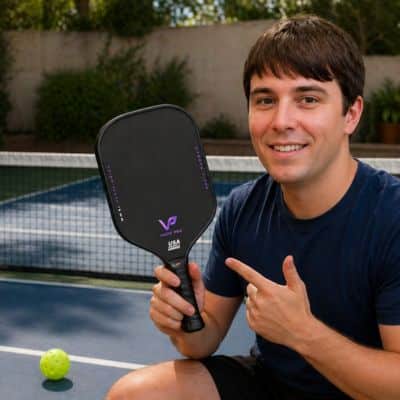
Dylan is a 4.5-rated pickleball player and gear writer who has tested 80+ paddles across 400+ hours on court. He rates spin, power, control, and forgiveness from real court time so you can buy smarter — no sponsored rankings, ever.