
Best Thermoformed Pickleball Paddles (2026): 6 Unibody Builds Tested

How I tested: Every paddle here was bought at retail with my own money and tested across real court sessions: baseline drives, kitchen resets, third-shot drops, and high-speed hand battles, cross-checked with 3.0–5.0 players. Full process: how I test pickleball paddles. Verify me on my DUPR profile.
Disclosure: If you buy through my Amazon links, I earn a commission at no extra cost to you. It never changes my rankings, and I paid retail for every paddle on this page. Details here.
Quick Answer: The best thermoformed pickleball paddle in 2026 is the Volair Mach 1 Forza (rated 9.6/10) because its unibody Toray T700 carbon fiber build and foam-injected perimeter walls deliver elite drive pop without sacrificing soft kitchen resets. For aggressive 4.0+ attackers, the Six Zero Double Black Diamond is the best flared unibody option, while the CRBN 3X Power Series is the best lightweight thermoformed carbon paddle for fast hands at the net.
Top Thermoformed Pickleball Paddles at a Glance:
- Best All-Around Unibody: Volair Mach 1 Forza (14mm/16mm Foam-Injected T700)
- Best for Aggressive Attackers: Six Zero Double Black Diamond (Flared Raw Carbon)
- Best Lightweight Thermoformed Carbon: CRBN 3X Power Series (7.8 oz Unibody)
- Best Pure Baseline Power: JOOLA Ben Johns Perseus (Charged Carbon)
- Best Intermediate Control Alternative: Vatic Pro Prism V7 (Cold-Molded T700)
Jump to: Quick Comparison · How I Tested · Thermoformed vs Foam · Delamination Risk · The 6 Paddles Reviewed · vs Standard Builds · How to Choose · FAQs
The best thermoformed pickleball paddles in 2026 aren’t the same paddles you’d have bought three years ago, and the category has split in two. Whether you’re shopping for a carbon fiber unibody thermoformed pickleball paddle with foam-injected perimeter stability or a stiff, undampened power frame, construction quality matters more than marketing labels. I’ve tested 80+ paddles across 400+ hours of court time with players from 3.0 to 5.0. If a paddle doesn’t hold up under tournament pressure, it doesn’t make this list.
Thermoformed Pickleball Paddles: Quick Comparison
| Product | Recommendation | Tech Specs | Dylan’s Rating | Shop |
|---|---|---|---|---|
 Volair Mach 1 Forza TOP PICK |
Best All-Around | Hybrid / 14mm or 16mm Thermoformed Raw Toray T700 Carbon / Foam-Injected Walls |
9.6 |
View Volair on Amazon |
 Six Zero Double Black Diamond |
Best for Attack Players | Flared / 14mm or 16mm Thermoformed Raw Carbon / 5.5″ Grip |
9.5 |
View Six Zero on Amazon |
 CRBN 3X Power Series |
Best Lightweight Unibody | Elongated / 12mm, 14mm, or 16mm Thermoformed Carbon Fiber / Foam-Injected Walls |
9.4 |
View CRBN 3X on Amazon |
 JOOLA Ben Johns Perseus |
Best Power & Speed | Elongated / 14mm or 16mm Thermoformed Charged Carbon Surface / 5.5″ Grip |
9.3 |
View Perseus on Amazon |
 Vatic Pro Prism V7 COLD-MOLDED |
Best Control Alternative | Elongated / 16mm Cold-Molded Raw Toray T700 Carbon / Foam-Injected Walls |
9.2 |
View Vatic on Amazon |
 JOJOLEMON Carbon Fiber |
Best Budget Thermoformed | Standard / 16mm Thermoformed T700SC Carbon Fiber / Teflon Coating |
8.8 |
View JOJOLEMON on Amazon |
How I Tested These Unibody Thermoformed Paddles
Five of these are true heat-molded thermoformed builds. The sixth, the Vatic Pro Prism V7, is cold-molded with foam-injected walls, and I’ll explain why it’s here. Every paddle got at least five hours on court through late 2026, and the top picks got significantly more. I ran each one through baseline drives, cross-court dinks, third-shot drops, and resets under pressure, then mapped the effective sweet spot and perimeter twist weight by repeating those same shots at off-center contact points. I measured swing weight on a calibrated balance board, checked spin with testing tools, and judged grip comfort over long sessions.
Before I set a final rating, I put each paddle in the hands of players from 3.0 to 5.0 to see if they felt what I felt. You can read the full process on my how I test pickleball paddles page.
Unibody Thermoformed (Gen 3) vs. Full Foam (Gen 4): What Changed in 2026
When most players search for a unibody thermoformed carbon fiber pickleball paddle, they mean Gen 3 builds: a polypropylene honeycomb core bonded to a raw carbon face under high heat and pressure as a single continuous unit. Some inject high-density foam into the perimeter edge walls (like the Volair Mach 1 Forza and CRBN 3X) to dampen vibration and expand the sweet spot, while others rely on rigid carbon encasement for maximum energy transfer. Either way, unibody thermoforming moves energy straight into the ball for crisper drives, higher exit velocity, and superior torsional stability on edge hits.
Gen 4 paddles (like the Six Zero Black Opal and CRBN TruFoam Genesis) drop the honeycomb entirely for a solid multi-density foam core. They feel denser and eliminate honeycomb core-crush, which I cover in my master guide to the best pickleball paddles of 2026. For immediate pop and crisp acoustic feedback on drives, Gen 3 thermoformed carbon is still what many 4.0+ players reach for, so this guide focuses on that profile.
The Delamination Risk: What Every Thermoformed Buyer Should Know
Most guides skip this. Thermoformed paddles can delaminate or suffer core crush over time, meaning the carbon face separates from the internal honeycomb core. The warning sign is backwards from what you’d expect: the paddle suddenly hits noticeably harder and sounds hollow. That internal gap acts like an illegal trampoline, and USA Pickleball can rule a delaminated paddle out of sanctioned play.
Fortunately, late-2026 resin and epoxy production from Volair, Six Zero, CRBN, and JOOLA is far more durable than during the early 2022–2023 delamination wave. Heat is still the enemy, though, and leaving your bag in a hot car trunk can weaken internal bonds. Try the knuckle-tap test once a month: tap across the whole face and listen. A healthy paddle sounds uniform edge to edge, whereas a hollow, lower-pitched spot signals core breakdown.
Best Thermoformed Pickleball Paddles: Reviewed & Ranked
These rankings come from how each paddle played in real match conditions, not from manufacturer spec sheets.
1. Volair Mach 1 Forza — Best All-Around Thermoformed Paddle
Best All-Around
| Shape | Hybrid (16.3″ L × 7.5″ W) |
| Weight | 8.0–8.2 oz |
| Grip Length | 5.5″ |
| Core Thickness | 14mm or 16mm Thermoformed |
| Face Material | Raw Toray T700 Carbon Fiber |
| Spin Potential | Elite Tier |
| Foam Injection | Yes (Edge Walls) |
| EVA Grip Dampening | Yes |
| USAP Approved | Yes |
The Volair Mach 1 Forza is the most complete unibody thermoformed carbon fiber pickleball paddle I’ve tested. Stiff unibody builds usually fight you on soft shots, but the foam-injected perimeter walls give this one genuine cushion and a wider sweet spot. Dinks sit down, drops stay low, and when I wanted to attack, the raw Toray T700 face gave me elite-tier topspin on baseline drives.
The EVA dampening in the handle and the foam walls also made it the easiest paddle on my arm of the six. The contact sound is deeper and quieter too, which matters on noise-restricted courts or at an HOA facility.
The honest limitation: the 14mm version punishes defensive resets, so I’d stick with the 16mm unless you’re a pure power player. The grip runs small at 4.125 inches, so keep an overgrip handy. The 90-day warranty is also short for this price tier.
See how Volair’s Forza series stacks up against the Bread & Butter Filth →
Buy if:
It moves from baseline drives to drops to kitchen resets without a big trade-off anywhere.
The handle dampening and foam walls took the harshness out of mishits for me.
Dinks sit down instead of popping up, and the quieter contact helps with noise rules.
Pass if:
At this price you’re paying for performance margins you can’t use yet. A solid standard 16mm paddle will serve you better.
The foam absorbs a little energy. The Six Zero or Perseus feels crisper.
The stock grip is small, so expect to add overgrip on day one.
2. Six Zero Double Black Diamond — Best for Attack Players
Best for Attack Players
| Shape | Flared Hybrid (16.3″ L × 7.7″ W) |
| Weight | 8.1 oz (Standard Edition) |
| Grip Length | 5.5″ |
| Core Thickness | 14mm or 16mm Thermoformed |
| Face Material | Japanese Toray T700 Raw Carbon Fiber |
| Spin Potential | Elite Tier |
| Edge Construction | Carbon Fusion Edge Technology |
| Thermoformed Handle | Yes (3D Carbon Forged Unibody) |
| USAP Approved | Yes |
The Six Zero Double Black Diamond plays with a distinctly crisper, more direct response than the Volair. Its flared aerodynamic shape widens toward the top of the face and pushes the sweet spot higher, which rescued a lot of wide kitchen balls that would have clipped the frame on a standard rectangular build. Spin tested in the elite tier, and drives come off crisp and connected, with only the Perseus feeling snappier. Because the 3D carbon-forged handle is part of the unibody with no neck joint, the whole paddle feels rock-solid on off-center blocks.
The honest limitation: its crisp thermoformed face transfers energy quickly, so kitchen-heavy players will notice less built-in dampening on dinks compared to the plush Volair or the Kevlar-faced Six Zero Ruby. The 14mm version is demanding and best reserved for 4.5+ specialists, and the flared shape took me about three sessions to recalibrate to.
Read my full Six Zero Double Black Diamond review →
Buy if:
Crisp unibody energy transfer means speed-ups and volleys come off with real bite.
The higher sweet spot saves wide balls you’d normally mishit off the frame.
The 5.5-inch handle gives your hands room, and the raw T700 face rewards fast swings.
Pass if:
The crisp carbon unibody makes you cushion soft dinks with active hands.
If you deal with tennis elbow, the Volair or Six Zero Ruby offers softer impact absorption.
The flared shape needs a few sessions to recalibrate your muscle memory.
3. CRBN 3X Power Series — Best Lightweight Thermoformed Carbon Paddle
Best Lightweight Unibody
| Shape | Unibody Elongated (16.5″ L × 7.5″ W) |
| Weight | 7.8–8.1 oz |
| Grip Length | 5.25″ |
| Core Thickness | 12mm, 14mm, or 16mm Thermoformed |
| Face Material | Toray T700 Raw Carbon Fiber |
| Spin Potential | Very High Tier |
| Foam Injection | Yes (Edge Walls) |
| Thermoformed | Yes (Unibody Construction) |
| USAP Approved | Yes |
The CRBN 3X Power Series is the most versatile lightweight thermoformed carbon pickleball paddle here because the exact same unibody frame is available in 12mm, 14mm, and 16mm thicknesses. You can move from control to power as your game changes without switching brands. The unibody build has no neck joint, eliminating the traditional weak spot that can flex over time. Drives feel planted and direct, spin sits in the very high tier, and the foam-injected walls widen the sweet spot on off-center hits. At 7.8 oz on the light end, it’s the lightest premium thermoformed paddle in this group, which noticeably boosted my hand speed at the net.
The honest limitation: the 5.25-inch handle runs short for an elongated paddle, so committed two-handed backhand players will feel crowded at the throat. I’d also skip the 12mm version unless you’re an aggressive 4.5+ player with dialed-in reset mechanics.
Read my full CRBN 3X Power Series review →
Buy if:
You can step between 16mm, 14mm, and 12mm over time without changing brands.
At 7.8–8.1 oz, it swings faster in kitchen firefights than heavier elongated power paddles.
It’s lighter than most 8.2+ oz premium paddles, so exchanges at the net feel quicker.
Pass if:
The unibody frame is lively; if you want zero-break-in solid foam control, look at the CRBN TruFoam Genesis.
At 5.25 inches, the handle is the shortest of the premium picks here.
It’s unforgiving and built for aggressive 4.5+ specialists. Start with the 16mm.
4. JOOLA Ben Johns Perseus — Best Power & Speed
Best Power & Speed
| Shape | Elongated (16.5″ L × 7.5″ W) |
| Weight | 8.0 oz |
| Grip Size | 5.5″ length × 4.25″ circumference |
| Core Thickness | 14mm or 16mm Thermoformed |
| Face Material | Charged Carbon Surface |
| Skill Level | Professional / Advanced (4.0+) |
| Spin Potential | Elite Tier |
| Edge Construction | HyperFoam Edge Wall + Carbon Encasement |
| USAP Approved | Yes |
The JOOLA Ben Johns Perseus is the hardest-driving thermoformed paddle on this list. Its elongated 16.5-inch frame is fully encased in rigid carbon, transferring swing energy straight into the ball so baseline drives come off with a snap that softer builds can’t match. Spin tested in the elite tier, and JOOLA tunes the balance specifically for 4.0+ players who already generate their own pace and want maximum put-away leverage.
The 5.5-inch handle feels immediately familiar if you transition from tennis and leaves plenty of room for two-handed backhands.
The honest limitation: its head-heavy swing weight demands clean mechanics, and soft kitchen resets require disciplined wrist touch. It’s also the most demanding paddle here on mistimed hits, so skip the 14mm if your elbow is sensitive. If you want JOOLA’s newest adaptive-flex flagship, see my full JOOLA Perseus Pro V review →
Buy if:
Nothing here transfers energy more directly or hits with more snap.
The long handle and 4.25-inch circumference feel racquet-like and give your hands plenty of room.
It’s built for advanced players who want feedback and speed, not help.
Pass if:
Its lively Charged Carbon face means delicate resets and dinks depend entirely on your hands.
Head-heavy mass tires the forearm faster than the balanced Volair Mach 1 Forza.
Off-center mishits pop up quickly if your footwork and contact point aren’t grooved.
5. Vatic Pro Prism V7 — Best Control Alternative (Cold-Molded)
Best Control Alternative (Cold-Molded)
| Shape | Elongated (16.3″ L × 7.5″ W) |
| Weight | 8.0–8.2 oz |
| Grip Length | 5.3″ |
| Core | 16mm Polypropylene Honeycomb (Cold-Molded Unibody) |
| Face Material | Toray T700 Raw Carbon Fiber |
| Swing Feel | Plush, Leverage-Focused |
| Spin Potential | Elite Tier |
| Foam Injection | Yes (Edge Walls) |
| USAP Approved | Yes |
I keep the Prism V7 in this guide because 3.5 intermediate players searching for a thermoformed intermediate pickleball paddle usually end up asking the real question: do I actually need stiff thermoformed pop, or do I want unibody foam-edge stability with softer touch? To be clear, this paddle is cold-molded, not heat-thermoformed. It keeps the unibody foam-injected perimeter walls and raw Toray T700 carbon face, but skips the high-heat curing step so the face stays plush and never delaminates.
Without high-heat stiffening, the dwell time is noticeably longer and more forgiving. The raw T700 carbon face gave me high-tier spin on serves, and the foam-injected walls kept off-center hits stable. Resets, placement, and third-shot drops all felt cushioned and predictable under pressure. Of everything I’ve tested under $100, it’s the best elongated control value, and it ships with a neoprene cover.
The honest limitation: it has less raw exit velocity than a heat-thermoformed paddle. Baseline drives feel competent but won’t overpower opponents on their own. Also compare it against its hybrid sibling in my Vatic Pro Prism Flash vs Prism V7 breakdown.
Read my full Vatic Pro Prism V7 review →
Buy if:
The cold-molded build favors touch, making shots easy to place and hot balls easy to reset.
The foam-injected walls keep off-center contact from dying without stiffening the face.
A USAP-approved raw T700 face with a cover included is hard to beat for control.
Pass if:
It deliberately favors control over pop; step up to the Vatic Pro V-Sol Pro for power.
The 5.3-inch handle feels slightly tighter next to 5.5-inch builds like the Six Zero DBD.
The elongated V7 swings heavier than the hybrid Vatic Pro Prism Flash.
6. JOJOLEMON Carbon Fiber — Best Budget Thermoformed
Best Budget Thermoformed
| Shape | Standard (16.5″ L × 7.5″ W) |
| Weight | 7.8–8.1 oz |
| Grip Length | 5.5″ |
| Core Thickness | 16mm Thermoformed |
| Face Material | T700SC Carbon Fiber (Teflon Coating) |
| Spin Potential | Mid-High Tier |
| Foam Injection | Yes (Edge Walls) |
| Thermoformed | Yes (Unibody) |
| USAP Approved | Unconfirmed (verify before tournament play) |
The JOJOLEMON gives you true unibody thermoformed construction, foam-injected walls, and a T700SC carbon face at an entry-level budget price. It’s the cheapest way I’ve found to test whether you like a thermoformed carbon fiber pickleball paddle before spending $180+ on a flagship.
The standout is the Teflon surface coating. Raw carbon faces lose texture and bite as they wear, and in my testing, the coated face held its spin profile well across recreational play. The 16mm core and foam walls give a soft thud instead of a loud crack, so it works on noise-restricted courts, and it makes an easy, low-risk backup paddle for your bag.
The honest limitation: USA Pickleball approval isn’t clearly confirmed for tournament play, so if you compete in sanctioned events, check out my TENVINA Hercules T700SC review or Osmo Elite Spin T700 review for USAP-approved budget carbon alternatives.
Buy if:
You get real thermoformed tech for one of the lowest entry costs in the category.
The Teflon coating held its spin profile better than I expect from cheap carbon at this price.
The deep thud clears strict HOA noise rules, and it’s an easy spare paddle to keep in your bag.
Pass if:
Certification isn’t confirmed in the listing. Choose a USAP-approved paddle like the Vatic Prism V7.
Spin sits below elite and unit-to-unit tolerances vary. Step up to the Volair or Six Zero DBD.
There’s no long-term durability track record yet compared to CRBN, Six Zero, or Volair.
Thermoformed vs. Standard Paddles: What You Actually Feel
Most guides either overstate the gap or pretend it doesn’t exist. Here’s what I noticed on court:
- On drives: Thermoformed paddles come off crisper and faster at the same swing speed. They won’t fix poor footwork, but they reward clean mechanics with heavier plow-through.
- On soft shots: Standard 16mm cold-molded paddles flex slightly and are more forgiving at the kitchen. Foam-injected thermoformed paddles (Volair Mach 1 Forza, CRBN 3X) close most of that gap. Stiffer builds (JOOLA Perseus) demand softer hands.
- On edge hits: Unibody thermoforming wins clearly. The sweet spot reaches closer to the frame and increases twist weight, so off-center blocks don’t die in the net.
- On durability: Modern Gen 3 epoxy resins hold up well, but thermoformed builds remain more heat-sensitive than cold-molded frames. Never leave them in a hot car trunk.
| Metric | Unibody Thermoformed (Gen 3) | Standard / Cold-Molded Build |
|---|---|---|
| Drive Pace | Higher (crisp and direct) | Moderate |
| Soft Game Feel | Varies (foam injection helps) | Naturally plush and forgiving |
| Edge Stability | Wider effective sweet spot & higher twist weight | Moderate (unless foam-injected) |
| Heat Sensitivity | Higher (avoid hot car trunks) | Low |
| Typical Cost | Mid-range to premium ($150–$250+) | Budget to mid-range ($80–$140) |
| Best Suited For | 3.5–5.0+ competitive players | Beginners through 4.0 control players |
How to Choose the Right Thermoformed Pickleball Paddle
By Playing Style
- Kitchen-dominant control: Go foam-injected. The Volair Mach 1 Forza 16mm is my top pick, and the cold-molded Vatic Pro Prism V7 is the sub-$100 control route. For more options, see my guide to the best pickleball paddle for control. Skip the Perseus and any 14mm build.
- Attack-first power: The Six Zero Double Black Diamond gives you reach from the flared shape, and the JOOLA Perseus is the hardest-driving paddle here. For even more pace, check out my best power pickleball paddles guide.
- All-court versatility: The Volair 16mm and CRBN 3X 16mm balance baseline power and transition resets well. CRBN also lets you change core thickness inside the same family as your game shifts.
By Player Skill Level (Intermediate vs. Advanced)
- 3.0 and below: Skip this category. The benefits show up in small mechanical margins you can’t use yet. A reliable starter paddle from my best pickleball paddles for beginners guide will help you develop faster.
- 3.5 thermoformed intermediate pickleball paddle: If you want a true thermoformed intermediate upgrade, start with the 16mm Volair Mach 1 Forza or 16mm Six Zero Double Black Diamond—their foam-reinforced perimeters forgive off-center contact while adding real pop. If thermoformed faces feel too hot during dink rallies, the cold-molded Vatic Pro Prism V7 is the safest bridge. See my full best pickleball paddles for intermediate players guide for more.
- 4.0+ competitive & advanced: This is where unibody thermoforming pays off. The Volair Mach 1 Forza, Six Zero Double Black Diamond, and JOOLA Perseus all reward fast hands and clean footwork. Compare them against newer Gen 4 foam builds in my best pickleball paddles for advanced players guide.
By Physical Needs
- Sore elbow or sensitive joints: Stick to 16mm foam-injected builds. The Volair was the easiest on my arm because of the EVA handle dampening plus foam walls. Avoid stiff 14mm frames, and see my best pickleball paddles for tennis elbow guide (or consult a doctor if pain persists).
- Tennis background: The 5.5-inch handles on the Perseus, Volair, and Six Zero feel familiar and leave room for a two-handed backhand.
- Hand speed: At 7.8 oz minimum, the CRBN 3X is the quickest lightweight thermoformed carbon paddle at the net.
Final Verdict: Which Thermoformed Paddle Should You Buy?
Thermoformed paddles are better tools for the right player, but they won’t fix flawed mechanics. If you’re building consistency at 3.5, the cold-molded Vatic Pro Prism V7 is the smart control buy. If you’re drilling several times a week at 3.5–4.5+, the Volair Mach 1 Forza 16mm is the best all-around thermoformed paddle I’d buy first, while the Six Zero Double Black Diamond is the winner if you live on aggressive speed-ups. To compare more options in this price bracket, my best pickleball paddles under $200 guide is the next stop.
Still can’t decide? Take my paddle finder quiz—four quick questions that match your swing style to a tested paddle.
FAQs
What is a unibody thermoformed pickleball paddle?
A unibody thermoformed pickleball paddle has its carbon fiber face, honeycomb core, and handle fused into one continuous unit under high heat and pressure—often with foam injected into the perimeter edge walls. The result is a stiffer frame with faster energy return, a wider effective sweet spot, and superior torsional stability on off-center hits.
Are thermoformed pickleball paddles worth it for intermediate players?
For upper-intermediate (3.5–4.0) and advanced players who drill regularly, yes—especially 16mm foam-injected models like the Volair Mach 1 Forza or Six Zero Double Black Diamond. Below 3.5, stiff thermoformed faces can cause dinks and resets to pop up, so a cold-molded T700 paddle like the Vatic Pro Prism V7 offers better control value.
Are thermoformed paddles legal for tournaments in 2026?
Yes, as long as the specific model carries current USA Pickleball (or UPA-A) approval. However, a thermoformed paddle that delaminates or suffers core crush over time and starts hitting like a trampoline can be ruled out of sanctioned play regardless of its stamp.
Do thermoformed paddles still delaminate easily?
Not like they did in 2022–2023. Late-2026 production from Volair, Six Zero, and CRBN uses reinforced epoxy and edge-wall formulas that resist core crush. Keep your paddle out of hot car trunks, clean the face with a rubber carbon eraser, and perform the knuckle-tap test monthly to listen for hollow spots.
Which thermoformed paddle has the most spin?
The Volair Mach 1 Forza and Six Zero Double Black Diamond both scored 9.5/10 for spin in my testing, landing in my Elite Spin Tier. Their textured raw Toray T700 carbon faces bite the ball cleanly on topspin drives and roll volleys. See my full best pickleball paddles for spin guide for more.
What’s the difference between thermoformed and cold-molded paddles?
Thermoformed paddles are cured under high heat and pressure with carbon encasing the perimeter, creating a stiffer, poppier response. Cold-molded paddles like the Vatic Pro Prism V7 skip the high-heat perimeter curing step, giving you a softer, more plush feel that prioritizes kitchen dwell time over raw baseline speed.
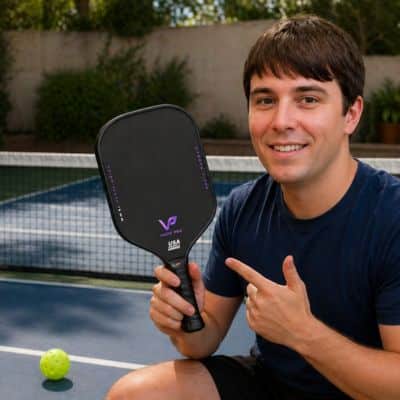
Dylan is a 4.5-rated pickleball player and gear writer who has tested 80+ paddles across 400+ hours on court. He rates spin, power, control, and forgiveness from real court time so you can buy smarter — no sponsored rankings, ever.