
Best Pickleball Paddles for Control (2026): 8 Tested for Dinking & Placement
Disclosure: The “View on Amazon” buttons on this page are affiliate links. I buy every paddle with my own money, and commissions never change a score. Prices change often, so check the current price on Amazon before you buy. Details here.
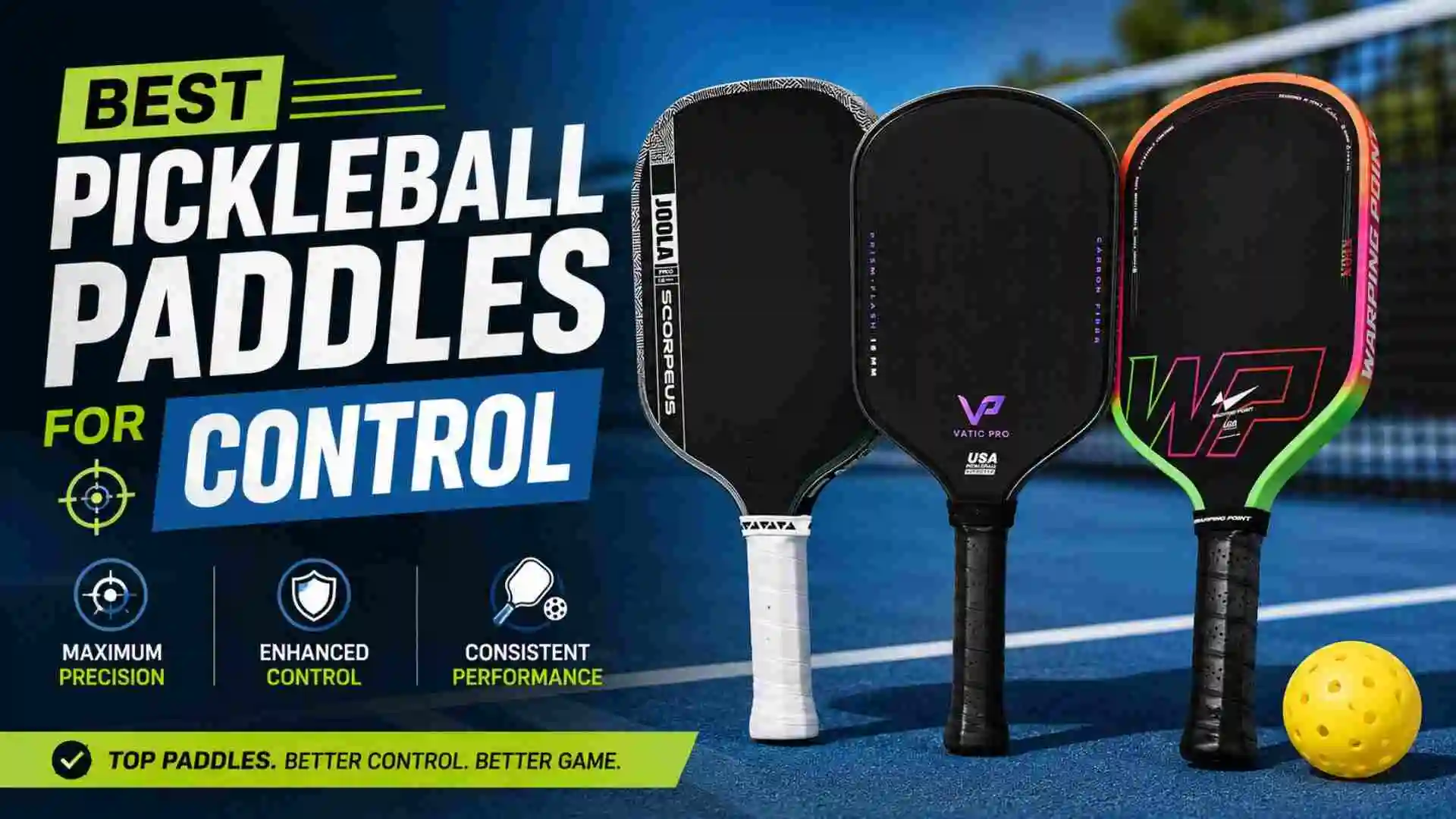
The best pickleball paddles for control give you dwell time, a big sweet spot, and a predictable launch angle. Control players don’t win by blasting balls through their opponents. I win by outthinking them. My game is built on surgical third-shot drops, reset blocks that die at the kitchen line, and placement that misses shoes by millimeters. But to play that way, your paddle has to cooperate.
Here’s the misconception I hear most: control means weak. It doesn’t. Control means the ball goes where you want it to go — every time. A good control paddle gives you dwell time. The ball sits on the face a fraction longer, giving you more influence over direction and pace before it leaves. That’s what makes your third-shot drops land in the kitchen, and your resets stay low in the transition zone instead of floating up for an easy smash.
The problem is that “control” has become a marketing buzzword. Brands take a stiff, cheap paddle, strip out its power, and label it a “control paddle” to hide its flaws. That’s a trap. True control isn’t just low power; it’s a predictable launch angle, deep ball-pocketing (dwell time), and an expanded sweet spot that bails you out when you miss the dead center.
To cut through the corporate noise, I’ve logged 400+ hours testing 80+ paddles to find the best pickleball paddles for control in 2026. Testing across open play sessions with players from 3.0 to 5.0 skill levels, here is my honest breakdown of the top 8 control setups that actually deliver on touch, ball-pocketing, and placement.
Quick Answer: The Best Control Pickleball Paddles of 2026
- Best Overall Control: The Vatic Pro Prism Flash is my top pick: cold-molded Toray T700 carbon and internal foam inserts give you plenty of dwell time without the flagship price.
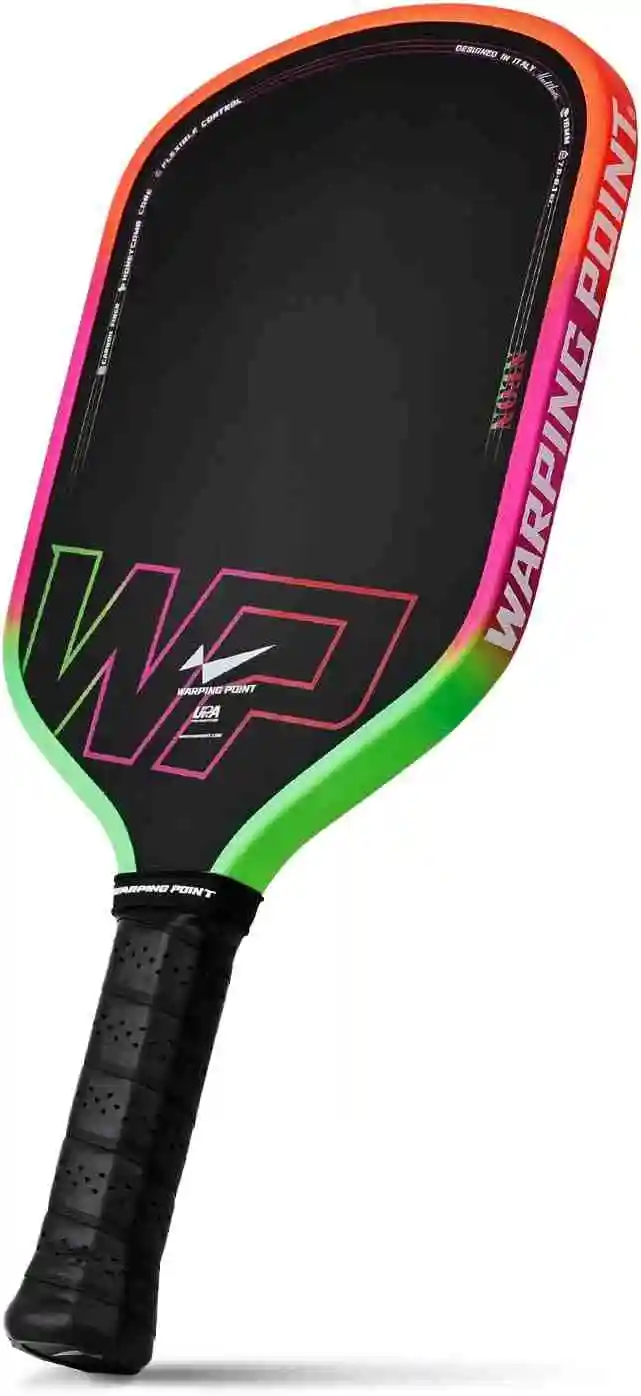
- Best Edge Stability: The Warping Point Neon Gen 3 wins if off-center hits are costing you points — its EdgeFusion perimeter foam widens the sweet spot noticeably.
- Best Two-Handed Backhand: The 11SIX24 Jelly Bean’s 6-inch handle is the longest in this group, built for double-handed control players.
- Testing Methodology: Every paddle here was bought with my own money. I’ve logged 400+ hours testing 80+ paddles with players from 3.0–5.0, using my testing process. No sponsored placements, ever.
What Actually Makes a Paddle a True “Control” Setup?
Forget the sales copy. If you want a predictable, repeatable short game, you need to look at how a paddle handles these four mechanical variables:
1. Dwell Time & Core Thickness
Dwell time is simply how many split-seconds the ball stays squished against your paddle face on impact. A longer dwell time pockets the ball deeper, absorbing incoming heat and giving you time to actually steer your placement.
If you want maximum pocketing, stick to classic, non-thermoformed 16mm polypropylene honeycomb cores or paddles built with internal polyurethane shock inserts. Thinner 13mm or 14mm cores usually kick the ball off the face faster, giving you crisper offensive pop but less delicate kitchen touch. Foam-core builds like the 14mm CRBN TruFoam Genesis are the exception. For a deeper breakdown of face engineering, see my guide to T300 vs T700 pickleball paddles, my paddle decision matrix, or my best thermoformed pickleball paddles.
2. Swing Weight vs. Static Weight
Static weight is what a paddle weighs on a scale. Swing weight is how heavy it feels when you’re actually whipping it through the air.
- Heavy Swing Feel: Turns your paddle into a sledgehammer. It drags your hands down and leaves you vulnerable during rapid net exchanges.
- Quick Swing Feel: The sweet spot for fast net reflexes.
For defensive players, a low swing weight gives you the reflex speed required to get your paddle in position and reset a body shot smoothly, instead of arriving late and popping the ball up into a high smash.
3. Twist Weight & Perimeter Stability
Twist weight is how much the paddle resists twisting in your hand when you hit the ball off-center. Catch a ball near the edge guard on a low-twist paddle, and the face will turn, spraying your reset wide.
Modern control paddles solve this by packing the perimeter edge walls with foam injection or high-density EVA boundaries. This adds structural weight to the outer rim, widening the usable sweet spot so your off-center hits still slide safely over the net.
4. Face Material & Friction Texture
Your paddle face dictates your grip and consistency over months of heavy play.
- Raw Toray T700 Carbon Fiber: The industry standard. Unpainted, raw carbon fiber uses a natural texture to bite the ball consistently, giving you a highly predictable launch angle every single time.
- Aramid-Carbon Hybrid Weaves: Blending carbon fiber with materials like Kevlar or aramid cushions the blow even more, giving you a very plush, deep-pocketed feel.
- Composite or Fiberglass Faces: Great for massive sweet spots on beginner setups, but as you hit the 3.5+ level, you’ll quickly outgrow that bouncy fiberglass pop and need the precision of raw carbon.
Best Control Pickleball Paddles: Quick Comparison
| Product | Recommendation | Tech Specs | Control Rating | Shop |
|---|---|---|---|---|
 Vatic Pro Prism Flash |
Best Overall Control | Hybrid / 16mm / 5.3″ Grip Non-Thermoformed Toray T700 Swing Feel: Light & Quick Spin Tier: High |
9.5 |
View on Amazon |
 Warping Point Neon Gen 3 |
Best Edge Stability | Hybrid / 16mm / 5.5″ Grip Triple-Layer T700 Raw Carbon Swing Feel: Balanced Spin Tier: High |
9.0 |
View on Amazon |
 JOOLA Scorpeus Pro V (16mm) |
Best Net Reflexes | Widebody (16.0″ L × 8.0″ W) / 16mm Reactive Core Carbon Friction Surface (CFS) / 5.25″ Grip Swing Feel: Lightning Fast & Quick Spin Tier: Elite |
9.5 |
View on Amazon |
 Apes Harmony Series |
Best Soft Feel Hybrid | Widebody / 16.5mm / 5.5″ Grip Aramid-Carbon Fiber Woven Face Swing Feel: Nimble & Deeply Cushioned Spin Tier: High |
9.4 |
View on Amazon |
 11SIX24 Jelly Bean |
Best Elongated Handle | Elongated (16.5″ L × 7.5″ W) / 16mm Polypropylene Core CFC Triple-Layer Surface Matrix / 6.0″ Grip Swing Feel: Quick, Elongated Reach Spin Tier: High |
9.0 |
View on Amazon |
 Six Zero Double Black Diamond |
Most Versatile Premium | Hybrid (16.3″ L × 7.5″ W) / 16mm Polymer Core Raw Carbon Fiber / 5.5″ Grip Swing Feel: Balanced & Quick Spin Tier: Elite |
9.5 |
View on Amazon |
 Vatic Pro V-Sol Pro |
Best Full Foam Core | Hybrid / 16mm / 5.3″ Grip Full EPP Foam Core & EVA Ring Swing Feel: Balanced, controllable Spin Tier: High |
8.5 |
View on Amazon |
 Selkirk LUXX Control |
Best Luxury Reset | Invikta Elongated / Polypropylene X7 Florek Carbon & Open Throat design Swing Feel: Balanced Spin Tier: High |
9.5 |
View on Amazon |
Control Rating is each paddle’s control category score out of 10, not its overall rating. Full category scores are in each review below.
Best Pickleball Paddles for Control Players: A Closer Look
Vatic Pro Prism Flash
Best Overall Control
| Shape | Hybrid |
| Static Weight | 7.9 – 8.0 oz |
| Grip Length | 5.3″ |
| Core Thickness | 16mm Polymer |
| Face Material | Raw Toray T700 Carbon Fiber |
| Thermoformed | No |
The Vatic Pro Prism Flash proved you don’t need a flagship-priced paddle to get high-level control. It’s the benchmark I measure other control paddles against for kitchen touch without a stiff, overly bouncy face response. If you’re deciding between this hybrid shape and the elongated version, read my detailed Vatic Pro Prism Flash vs Prism V7 comparison. For the full breakdown, read my Vatic Pro Prism Flash review.
Why It Wins
Instead of baking the paddle under heat like thermoformed models, Vatic Pro uses a cold-molded build. That limits raw power but gives it a cushioned, plush feel at contact. Vatic Pro also says it added internal polyurethane shock inserts and a foam-injected perimeter, and on court the paddle felt stable and soaked up the pace of incoming baseline drives.
On the court, this translates to predictable defense. When you’re stuck in the transition zone trying to drop a heavy drive into the kitchen, the ball pockets beautifully into the raw Toray T700 carbon face rather than bouncing wildly off it. It handles dinking battles consistently, with enough dwell time to slice or steer your placements.
The trade-off is power: advanced players will work harder to manufacture deep baseline drives. For the money, it played like paddles that cost far more in my testing.
Buy if:
You prioritize accuracy and soft game development; gives predictable accuracy on short drops.
A light and quick swing feel makes this paddle fast at the kitchen line for rapid exchanges.
Pass if:
This is a non-thermoformed paddle that prioritizes dwell time over raw, aggressive pop.
Warping Point Neon Gen 3
Best Edge Stability
| Shape | Hybrid |
| Weight | 7.9–8.1 oz |
| Grip Length | 5.5″ |
| Core Thickness | 16mm EdgeFusion Core |
| Face Material | Triple-Layer Raw T700 Carbon Fiber |
| Thermoformed | Yes |
| Swing Feel | Balanced |
| Spin Tier | High |
The Warping Point Neon Gen 3 is built for intermediate and advanced players who want elite perimeter stability without paying a premium price. It stands out as a reliable option for players looking to balance quick kitchen exchanges with defensive resets.
Why It Wins
The defining feature of this paddle is its EdgeFusion core layout. Instead of using standard polypropylene all the way to the rim, the outer edge guard is lined with a high-density EVA perimeter ring. This adds structural weight to the outside framework, widening the sweet spot and preventing the paddle face from twisting in your hand when you catch a ball off-center.
The face uses three distinct layers of raw T700 carbon fiber laid in a multi-directional weave. This improves structural durability and increases ball grip, helping you execute top-spin baseline returns and soft transition drops with a very predictable launch angle. The unibody construction ensures the handle feels completely connected to the face, reducing standard vibrations and giving you clear, clean feedback during fast net volleys.
Buy if:
You want a highly stable sweet spot; the high-density EVA foam edges prevent the face from twisting on off-center hits.
The elongated 5.5-inch octagonal handle provides plenty of room for comfortable two-handed backhand control.
Pass if:
You prefer a traditional short handle to maximize your pure hitting surface area.
JOOLA Scorpeus Pro V (16mm)
Best Net Reflexes
| Shape | Widebody (16.0″ L × 8.0″ W) |
| Weight | 8.0 – 8.3 oz |
| Grip Length | 5.25″ |
| Core Thickness | 16mm Reactive Core |
| Face Material | Carbon Friction Surface (CFS) |
| Thermoformed | Yes (KineticFrame Unibody) |
| Swing Feel | Lightning Fast & Quick |
| Spin Tier | Elite |
Most traditional control paddles use an elongated 16.5-inch frame, which naturally pushes the balance point toward the tip and can slow your hands down in rapid hand battles. JOOLA handles this differently with the Scorpeus shape by shortening the total length to 16 inches and widening the face to a full 8 inches. This square profile pulls the center of mass down closer to your wrist, making its 8.2-ounce average weight feel fast and easy to swing when you’re defending at the kitchen line.
Why It Wins
JOOLA’s KineticFrame throat is designed to flex like a hockey stick, storing and releasing energy. This design gives you clean pace absorption on defensive drop shots while providing responsive, controlled pop when you need to drive the ball deep. The face features a high-friction, reinforced raw carbon fiber texture that bites the ball to generate elite rotational spin. Additionally, JOOLA integrates its TechFlex material blending across the unibody frame, which JOOLA says widens the usable sweet spot. In my testing, off-center mishits stayed in play instead of dying or spraying wide.
In my testing, this is an excellent defensive paddle. It excels at absorbing heavy baseline drives, allowing you to drop the ball softly into the kitchen with a highly predictable launch angle. For players who value fast net reflexes, stable blocking platform control, and an integrated tech setup featuring an embedded NFC chip for warranty tracking, the Scorpeus Pro V delivers pro-level short game performance.
Buy if:
The widebody balance point sits closer to your hand, giving you rapid paddle speed during high-velocity kitchen exchanges.
The wider 8-inch face and TechFlex optimization maximize perimeter forgiveness on off-center blocks.
Pass if:
You prefer an elongated 16.5-inch paddle to maximize your pure linear court coverage and baseline leverage.
Pickleball Apes Harmony Series
Best Soft Feel Hybrid
| Shape | Widebody |
| Weight | 7.9–8.1 oz |
| Grip Length | 5.5″ |
| Core Thickness | 16.5mm Polypropylene Honeycomb |
| Face Material | Raw Carbon Fiber Face & Fiberglass Walls |
| Thermoformed | No (PU Foam Padded Rim) |
If you think most 16mm paddles still feel a bit too stiff or crisp on block resets, the Pickleball Apes Harmony Series takes cushioning further than any other paddle here. Instead of sticking to the industry-standard 16mm mold, this paddle pushes the core thickness out to 16.5mm. It is explicitly engineered for players who want a deeply dampened, shock-absorbing feel that takes most of the vibration out of hard-driven balls.
Why It Wins
The structural layout here is unique. Pickleball Apes built this with a polypropylene honeycomb core, lined the inner edges with specialized PU foam padding, and added fiberglass walls beneath a raw carbon fiber face. This multi-layer setup achieves a highly responsive but very plush hitting surface. The ball squishes deeply into the face on impact, maximizing your baseline dwell time and giving you a ton of control when steering delicate side-spin or top-spin angles.
The most surprising aspect of its feel is the swing weight. Despite its thick 16.5mm profile and solid unibody build, it clocks in with a nimble, quick swing feel through the air. This layout makes it exceptionally easy to maneuver during lightning-fast net volleys. The generous sweet spot treats off-center hits with great forgiveness, though my baseline testers noted that the plush, shock-absorbing design means your deep drives won’t have quite as much penetration unless you customize the rim with a bit of lead tape.
Buy if:
You hate harsh paddle vibrations; the 16.5mm core and PU foam padding completely cushion impact shock.
The premium 5.5-inch leather grip provides plenty of length and leverage for comfortable two-handed play.
Pass if:
You want effortless put-away depth; this heavily dampened control face requires you to swing harder for deep penetration.
11SIX24 Jelly Bean
Best Elongated Handle
| Shape | Elongated (16.5″ L × 7.5″ W) |
| Weight | 8.0 – 8.3 oz |
| Grip Length | 6.0″ XL Handle |
| Core Thickness | 16mm Polypropylene Honeycomb |
| Face Material | CFC Triple-Layer |
| Thermoformed | Yes (Unibody Construction) |
| Swing Feel | Quick, Elongated Reach |
| Spin Tier | High |
If you hit a two-handed backhand or simply crave the absolute maximum reach possible on the court, most standard control paddles will leave you feeling cramped. The 11SIX24 Jelly Bean solves this by extending the handle to 6 inches, the longest of any paddle I’ve tested. It trades a little face area to give you more leverage on two-handed shots.
Why It Wins
The standout feature here is 11SIX24’s proprietary CFC triple-layered surface. Instead of a single sheet of carbon, they engineered a composite matrix sandwiching a layer of fiberglass between two sheets of raw Toray T700 carbon fiber. This setup offers a fascinating feel—you get the plush, uniform ball grip of raw carbon for your drop shots, but the fiberglass core adds a distinct layer of structural durability and responsive energy return when you swing fully.
It creates a quick, elongated-reach swing feel that offers exceptional leverage over standard hybrid shapes. Supported by foam-reinforced edges, its solid perimeter stability keeps the paddle face from twisting when you are blocking hard drives at the net. For players who use a two-handed style, the extra grip length provides the perfect physical platform to steer and roll ball trajectories with clean, predictable accuracy.
Buy if:
The 6-inch grip is specifically designed for players who need extra handle room for double-handed control adjustments.
Foam-reinforced edges and strong torsional stability provide stable baseline blocking with minimal face twisting.
Pass if:
The elongated frame creates a more leverage-focused profile that requires active wrist mechanics during high-velocity kitchen volley exchanges.
Six Zero Double Black Diamond
Most Versatile Premium
| Shape | Hybrid (16.3″ L × 7.5″ W) |
| Weight | 7.9 – 8.2 oz |
| Grip Length | 5.5″ |
| Core Thickness | 16mm Polymer Honeycomb |
| Face Material | Raw Carbon Fiber |
| Thermoformed | Yes (3D Carbon Handle) |
| Swing Feel | Balanced & Quick |
| Spin Tier | Elite |
The Six Zero Double Black Diamond (DBD) is the most versatile premium paddle I’ve tested. While many early thermoformed paddles felt incredibly stiff, harsh, and difficult to control at the kitchen line, Six Zero figured out how to inject a premium thermoformed unibody build with actual, plush control and touch. If you want the full breakdown, read my in-depth Six Zero Double Black Diamond review.
Why It Wins
What makes the DBD special is how it balances contrasting features. It is a fully thermoformed, edge-sealed paddle, meaning it offers great durability, a solid unibody feel, and clean baseline power. However, Six Zero uses a specialized internal edge foam configuration and a 3D carbon handle that actively cushions impact shock and eliminates harsh vibrations. You get a highly predictable launch angle on your dinks, paired with excellent ball pocketing that lets you feel exactly where your shots are going.
The face shape is flared and aerodynamic, which pulls the sweet spot upward and outwards, giving you strong perimeter forgiveness on off-center hits. The raw, textured carbon surface provides excellent ball grip for shaping reliable top-spin drives or heavy cut slices. Plus, giving players the choice between a faster 14mm core for pure hand speed or a plush 16mm core for maximum kitchen touch makes it a customizable control paddle. I’d still start with the 16mm unless you’re 4.5+.
Buy if:
You want a perfect mix of thermoformed durability, baseline spin, and soft, predictable kitchen touch.
The 5.5-inch elongated 3D carbon handle absorbs handle vibrations and easily accommodates two hands.
Pass if:
You are shopping on a tight budget; the DBD is a premium build designed for serious competitive play. Start with the Vatic Pro Prism Flash instead.
Vatic Pro V-Sol Pro
Best Full Foam Core
| Shape | Hybrid |
| Weight | 8.1 oz |
| Grip Length | 5.3″ |
| Core Thickness | 16mm Full EPP Foam Core |
| Face Material | Carbon Fiber Surface |
| Thermoformed | Yes (EVA Outer Ring) |
Vatic Pro shifts gears with the V-Sol Pro, stepping away from the standard honeycomb grid to deliver a full-foam experience. If you are tired of the traditional hollow feel of standard paddles and want a solid, deep-pocketing response, this is the one to try.
Why It Wins
Instead of a standard plastic honeycomb design, the V-Sol Pro is built with a full EPP foam core surrounded by an outer EVA foam ring. This combination completely changes how the paddle behaves. The EVA outer ring expands the sweet spot all the way out to the edges, meaning your off-center hits don’t die or twist erratically. It dampens impact vibrations beautifully, giving you a smooth, connected touch during delicate kitchen play while offering plenty of power on deep drives.
On the court, the full foam core gives your short game a highly predictable, repeatable feel. It excels at absorbing heavy baseline drives, allowing you to drop the ball softly into the kitchen with excellent control. The raw carbon surface provides fantastic ball grip for shaping heavy top-spin drives. While the pop level can take a few games to get used to if you are coming from a traditional honeycomb paddle, the overall value and performance stability make it an outstanding choice for all-court players.
Buy if:
You want a smooth, plush feel; the full EPP foam core and EVA outer ring eliminate harsh impact shock.
The EVA outer ring stabilizes the entire perimeter, giving you highly consistent performance across the whole face.
Pass if:
You prefer the crisp, loud click of a traditional polypropylene honeycomb core over a cushioned foam sink feel.
Selkirk LUXX Control
Best Luxury Reset
| Shape | Invikta (Elongated) |
| Weight | 8.1 oz |
| Grip Length | 5.35″ |
| Core Thickness | 20mm (Polypropylene X7) |
| Face Material | Florek Raw Carbon Fiber |
| Thermoformed | No (360° Proto Molding) |
| Swing Feel | Balanced |
| Spin Tier | High |
If you want a premium, plush, and hyper-forgiving paddle that completely tames hot incoming shots, the Selkirk LUXX Control is built exactly for that purpose. Selkirk packed this paddle with high-end tech, aiming it squarely at players who want to dominate the kitchen and slow down fast-paced games.
Why It Wins
The standout feature here is the open Air Dynamic Throat and ThroatFlex design. When the ball hits the face, this open throat allows the paddle to flex slightly more than a traditional solid face. That extra flex extends your dwell time, giving you a remarkably plush feel and plenty of time to guide your drop shots and dinks exactly where you want them. The core uses a thick Polypropylene X7 setup paired with a premium Florek Carbon Fiber face to ensure a smooth, stable response.
On the court, the LUXX Control behaves like a defensive wall. Its 360° Proto Molding layout gives the entire edge exceptional stability, so your off-center blocks don’t twist or fly deep. The face is finished with ProSpin+ NextGen micro-texture to deliver high-tier spin and ball grip.
However, keep an eye on the face durability over time. While the control and soft grip are outstanding, buyer reviews report the painted outer layer chipping under regular use, so treat the face finish as the weak spot. If you don’t mind the premium price and the delicate face finish, it stands out as one of the most forgiving luxury reset paddles on the market.
Buy if:
The open throat design and ThroatFlex architecture extend dwell time to easily slow down fast baseline drives.
High-pressure 360° Proto Molding delivers a highly uniform, predictable response across the entire face.
Pass if:
You want a rugged, scratch-resistant finish; the outer micro-texture layer is prone to cosmetics and paint chipping under heavy play.
Best Control Paddle for Your Situation
- Spin and control: The Six Zero Double Black Diamond 16mm rates 9.5 for both. See my best pickleball paddles for spin.
- Power and control: The JOOLA Scorpeus Pro V (8.5 power, 9.5 control) and the DBD 16mm (8.5 power, 9.5 control) give the most pop without giving up touch.
- Control on a budget: The Vatic Pro Prism Flash. See my best pickleball paddles under $100.
- Women and lighter-swing players: Choose by swing feel and grip size, not gender. My best pickleball paddles for women guide covers the options.
How to Choose Your Control Paddle: The Tactical Buyer’s Guide
Picking a control paddle isn’t about grabbing the softest option on the shelf and calling it a day. You need to figure out exactly where your defensive game breaks down on the court. Matching a paddle’s physical specs to your mechanical flaws is the difference between dropping a dead third-shot reset and giving your opponent an easy overhead smash.
1. Core Thickness: 16mm vs. 14mm
Core thickness is your primary tool for managing energy absorption.
- 16mm and Thicker (16.5mm, up to 20mm on the LUXX): This is your safe zone for pure control. A thick block of polypropylene honeycomb swallows the ball’s kinetic energy, keeping it on the face longer (dwell time) and killing accidental pop-ups. If your biggest headache is resetting hard baseline drives without launching them deep, stick to a thick core like the Vatic Pro Prism Flash or the deeply dampened Pickleball Apes Harmony Series.
- 14mm and Thinner: Thinner cores don’t compress as much on impact. The ball snaps off the face much faster, giving you a crisper, more offensive feel. You lose that deep, plush pocketing touch, but your hands instantly feel faster. If you are a proactive kitchen player who relies on rapid counter-attacks and speed-ups, you’ll want a thinner profile setup, or a hyper-fast widebody design like the JOOLA Scorpeus Pro V.
2. Shape Dynamics: Widebody vs. Elongated
Frame shape dictates your overall reach and determines where your sweet spot lives.
- Widebody / Standard Square (8″ to 8.1″+ Width): Shortening the frame to 16 inches and widening the face creates a highly stable platform. It pulls the balance point down closer to your grip, quickening your overall swing feel and making your hands lightning-fast during net volleys. It also creates a massive, forgiving sweet spot that protects you from edge-hit errors. The JOOLA Scorpeus Pro V is the prime example of this reflex-heavy layout.
- Elongated (16.5″ Length, 7.5″ Width): Pushing the paddle length to 16.5 inches gives you extra linear reach from the baseline and helps you scrape up low dinks. The catch? It narrows the face down and creates a head-heavy swing weight. If you want maximum reach but still need a dead, controlled face, options like the Selkirk LUXX Control or 11SIX24 Jelly Bean offer that balance.
3. Handle Length: Do You Need a Two-Hander?
Grip length changes how much physical leverage you can apply to the ball.
- Short Grips (4.5″ to 5.25″): Give you more raw paddle face area. This expands the sweet spot but leaves no room for a second hand. It is perfect for traditional, one-handed dinkers.
- Long Grips (5.5″ to 6.0″): Essential if you hit a two-handed backhand. That extra room gives your non-dominant hand the space it needs to roll or flick the ball over the net with heavy spin. The 11SIX24 Jelly Bean dominates this with its massive 6-inch handle, while the Warping Point Neon Gen 3 gives you a highly comfortable 5.5-inch setup.
The Final Verdict
Finding the right control paddle comes down to diagnosing your biggest court error. If you need ultimate pace absorption and kitchen touch on a budget buy the Vatic Pro Prism Flash, or grab the extra-thick Pickleball Apes Harmony Series to completely kill handle vibrations. If you struggle with clean contact and need a forgiving sweet spot, the EVA-edge Warping Point Neon Gen 3 keeps off-center blocks steady, while the widebody JOOLA Scorpeus Pro V keeps your hands incredibly fast during reflex battles. Finally, if you run a two-handed backhand or crave maximum reach, the 6-inch handle on the 11SIX24 Jelly Bean gives you the best physical leverage to dictate the kitchen. Still building your game? See my best pickleball paddles for beginners and best pickleball paddles for intermediate players, or compare control picks across makers in my guide to the best pickleball paddle brands.
FAQs
Is the Six Zero Double Black Diamond a good control paddle?
Yes — the 16mm core version is one of the most control-friendly thermoformed paddles I’ve tested. The internal edge foam and 3D carbon handle cushion impact enough to compete with non-thermoformed builds on dwell time, while still giving you thermoformed durability. If you want the full breakdown, see my Six Zero Double Black Diamond review, and see where it fits in my best Six Zero pickleball paddle guide.
How does a 16mm core thickness compare to 14mm for kitchen play?
Think of a 16mm core as a shock absorber. It deadens heavy shots and keeps the ball on the face longer, allowing you to guide your dinks with high accuracy. A 14mm core acts more like a trampoline. The ball kicks off the face fast, which is great for put-away power, but it means you’ll need incredibly soft hands to keep your resets from floating up at the kitchen line.
What does a paddle’s twist weight mean for performance?
Perimeter twist stability measures how well a paddle resists turning on off-center hits. If you make contact near the edge on a low-stability paddle, the face twists in your hand, spraying your shot wide. High-stability setups pack high-density perimeter foam or widebody geometries to keep the face square, saving your off-center blocks.
Are thermoformed or cold-molded paddles better for soft net play?
Cold-molded paddles (like the Vatic Pro Prism Flash) don’t get baked under massive heat, leaving the core softer and far more damp. They usually absorb pace better. Thermoformed paddles are glued and heated, which usually makes them stiffer and punchier. The Six Zero Double Black Diamond shows a thermoformed paddle can still be a control paddle, but most need more work to develop soft touch.
How often do raw carbon fiber surfaces lose their grip and texturing?
If you play multiple times a week, expect a premium Toray T700 raw carbon face to gradually smooth out over a few months of heavy use as those tiny carbon weaves repeatedly smash plastic balls. The paddle will still play great defensively because of its core, but your heavy topspin and sharp cut slices will start to lose their bite over time.
What is the best pickleball paddle for control?
For most players, the Vatic Pro Prism Flash: a 16mm raw carbon paddle with a plush, foam-reinforced build that gives you dwell time on drops and resets. The Warping Point Neon Gen 3 is my pick for edge stability, and the Six Zero Double Black Diamond is the best premium all-court option.
What is the best paddle for dinking?
A 16mm paddle with a plush face and a stable perimeter. The Prism Flash, the Pickleball Apes Harmony Series, and the Selkirk LUXX Control all gave me strong dwell time on dinks. Match the shape to your hands: widebody for speed, elongated for reach.
Do control paddles have less power?
Usually, yes. The Prism Flash rates 7.5 for power and 9.5 for control on my scale, while the Double Black Diamond rates 8.5 for power and 9.5 for control. If you want more pop, move up to a thermoformed build, and expect to lose some dwell time.
Dylan is a 4.5-rated pickleball player and gear writer who has tested 80+ paddles across 400+ hours on court. He rates spin, power, control, and forgiveness from real court time so you can buy smarter — no sponsored rankings, ever.