
11SIX24 Jelly Bean Review: Budget Control Paddle With a 6-Inch Handle

Last Updated: October 2026 · By Dylan, 4.5-rated competitive player
11SIX24 Jelly Bean Review: Quick Verdict
The 11SIX24 Jelly Bean is a 16mm elongated control paddle with a 6-inch handle, and it gave me high-tier spin for a budget paddle. It’s built for two-handed backhand players who want reach and grip room. The trade-off is stability: hard drives toward the edges twist more than on a widebody paddle.
11SIX24 isn’t a brand most players have heard of, which is exactly why I bought a Jelly Bean with my own money instead of waiting for someone to send me one. This 11SIX24 Jelly Bean review covers a control-first elongated paddle. The brand lists a three-layer carbon face: two layers of Toray T700 carbon over fiberglass. I can’t verify a paddle’s layup from the outside, so I judged what I can: spin, feel, and how the face wears. I wanted to know if a budget paddle could play like one that costs a lot more.
Every paddle I review gets at least five hours of court time before I rate it. As an Amazon Associate, I earn from qualifying purchases made through my links, at no extra cost to you. That never changes what I write. You can see how I evaluate spin, swing weight, and feel in my pickleball paddle testing methodology.
Who Is the 11SIX24 Jelly Bean For?
Best fit:
- Two-handed backhand players who’ve never found a budget paddle with real grip room
- Control players who also want reach and serve leverage
- Players who want a carbon face that holds up without paying for a big brand name
Look elsewhere if:
- You care more about edge stability than reach. The Vatic Pro Prism Flash handles off-center hits better
- You play fast hands battles at the net and want the quickest possible paddle
- You’re brand new to the game. The shape rewards clean contact (more in the FAQs)
11SIX24 Jelly Bean — Best Budget Control Pickleball Paddle Under $100
Best Budget Control
| Variant Tested | Vapor |
| Dimensions | 16.5″ L × 7.5″ W (Elongated) |
| Core Thickness | 16mm |
| Construction | Foam-Reinforced Edges + Unibody Construction |
| Face Material | Carbon Fiber (brand lists 2× Toray T700 Carbon + 1× Fiberglass) |
| Grip Length | 6″ |
| Grip Circumference | 4.125″ |
| Avg. Weight | 8.0–8.3 oz |
| Swing Feel | Quick, elongated reach |
| Includes | Neoprene paddle cover |
| USAP Approved | Yes |
How Does the Jelly Bean Play On Court?
Across my testing, the Jelly Bean’s strengths showed up in two very different places: soft dwell time at the kitchen, and real leverage on serves. The trade-off lands on defensive reaches near the edges.
Dinks & Kitchen Play
The 16mm core absorbs hard pace cleanly, which gives soft resets a plush, predictable feel at the kitchen. On dink exchanges, it plays slightly softer than the Vatic Pro Prism Flash. Off-center contact near the top edge needs a firm wrist, or the ball drops short.
Drives & Power Shots
Drive pace is controllable rather than explosive. It produces deep, topspin-heavy drives, but you supply your own power. Next to a modern thermoformed or Gen 4 foam paddle, it gives you less help.
Serves
The 16.5-inch length adds real leverage on serves. It was easy to drive the ball deep to the baseline with heavy topspin without over-swinging.
Resets & Defense
Transition resets feel soft and controlled, with minimal popping. The cost shows up on wide, off-center defensive reaches, where the narrower elongated shape twists more than a widebody does.
Feel, Pop & Power
This is a control paddle, so the pop is modest by design. The 16mm core soaks up pace instead of sending it back, which is why resets feel so settled. The flip side is that you do the work on drives. If you want a paddle that adds power for you, look at a thermoformed build, like the ones in my best power pickleball paddle guide.
Spin & Ball Contact: How Much Bite Does It Have?
The face gave me high-tier spin, close to paddles that cost noticeably more. It doesn’t reach elite flagship territory, but the bite is well ahead of what I expected from a budget paddle. If spin is your top priority, my best pickleball paddles for spin guide has stronger options. The Osmo Elite Spin T700 is my pick if you want more bite on a budget.
Swing Weight & Maneuverability
Swing weight is how heavy a paddle feels when you swing it, which isn’t the same as its listed weight. The 16.5 × 7.5-inch elongated shape gives the Jelly Bean a quick swing with extra reach. That’s fast enough for most doubles play, but hand battles at the net take more active wrist work than a shorter widebody paddle would.
Off-center stability is a touch lower for the same reason. Hard drives into the outer edges twist more than they do on the Prism Flash. Lead tape at the 3 and 9 o’clock positions is a common way to add edge stability if it becomes a real issue in your game.
Grip & Comfort
This is the Jelly Bean’s clearest differentiator. At 6 inches, the handle is longer than the Selkirk Boomstik’s elongated grip. It ties the Honolulu J6CR for the longest handle I’ve measured on any paddle. If handle length has frustrated you on budget paddles, especially with a two-handed backhand, this fixes it. The stock grip stayed tacky and absorbed sweat well over long sessions, and my top hand had plenty of clearance with no palm crowding.
Durability
Through my testing, the edge guard, core, and face showed no delamination, dead spots, or surface wear. The face texture showed no early smoothing or grit loss, and ball dust cleared easily with a carbon eraser without hurting the friction underneath. The Jelly Bean is newer in my rotation than my longest-standing paddles, so I’ll update this section as the hours add up.
Is the Jelly Bean Worth the Money?
For a budget paddle, the face spins and holds up like paddles that cost noticeably more, and I haven’t found a 6-inch handle on another budget paddle. The risk is the brand: 11SIX24 is a new name, and I can’t promise the long-term track record you’d get from an established company. If that bothers you, my best pickleball paddles under $100 guide has more proven options.
How Does the Jelly Bean Compare to the Vatic Pro Prism Flash?
The Prism Flash is my budget benchmark. Its hybrid shape handles off-center hits better and is faster in rapid net exchanges, but it doesn’t match the Jelly Bean’s reach or handle length. If you hit a two-handed backhand, the Jelly Bean’s grip may decide it. If you play fast, hands-heavy doubles and rarely use two hands, the Prism Flash is the more forgiving all-around pick. Read my full Vatic Pro Prism Flash review, or see how it fits in my best budget pickleball paddle guide.
| Paddle | Shape | Strength | Best For |
|---|---|---|---|
| 11SIX24 Jelly Bean | Elongated | Reach and 6-inch handle | Two-handed backhand and control players |
| Vatic Pro Prism Flash | Hybrid | Off-center stability, fast hands | Fast doubles and all-around budget play |
Buy if:
The 6-inch handle gave me more usable grip length than any other paddle I’ve tested.
I saw no early smoothing or grit loss in testing, which isn’t a given on budget paddles.
The 16.5-inch shape adds court coverage and serve leverage, and the 16mm core keeps your soft game predictable.
Pass if:
Off-center hits toward the outer edges twist more than on a widebody. The Vatic Pro Prism Flash handles this better.
Rapid kitchen exchanges take more active wrist work than on a shorter widebody shape.
Final Verdict: 11SIX24 Jelly Bean Review
The Jelly Bean is the best example I’ve found of a newer brand delivering on what its listing promises. The carbon face produced real spin, and the 6-inch handle solves a problem most budget paddles don’t try to address. The trade-off is edge stability. If your game depends on absorbing pace on off-center contact, look elsewhere. If you want reach, control, and genuine handle room without spending flagship money, it’s one of the better budget paddles I’ve tested.
FAQs
Is the 11SIX24 Jelly Bean good for a two-handed backhand?
Yes, that’s its best use. The handle is 6 inches long, which is the longest I’ve measured on any paddle. My top hand had plenty of clearance with no palm crowding. If you hit a two-handed backhand, it’s the first thing I’d look at.
Is the 11SIX24 Jelly Bean good for beginners?
It suits players who already have some swing consistency. The elongated shape rewards clean contact more than a forgiving widebody does. A true beginner may find more room to grow with the Vatic Pro Prism Flash first, or a paddle from my best pickleball paddles for beginners guide.
Does the Jelly Bean’s carbon face hold its spin?
In my testing, yes. The texture showed no early smoothing or grit loss, and a carbon eraser cleared ball dust without hurting the friction. It’s newer in my rotation than my longest-standing paddles, so I can’t speak to multi-season wear yet.
Is 16mm or 14mm better for a control paddle like this?
In my experience, 16mm is the right default for most players rated 2.5 to 4.0. You get more dwell time, more forgiveness, and softer resets. See my 14mm vs 16mm breakdown for on-court examples.
Is 11SIX24 a brand worth trusting for a first carbon paddle?
11SIX24 is a newer name with a short track record. What I can vouch for is how the Jelly Bean played and wore in my testing. I bought it at retail with my own money, with no sponsored units or paid placements. For more brand context, see my guide to who makes the best pickleball paddle.
Is the 11SIX24 Jelly Bean USA Pickleball approved?
I list it as USA Pickleball approved. If you play sanctioned events, confirm it on the official USA Pickleball approved paddle list before you buy, since that list is what tournament officials go by.
How much does the 11SIX24 Jelly Bean cost?
It’s priced as a budget paddle. Check the current Amazon listing for today’s price, since it shifts. Some players type the name as “Jellybean,” but it’s the same paddle.
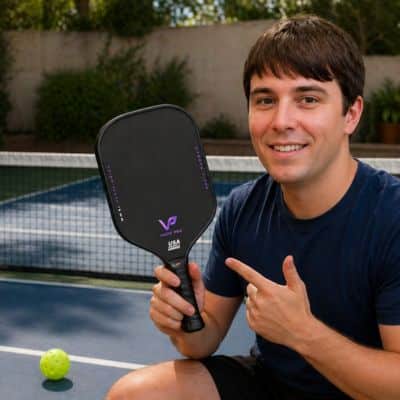
Dylan is a 4.5-rated pickleball player and gear writer who has tested 80+ paddles across 400+ hours on court. He rates spin, power, control, and forgiveness from real court time so you can buy smarter — no sponsored rankings, ever.