
14mm vs 16mm Pickleball Paddle: What Do Pros Actually Use? (2026)

The Verdict: In the 14mm vs 16mm pickleball paddle debate, the 16mm paddle is better for most players because the thicker core provides more dwell time, an expanded sweet spot, and softer touch on dinks. You should only choose a 14mm paddle if you are an advanced 4.0+ player who consistently hits the sweet spot and needs maximum hand speed and pop.
Which Thickness Fits Your Rating?
- Beginners (Under 3.0): 16mm only. Prioritize forgiveness.
- Intermediates (3.0–3.5): 16mm by default.
- Advanced (4.0): Depends on style. Drivers choose 14mm; control/resetters choose 16mm.
- Tournament (4.5+): 14mm if your soft game is dialed in. Top pros are currently split on thickness based on gender and playstyle.
Not sure what else to match? Start with my complete guide on how to choose a pickleball paddle.
The 14mm vs 16mm pickleball paddle question comes up in almost every gear conversation on the court, and it’s one of the easiest specs to get wrong. After putting in over 400 hours testing paddles in both thicknesses, I’ve found the honest answer changes depending on your DUPR rating, your arm health, and what the core is actually made of.
Paddle thickness isn’t just a minor detail on a spec sheet. The difference between 14mm and 16mm pickleball paddles directly impacts your power, touch, sweet spot forgiveness, and whether your elbow is aching after a weekend tournament. It changes how the ball exits the face, your margin for error on off-center hits, and your hand speed during fast net exchanges.
Jump to: The difference · Comparison table · Core material · What pros use · For beginners · By rating · Recommended paddles · FAQs
What’s the Difference Between 14mm and 16mm Pickleball Paddles?
The difference comes down to the depth of the core inside the paddle, not the paddle’s overall length or face width. That core depth dictates your dwell time (how long the ball stays on the face) and how much impact energy the paddle absorbs.
- 14mm core (thinner): Shorter dwell time. The ball compresses less and snaps off the face faster. This delivers higher exit speeds and pop, but results in a smaller sweet spot and less impact dampening.
- 16mm core (thicker): Longer dwell time. The ball sinks deeper into the face, absorbing impact energy. This provides a softer touch, an expanded sweet spot, and significantly lower vibration on off-center hits.
Thinner cores flex less on contact, meaning the ball spends less time compressed against the face before rebounding. That’s the general pattern, but construction changes it, as the next section shows.
14mm vs 16mm Pickleball Paddle: Performance Comparison
| Feature | 14mm Core Paddle | 16mm Core Paddle |
|---|---|---|
| Primary Advantage | High pop and fast hand speed | Soft touch and high forgiveness |
| Dwell Time | Short (instant rebound) | Long (ball pocketing) |
| Sweet Spot Size | Moderately compact | Expanded and forgiving |
| Best Shot Types | Baseline drives and speed-ups | Dinks, drops, and resets |
| Vibration Absorption | Lower (more feedback) | High (arm-friendly) |
| Ideal Skill Level | 4.0+ players with clean mechanics | Beginners through 4.0 |
Core Material Matters as Much as Thickness
Thickness is just the starting point. During my playtesting, I’ve found that the material and construction around the core can completely flip the usual 14mm vs 16mm rules.
- A 16mm paddle isn’t always a control paddle. The 16mm Selkirk Labs Project Boomstik utilizes a foam BoomCore and plays entirely like a power paddle, featuring a hot launch angle and a real adjustment period on soft resets. Meanwhile, the JOOLA Hyperion CFS 16mm remains the best-driving 16mm paddle I’ve tested at its price point.
- A 14mm paddle isn’t always harsh. The 14mm Six Zero Black Opal uses a floating solid foam core that gave me noticeably more dwell time at the net than a standard 14mm build. Similarly, the 14mm CRBN TruFoam Genesis is a strong control-first foam pick.
- The exact same model can change drastically with thickness. I recommend the 16mm Six Zero Double Black Diamond to almost everyone, but reserve the 14mm strictly for 4.5+ players with a dialed-in soft game.
Use thickness as your first filter, but always check what’s inside the paddle. My guide to the best thermoformed pickleball paddles covers core construction in much greater detail.
Do Pros Use 14mm or 16mm Paddles? (Late 2026 Pro Setups)
If you are wondering, “do pro pickleball players use 14 or 16mm paddles?”, the answer is both—but not evenly. In looking at the late-2026 tournament setups of the top pro players, almost every top male pro (Ben Johns included) plays a 16mm paddle for control and reset stability. Conversely, many of the top female pros opt for 14mm paddles to maximize their hand speed and instant pop during fast kitchen firefights.
Here’s why thinner cores appeal at the highest level: Pros generate their own pace through refined mechanics and perfect footwork. They don’t need a thick core to absorb energy or widen their margin for error. For a 4.5 to 5.0+ player, a 14mm paddle offers instant pop on counter-attacks and a more aerodynamic frame that cuts through the air faster in firefights.
That said, copying a pro’s core thickness without having their consistency will backfire. A 14mm core severely punishes off-center hits. If your dink mechanics aren’t perfectly grooved, a thin paddle will pop balls up high enough for opponents to smash away.
| Player | Paddle | Core |
|---|---|---|
| Ben Johns | JOOLA Perseus Pro V | 16mm |
| Federico Staksrud | JOOLA Kosmos Pro V | 16mm |
| Noe Khlif | JOOLA Perseus Pro V | 16mm |
| CJ Klinger | Adidas AdiPower Pro Edition ATTK | 16mm |
| JW Johnson | PIKKL Hurricane Pro | 16mm |
| Anna Leigh Waters | Franklin C45 Aurelius | 14mm |
| Anna Bright | JOOLA Scorpeus Pro V | 14mm |
| Tyra Black | PIKKL Hurricane Pro | 14mm |
| Kate Fahey | JOOLA Agassi Pro V | 14mm |
| Jorja Johnson | PIKKL Hurricane Pro | 16mm |
Setups as of October 2026, from a sample of players in Pickleball.com’s top-20 gear roundup. Pros change paddles mid-season, and a few newest paddles are still unreleased. For current setups, see my page on what paddles the best pickleball players use.
13mm vs 16mm Pickleball Paddle for Beginners
Whether you are weighing a 13mm, 14mm, or 16mm core, the rule is the same: a 16mm pickleball paddle is significantly better for beginners. The thicker core gives you a much larger sweet spot, absorbs harsh impact shock, and makes soft touch shots much easier to control while your mechanics are still developing. Beginners who buy a thin, poppy 14mm or 13mm paddle usually find their dinks popping up and their resets sailing long.
If you’re asking about 13mm or 16mm pickleball paddles, the advice is the same. A 13mm core is even thinner and built purely for hand speed and put-away power. In my testing, the 13mm Selkirk Vanguard Power Air rated a 9 for power but only an 8 for forgiveness. Stick to 16mm models like the Vatic Pro Prism Flash if you want an elite paddle that will grow with your game.
Core Thickness Recommendations by Player Rating
- Below 3.0 (beginners): 16mm only. You need forgiveness and control more than raw pop. A 16mm core dampens off-center hits and keeps your dinks from bouncing too high.
- 3.0–3.5 (intermediates): 16mm by default. Stick with 16mm unless you have a highly reliable third-shot drop under pressure. For paddle picks at this level, see my best pickleball paddles for intermediate players, or the full best pickleball paddles of 2026 ranking.
- 4.0 (advanced intermediates): Depends on your style. Choose 14mm if you rely on drives, aggressive counter-attacks, and fast hands at the net. Choose 16mm if your strategy centers on resetting hard drives and patient dinking.
- 4.5+ (advanced/tournament): 14mm or 13mm. At this level, responsiveness outweighs sweet spot size. Going thinner than 14mm is a real choice for tournament players chasing quickness, but it demands very clean mechanics. My best pickleball paddles for advanced players guide covers the picks.
Does Core Thickness Affect Spin?
Only a little. Face texture and grit matter far more than core depth when it comes to generating RPMs. While a thicker core can technically give the grit slightly more time to “bite” the ball, the paddles I’ve tested show no clear spin pattern based strictly on thickness:
| Paddle | Core | Spin Score |
|---|---|---|
| CRBN TruFoam Genesis | 14mm full foam | 9.5 |
| Selkirk Vanguard Power Air | 13mm polymer | 9 |
| Osmo Elite Spin T700 | 16mm honeycomb | 9.5 |
| Vatic Pro Prism Flash | 16mm polymer | 8.5 |
| Selkirk Boomstik | 16mm foam | 9.5 |
| Six Zero Black Opal | 14mm foam | 9.8 |
If maximum rotation is your goal, focus on the paddle face material. My guide to the best pickleball paddles for spin ranks the top options by their tested spin tiers.
Arm Health: The Case for 16mm Cores
Thicker 16mm polymer and foam cores absorb significantly more impact shock on every shot than thinner builds. In my testing, the 16mm builds felt softer on mishits and sent less vibration up the handle. If you’re dealing with flare-ups, the thicker core is worth trying (though I’m not a doctor, so see one if pain persists).
If you play four or five days a week, a 16mm setup provides structural shock absorption that helps keep you on the courts pain-free. Just remember that head-heavy builds can still tire your arm regardless of thickness—something I experienced during heavy testing blocks with the Hyperion and Perseus Pro V.
Recommended 14mm and 16mm Paddles
Top 14mm and 13mm Paddles (Power and Speed)
- Six Zero Black Opal (14mm): My #1 overall pick in this category, featuring a floating solid foam core that plays softer than its thickness suggests. It amplifies your swing, so give it two practice sessions to adjust.
- CRBN TruFoam Genesis (14mm): A honeycomb-free foam core built for elite placement over sheer pace. My favorite control-first pick in the thin-core group.
- JOOLA Perseus Pro V (14mm or 16mm): The hardest-hitting paddle I’ve tested this year. Very head-heavy and strictly best for 4.0+ players.
- Selkirk Vanguard Power Air (13mm): An open-throat design built purely for swing speed, giving you the fastest possible hands at the kitchen.
- Six Zero Double Black Diamond 14mm: Packs noticeably more pop than the 16mm version, but comes with a real skill floor. Recommended only for 4.5+ players.
Top 16mm Paddles (Control and Forgiveness)
- Vatic Pro Prism Flash (16mm): Features a raw T700 carbon face and a plush soft-game feel. This remains one of my most consistently recommended budget picks on the market.
- JOOLA Hyperion CFS 16mm: The best all-court paddle I’ve tested in its class. It offers a crisp feel and real pop, though it swings heavier than its static weight implies.
- Six Zero Double Black Diamond 16mm: Plush, reliable, and control-first. This is the version of the DBD I’d point 90% of players toward.
- Vatic Pro V-Sol Pro (16mm): An excellent budget full-foam 16mm option providing strong power metrics for the price.
Final Verdict: 14mm or 16mm?
Pros who play thinner cores generally do it because their elite technique doesn’t require a built-in safety net. That’s not true of every pro, and it’s almost certainly not true of your game yet either. Base your core thickness decision on your current skill set:
- Choose 16mm if you want to reduce unforced errors, improve dink consistency, or protect your arm from tennis elbow.
- Choose 14mm if you consistently hit the sweet spot, win fast kitchen exchanges, and want maximum put-away pace.
Then check the core material, shape, and swing weight using my guide on how to choose a pickleball paddle, or take the Paddle Finder quiz for a personalized recommendation.
FAQs
Is 14mm or 16mm better for beginners?
16mm is better for beginners. The thicker core provides a larger sweet spot, absorbs impact shock, and makes soft touch shots much easier to control. See my best pickleball paddles for beginners for top starter picks.
Is a 13mm vs 16mm pickleball paddle better for beginners?
16mm is significantly better for the vast majority of players. A 13mm core is very thin, built strictly for pop and elite hand speed. It punishes off-center hits and makes soft resets difficult to control. Save 13mm paddles for 4.5+ players with highly consistent mechanics.
What’s the difference between 14mm and 16mm pickleball paddles?
The core difference is dwell time and feel. A 14mm core is thinner, causing the ball to compress less and rebound faster (yielding more pop but a smaller sweet spot). A 16mm core is thicker, allowing the ball to sink in longer before leaving the face (yielding more control, an expanded sweet spot, and softer feel on mishits).
Do pros use 14mm or 16mm paddles?
Both. In Pickleball.com’s 2026 roundup of top players, the men listed all play 16mm (Ben Johns included) while most of the women listed play 14mm. Pro setups change regularly between seasons, so check my page on what paddles the best pickleball players use for confirmed current info.
What thickness paddle does Ben Johns use?
Ben Johns plays the 16mm Perseus Pro V, per Pickleball.com’s 2026 gear roundup. His signature JOOLA line is offered in both thicknesses. I tested both the Hyperion CFS in 16mm and the newer Perseus Pro V, which comes in 14mm or 16mm.
Is 14mm or 16mm better for control?
16mm is the safest choice for most control players (see my best pickleball paddle for control picks) because the thicker core inherently adds dwell time. The exception is modern foam core technology: the 14mm CRBN TruFoam Genesis is my top control-first pick, and the 14mm Six Zero Black Opal plays much softer than its specs suggest.
Does a 16mm core make dinking easier?
Yes. The longer dwell time on a 16mm core absorbs incoming energy and stops the ball from springing off the face too quickly during delicate kitchen rallies.
Can you switch from 16mm to 14mm later?
Yes, and many players make the switch as their mechanics improve into the 4.0–4.5 range. Just expect a brief adjustment period: drives will come off hotter, dinks will lose some built-in softness, and your timing will take a session or two to fully recalibrate.
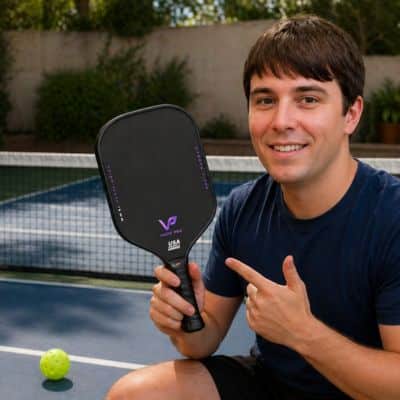
Dylan is a 4.5-rated pickleball player and gear writer who has tested 80+ paddles across 400+ hours on court. He rates spin, power, control, and forgiveness from real court time so you can buy smarter — no sponsored rankings, ever.