
Six Zero Double Black Diamond Review (2026): 16mm vs 14mm

How I tested: Both the 16mm Lightweight Edition (7.7–7.9 oz) and the 14mm Standard Double Black Diamond were bought at retail with my own money and put through rigorous wear-testing through late 2026: dinks, drives, drops, serves, and fast kitchen exchanges, cross-checked with 3.0–5.0 players. Verify my level on my DUPR profile, and read the full method in how I test pickleball paddles.
Disclosure: Some links on this page are affiliate links—I earn a small commission if you purchase through them, at no extra cost to you. No brand paid to appear in this review, and every paddle here was purchased with my own money and tested on my own courts. Details here.
Quick Verdict: My Six Zero Double Black Diamond review in one line: it’s one of the best control-first thermoformed paddles I’ve tested (rated 9.2/10). The 16mm Lightweight Edition is the right pick for most 3.5–5.0 players who live at the kitchen. The 14mm adds pop but demands a dialed-in soft game, so it suits 4.5+ players. If you’re asking which one to get, get the 16mm.
The Double Black Diamond at a Glance:
- Best for Most Players: Six Zero Double Black Diamond 16mm Lightweight Edition (Control & Spin)
- Best for Advanced Bangers (4.5+): Six Zero Double Black Diamond 14mm Standard Edition (Extra Pop)
- Core Tech: Carbon Fusion Edge (Foam-Injected Perimeter Walls)
- Face Material: Japanese Toray T700 Raw Carbon Fiber
Jump to: Specs & 16mm vs 14mm On-Court Performance Thickness Breakdown How It Compares Final Verdict FAQs
I’ll be honest — I came into this review a little skeptical. Six Zero is an Australian brand that built massive popularity through community-driven feedback, and anytime a paddle gets hyped this hard this fast, I want to test it myself before I say anything about it. I’ve now put both the 16mm Lightweight Edition (7.7–7.9 oz) and the 14mm Standard Double Black Diamond through extensive drilling and match play.
Quick naming note: you’ll see this spelled differently across retailers — Six Zero Double Black Diamond, SixZero DBD, 6.0 Double Black Diamond. Same paddle. I’ll shorten it to DBD from here. Separately, the Six Zero Black Diamond — without “Double” — is a different, more power-oriented hybrid carbon-fiberglass paddle; this review covers the control-first Double Black Diamond only.
Transparency: Some links on this page are affiliate links—I earn a small commission if you purchase through them, at no extra cost to you. No brand paid to appear in this review, and this paddle was purchased with my own money and tested on my own courts.
The Reasoning Behind the Verdict
Full breakdown is below, but here’s the reasoning in short: the 16mm’s foam-injected Carbon Fusion Edge gives it dwell time and forgiveness that’s rare for a thermoformed paddle at this price — that’s why it wins for most players. The 14mm trades that cushion for speed. It’s a real upgrade in the right hands and a real downgrade in the wrong ones. Read on for exactly where that line sits.
Who This Double Black Diamond Pickleball Paddle Is For
Best fit: 3.5–5.0 players who prioritize control and kitchen play; anyone stepping up from fiberglass without wanting to lose touch; players who want NVZ hand speed without sacrificing stability — the Lightweight Edition’s 7.7–7.9 oz static weight helps here.
Look elsewhere: pure power players (the 16mm is plush, not punchy); beginners still building a soft game (the 14mm especially will expose gaps); anyone who hates replacing grips — the stock grip runs thin.
Six Zero Double Black Diamond Control 16mm vs 14mm Specs
Six Zero Double Black Diamond Series
16mm Lightweight Edition for most players · 14mm for 4.5+
| Specification | 16mm Version | 14mm Version |
|---|---|---|
| Edition | Lightweight Edition | Standard Edition |
| Face Material | Toray T700 Raw Carbon | Toray T700 Raw Carbon |
| Shape | Aerodynamic Flared (16.3″ × 7.7″) | Aerodynamic Flared (16.3″ × 7.7″) |
| Core Thickness | 16mm Honeycomb | 14mm Honeycomb |
| Swing Feel | Balanced, plush | Faster, more responsive |
| Sweet Spot | Noticeably larger | Slightly tighter |
| Mishit Forgiveness | High | Moderate |
| Static Weight | 7.7–7.9 oz | 8.1 oz |
| Grip Details | 5.5″ Length | 4.5″ Size | 5.5″ Length | 4.5″ Size |
| Handle | 3D Carbon Thermoformed Unibody | 3D Carbon Thermoformed Unibody |
| Performance Focus | Control, Spin, Reset Touch | Pop, Hand Speed, Drive Pace |
| Spin Potential | Elite Spin Tier | Elite Spin Tier |
Also worth knowing: Six Zero makes an Infinity edgeless version (16mm control feel, 14mm-level hand speed) and an Elongated shape — I haven’t run the Elongated through my full protocol yet, so no verdict there.
On-Court Performance
Tested across four sessions (two per paddle) with players from 3.5–4.5, plus a drilling session on dinks, resets, and third-shot drops.
Dinks and Kitchen Play
This is where the DBD earns its reputation. Most thermoformed paddles feel a little mechanical on soft shots — like you’re placing the ball rather than feeling it. This one doesn’t. The Carbon Fusion Edge construction (foam-injected perimeter, carbon seam bonding the two faces) creates dwell time noticeably longer than a standard edge guard gives you. Off-center contact stayed in far more reliably than I expected from carbon. I played three games staying deliberately patient at the kitchen, refusing to attack until I had a clean ball — won all three. Some of that’s strategy. Some of it’s this paddle.
Drives and Power Shots
The honest answer most reviews won’t give you: the 16mm is not a power paddle, and it doesn’t pretend to be. The plush feel that wins you the kitchen absorbs some of the energy you’d want on a hard drive. It’s not dead — I got plenty of pace loading up properly — but against a 14mm, the punch difference on flat drives was noticeable. The 14mm springs more off the face and pops harder, but forgiveness drops considerably. See how this carbon layout stacks up against a woven alternative in my Six Zero DBD vs Ruby comparison.
Serves, Resets, and Defense
Above average on spin serves — the T700 texture grabs well; topspin and kick serves came consistently, and launch angle stayed neutral. Resets are where it really shines: blocking hard-driven balls from midcourt felt confident, and shots I fully expected to pop up for a put-away died into the kitchen instead. Two players I lent it to during a session — a 3.5 and a 4.2 — both commented on the reset forgiveness unprompted.
Feel, Spin, and Swing Weight
Plush and controlled, with enough pop to keep rallies honest but not enough to compensate for passive technique — a skill amplifier, not a skill compensator. It’s not as soft as a Gearbox CX14E, but meaningfully softer than a CRBN 3X or JOOLA Hyperion CFS at full power.
T700 raw carbon is best-in-class for spin, and it held its grit noticeably longer than standard cross-hatch faces I’ve tested over comparable hours. One inconsistency: off-center contact (heel or tip rather than center) dropped spin more than on some other carbon faces — a non-issue at 4.0+, but worth knowing below that. For how it stacks up against every other spin option I’ve tested, see my best pickleball paddles for spin.
The Lightweight Edition’s 7.7–7.9 oz sits in balanced swing-weight territory — quick enough for speed-ups, stable enough on hard-driven resets, and no arm fatigue across four sessions.
Grip and Durability
The 5.5″ elongated grip handled two-handed backhands comfortably; three players in my group specifically mentioned the handle length as a reason they were comfortable switching. Stock grip runs thin — I added an overgrip before session two and felt the difference immediately (my best pickleball grip tape guide covers what I use). Both my units have held up cleanly through testing with no chips or separation. General note for any thermoformed paddle: delamination is a known industry-wide risk over a long ownership period, especially with hard face contact on overheads. I haven’t seen it here, and build quality seems above average for the construction type.
Value for Money
This paddle is priced below where it plays. I’ve tested paddles costing significantly more that don’t outperform it on kitchen feel and reset performance specifically — that’s where it competes with the best I’ve used at any price. If it’s over your budget, my best pickleball paddles under $150 guide has the Vatic Pro Prism Flash as the closest alternative in kitchen feel at a lower price. Haven’t settled on Six Zero as a brand yet? My best pickleball paddles guide covers the full field.
The Infinity edgeless is harder to justify — the jump from standard 16mm is real but narrow, and it’s a tough sell for a feel difference you might not notice in your first three sessions. Start with the standard 16mm.
14mm vs 16mm: Which Should You Get?
- Choose the 16mm if: you’re 3.5–4.5, want more forgiveness and a bigger effective sweet spot, your game lives at the kitchen, or you want NVZ speed without sacrificing stability.
- Choose the 14mm if: you’re 4.5+ with a dialed-in soft game and want more zip, or you’ve played the 16mm and felt it holding back your attack.
Practical rule: if you’re asking which one to get, get the 16mm. The 14mm is the right answer for a specific player, not most players. For the general trade-offs of each thickness, see my 14mm vs 16mm pickleball paddle comparison.
How the Six Zero Double Black Diamond Compares
vs. CRBN 3X: stiffer, slightly more pop on hard drives — better for aggressive baseline players. DBD wins clearly for kitchen-first players. Both excellent; the choice is about your game.
vs. JOOLA Hyperion CFS 16mm: more pop, more well-rounded all-court. But in dinking sequences and resets specifically, the DBD’s kitchen feel is noticeably better, and the Hyperion feels a little mechanical by comparison at the NVZ. Priced comparably — the decision is all-court versatility (Hyperion) vs. kitchen-first control (DBD).
vs. other Six Zero paddles: The Ruby swaps the carbon face for aramid fiber and plays with a different feel — I break down the differences in my Six Zero DBD vs. Ruby comparison. If you want Six Zero’s highest-rated paddle (9.7/10 on my four-score average), see my Six Zero Black Opal review, and my full Six Zero lineup ranked shows where each model fits.
Pros and Cons
- Pro: Excellent kitchen feel and reset performance, the best I’ve found at this level
- Pro: Elite-tier spin from T700 raw carbon that holds its grit
- Pro: A bigger, more forgiving sweet spot than it looks on paper (16mm)
- Pro: A 5.5″ handle with room for two-handed backhands
- Con: Not a power paddle: the plush 16mm gives up punch on hard drives
- Con: The 14mm has a real skill floor and is a poor choice below about 4.5
- Con: Spin drops more on off-center contact than on some other carbon faces
- Con: The stock grip runs thin, so plan on an overgrip
Final Verdict
One of the best control-oriented thermoformed paddles I’ve tested in its class, and a standout in the kitchen. If you’re 3.5–5.0 and want to win dinking battles, execute resets under pressure, and generate real spin without sacrificing touch — this is the paddle. The one honest caveat: it’s not for players who want power first. Spend time with the 14mm or look at the CRBN 3X instead if that’s you. It’s priced well below where paddles that play like this usually land, and the Lightweight Edition gives you NVZ agility most 16mm control paddles simply don’t offer.
Still comparing it against the rest of Six Zero’s range? See my full Six Zero paddle lineup ranked. Comparing outside the thermoformed category entirely? My best pickleball paddles guide covers the full field, and my guides to the best control pickleball paddles and best pickleball paddles for intermediate players show where the DBD lands.
FAQs
Is the Six Zero Double Black Diamond good for beginners?
The 16mm can work for a motivated beginner willing to put in court time, but I wouldn’t recommend it as a first paddle — it’s more demanding than a fiberglass starter. The 14mm is a hard no for beginners. See my best pickleball paddles for beginners guide for better first-paddle options.
Six Zero Double Black Diamond 14mm vs 16mm: which should I buy?
16mm is softer and more forgiving, better in the kitchen. 14mm is faster and poppier, better for advanced players with a dialed-in soft game. Unsure? Get the 16mm.
Is the Six Zero Double Black Diamond a good paddle for spin?
Yes. The Toray T700 raw carbon face is elite-tier for spin and held its grit noticeably longer than cross-hatch faces in my testing. Spin drops a little on off-center contact, which matters below 4.0. See my best pickleball paddles for spin for the full comparison.
Is “Double Black Diamond Control” a different paddle?
No — same 16mm paddle, just a more descriptive name some retailers use.
What is the difference between the Six Zero Black Diamond and Double Black Diamond?
Different paddles — the Black Diamond is a hybrid carbon-fiberglass, with more power and pop. This review covers the Double Black Diamond’s pure T700 raw carbon, control-first build.
What is Carbon Fusion Edge technology?
Foam is injected around the perimeter, then a carbon seam bonds the two face panels into one unibody structure instead of a separate glued edge guard. In practice: bigger effective sweet spot toward the edges, less vibration on off-center contact, more durability. Real difference, especially on resets and off-center dinks.
Is the Six Zero Double Black Diamond worth it?
Yes. It plays like a paddle costing considerably more in the areas that matter for a control-focused game — kitchen feel, sweet spot, reset performance. Thin stock grip is a minor gripe; everything else earns its price.
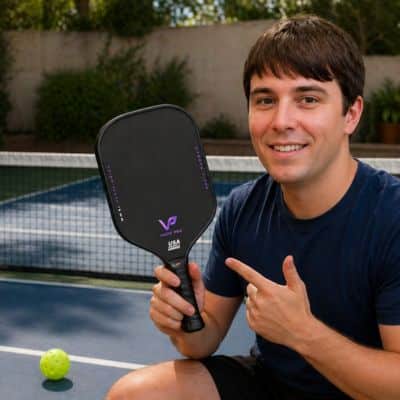
Dylan is a 4.5-rated pickleball player and gear writer who has tested 80+ paddles across 400+ hours on court. He rates spin, power, control, and forgiveness from real court time so you can buy smarter — no sponsored rankings, ever.