
How to Choose a Pickleball Paddle: What Actually Matters

Choosing a pickleball paddle comes down to four decisions: who you are as a player, how thick the core is, what the face is made of, and how the paddle feels in your hand. Get those four right and the model name almost picks itself. It’s the framework I’ve used across 400+ hours testing 80+ paddles — every one bought with my own money.
The shopping experience is the opposite of simple. You walk into a pro shop or scroll a marketplace and get buried in “thermoformed unibody” and “polypropylene honeycomb core.” This guide cuts through that noise by matching your game to the right construction instead of handing you a generic top-10 list.
There is no single “best pickleball paddle.” A frame that feels crisp and explosive to a tournament regular will spray balls past the baseline for a developing beginner, and 400+ hours of on-court testing keeps confirming it. The best paddle is the one that fits your swing, your contact consistency, and your joints — not the one at the top of a ranked list.
Quick Answer: To choose a pickleball paddle, match four things to your game: your skill level and arm health, the core, the face, and the shape. Most players between 2.5 and 4.0 do best with a 16mm core, a raw carbon or fiberglass face, a hybrid or widebody shape, and a midweight (7.6–8.2 oz) build.
My picks by player type:
- Beginner: the MTEN Power Set to get a group on court, or the Vatic Pro Prism Flash if you want a paddle that grows with you. Full list in my best pickleball paddles for beginners.
- Control-first: the Vatic Pro Prism Flash on a budget, or the CRBN TruFoam Genesis if money allows.
- All-court: the Six Zero Black Opal.
- Power (4.0+ mechanics): the JOOLA Ben Johns Perseus Pro V.
Not sure where you fit? Take the Paddle Finder quiz, or see every tested paddle ranked in my best pickleball paddles of 2026.
Jump to: The short answer · Match the paddle to your rating · Core thickness: 14mm vs 16mm · Weight and balance · Grip size · Surface and spin · Budget: what $50 vs $150 buys · FAQs
The Short Answer
In a hurry? Four rules cover about 90% of the decision:
- Buy for your rating, not your aspirations. Below 3.0, buy forgiveness. At 3.0–4.0, buy all-court versatility. At 4.0+ with repeatable mechanics, buy the power or precision your game actually needs. If you’re between ratings, buy for the lower one.
- Default to 16mm. The thicker core gives you a bigger sweet spot, a softer feel, and more margin on off-center hits. Go 14mm only when your swing is fast and repeatable enough to use the extra pop without spraying balls.
- Stay midweight (7.6–8.2 oz). It’s quick enough at the kitchen and stable enough from the baseline. Go lighter for hand speed, heavier for plow-through — never the other way around just because a number looked fun.
- Match the face to your spin style. Raw carbon if you shape the ball, fiberglass if you want easy power, graphite or aramid if touch is your game. Face material drives spin and durability more than any marketing term on the box.
Here’s the same advice as a quick decision matrix:
| Your game | Your build |
|---|---|
| Developing (below 3.0), building contact | 16mm core, widebody or hybrid shape, forgiving fiberglass or carbon face, midweight |
| Improving (3.0–4.0), adding spin and shape | 16mm hybrid, raw carbon face, midweight |
| Advanced (4.0+), fast repeatable mechanics | 14mm thermoformed or foam core, raw carbon face |
| Sore arm or elbow history | Midweight, softer-flexing face, comfortable grip — don’t chase the stiffest, lightest frame |
Match the Paddle to Your Rating
Your rating is the single best filter for paddle choice, because it tells you how consistent your contact is — and contact consistency decides how much forgiveness you need. Be honest about where your game sits today, not where you want it to be in a year.
3.0: Developing contact — buy forgiveness
At this stage your swing is still forming, so the paddle’s job is to keep mishits in play. Look for a control-first 16mm core in a widebody or hybrid shape with a forgiving face — fiberglass for easy power or a soft raw carbon for a blend of touch and spin. Stay midweight so the paddle stays stable without wearing out your arm. This is not the time to chase a stiff 14mm power frame; it will punish every off-center hit. See my full best pickleball paddles for beginners guide for tested picks.
3.5: Adding shape — buy versatility
You’re starting to hit with intention — topspin drives, roll volleys, purposeful resets. This is where a raw carbon face earns its keep, because the texture actually grabs the ball when you brush it. A 16mm hybrid is the sweet spot: forgiving enough for kitchen exchanges, spinny enough to shape drives. This is also the level where construction starts to matter — you’ll feel the difference between a basic honeycomb core and a tuned foam or thermoformed build. My best paddles for intermediate players guide ranks the ones I’d actually buy at this level.
4.0+: Mechanics are set — buy the power or precision your game needs
When your contact is repeatable, you can finally use a paddle that gives less for free. A 14mm thermoformed frame rewards fast swings with real pop, and foam-core builds like the CRBN TruFoam Genesis give reset-heavy players power with touch. That said, plenty of 4.0+ players still win with control-first 16mm setups — buy the style you actually play, not the one that looks good in a highlight reel. For the power route, see my best power paddles and best paddles for advanced players guides.
Core Thickness: 14mm vs 16mm
Core thickness is the spec I’d tattoo on every buyer’s hand if I could. It changes how a paddle feels more than almost anything else on the sheet:
- 16mm: the control and forgiveness choice. More dwell time, a bigger effective sweet spot, and a softer, quieter feel. This is the default I recommend for most players from 2.5 through 4.0.
- 14mm: the pop and precision choice. Crisper, more responsive, more energy return. It rewards fast, compact mechanics — and punishes slow or sloppy ones. Best for 4.0+ players who generate their own pace.
Thickness isn’t the whole story, though. Core material matters just as much: a modern density-tuned foam core can feel completely different from a traditional polymer honeycomb at the same thickness. And what the pros use is its own conversation — I broke that down in my guide to whether pros use 14mm or 16mm paddles.
Weight and Balance
Ignore the sticker weight and think in motion. How a paddle swings — its balance — matters more than what the scale says, because mass toward the head gives you driving power but slower hands, while mass toward the handle speeds up your kitchen game at the cost of plow-through.
- Lightweight (7.2–7.6 oz): fast hand speed at the kitchen — the Diadem Hero V2 lives here. Great for quick exchanges, but you’ll work harder to generate depth from the baseline.
- Midweight (7.6–8.2 oz): the best starting zone for most players. Stable without being sluggish.
- Heavyweight (8.2 oz+): serious plow-through and depth, but wrist and elbow fatigue show up fast if your arm isn’t ready for it.
Two more things people underrate. Handle length: if you hit a two-handed backhand, check it before you buy — a 5.3-inch handle like the Vatic Pro Prism Flash’s suits one-handers, while a 6-inch handle like the 11SIX24 Jelly Bean’s gives two-handers room to work (see my Jelly Bean review). Arm comfort: a paddle that feels weightless on the scale can still rattle a sensitive elbow if it’s stiff and head-heavy, so don’t buy purely on low weight.
Grip Size
Grip size is the cheapest performance upgrade in pickleball and the one most people ignore. A grip that’s too small forces you to squeeze harder, which tires your forearm and invites tennis elbow. A grip that’s too big locks up your wrist and costs you spin on rolls and flicks.
My rule: go with the larger stock grip if you have any elbow history or a wristy, flippy swing — it stabilizes the paddle. Go smaller if you’re a spin-first player who lives on wrist action. And remember that an overgrip adds a touch of size, so you can always build a slightly small grip up. My grip tape guide walks through rewrapping to dial in the exact feel.
Surface and Spin
The face is what actually touches the ball, so it drives spin and durability. Four materials cover nearly everything on the market:
- Raw carbon fiber (Toray T700): the spin choice. The exposed weave bites the ball for heavy topspin and slice. The trade-off is that the texture wears with play, so it needs more care. See my best spin paddles and my explainer on T300 vs T700 carbon.
- Fiberglass: the easy-power choice. It flexes and snaps back, giving developing swings free depth without demanding perfect mechanics.
- Graphite: the balanced classic. A controlled, predictable response that suits touch players and traditionalists.
- Aramid fiber: the feel-first option. A few paddles, like the Six Zero Ruby, use aramid for a uniquely soft, connected feel at the net.
Beware the spray-on texture trap. Budget paddles advertising “advanced spin grit” often use a coating that washes off in weeks. A real peel-ply or raw-weave surface outlasts it by months — that’s one of the first things I check in how I test paddles.
Budget: What $50 vs $150 Buys
You don’t need to spend big to get a good paddle anymore — real performance has moved downmarket. Here’s roughly what each tier buys:
- Around $50: gets you on the court. Two-paddle sets and basic fiberglass frames. Perfectly fine for learning whether you love the game before investing more. See my best budget paddles.
- Around $100: the performance floor. This is where raw carbon faces and honest 16mm builds start showing up — paddles you won’t outgrow in three months. My best paddles under $100 guide lives here.
- Around $150: refined construction. Thermoformed unibodies, foam cores, tighter quality control, and more consistent feel from paddle to paddle. See the best paddles under $150.
- Beyond that: diminishing returns. You’re paying for small refinements and brand premiums. Worth it if you’ve found your forever paddle — not where you should start. My best value paddles guide compares the sweet spot.
FAQs
How do I choose a pickleball paddle for my skill level?
Start with a 16mm core, midweight (7.6–8.2 oz), hybrid or widebody paddle, then adjust. Below 3.0, prioritize forgiveness and a soft face. At 3.0–4.0, add a raw carbon face for spin. At 4.0+, choose the power or control build your style demands. When in doubt, buy for the lower of the two ratings you’re between.
What is the best pickleball paddle for a beginner?
A 16mm polymer honeycomb paddle in a widebody or hybrid shape, midweight, with a fiberglass or forgiving carbon face. It keeps mishits in play while your swing develops. My beginners guide ranks the ones I’ve actually tested.
Is a 14mm or 16mm core better for control?
16mm is the safer choice for most control players — the thicker core adds dwell time and a bigger sweet spot, which keeps resets and dinks consistent. 14mm gives you more pop but a smaller margin for error, so it only helps control players whose mechanics are already repeatable.
Is a foam core always better than polymer honeycomb?
No. Foam cores add power and a deeper ball-pocketing feel, which suits intermediate and advanced players. But a well-made honeycomb core is more forgiving and often cheaper — for developing players it’s still the smarter buy.
Carbon fiber or fiberglass: which should I choose?
Choose fiberglass if you want easy power and forgiveness while you build your swing. Choose raw carbon if you shape the ball with spin and want maximum bite — just know the texture wears faster and needs more care.
Does the paddle face affect pickleball elbow?
It can. Stiffer faces transmit more vibration to your arm, while softer, more flexible faces absorb it. If your elbow talks to you, pair a midweight paddle with a forgiving face and a comfortable grip rather than the stiffest, lightest frame you can find. See my tennis elbow paddles guide.
How much does shape really affect power?
Meaningfully. An elongated shape produces more power than a widebody of the same construction because the mass sits farther from your hand. But it also shrinks the sweet spot, so only buy the extra reach if your contact is consistent enough to find it.
I’m a 3.5 player who loves spin. Should I get a thermoformed paddle?
Only if your contact is already repeatable. Spin comes mostly from the face texture, not from the construction — a raw carbon 16mm hybrid will give you the spin you want with far more forgiveness. Move to thermoformed when you stop missing the sweet spot, not before.
Why do two paddles with the same weight feel so different?
It’s weight distribution, not total weight. Mass toward the head gives you driving power but slower hands; mass toward the handle speeds up your kitchen game but costs you plow-through. Two 8.0 oz paddles can swing like completely different animals.
How much should I spend on a pickleball paddle?
Less than you’d think. Raw carbon faces and real foam-core builds now exist in every price tier, so the jump from $50 to $100 buys you far more than the jump from $150 to $250. Spend enough to get the right construction for your game — then stop and go drill.
Where to Go Next
You know what to look for — now go find it. Start with my best pickleball paddles of 2026 hub for the full ranked list, or jump straight to the beginners, intermediate, and spin guides. Still torn? The Paddle Finder quiz will match a paddle to your game in about a minute.
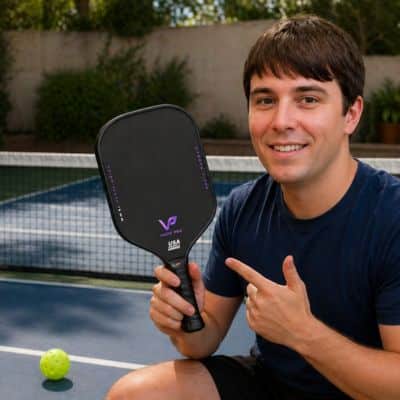
Dylan is a 4.5-rated pickleball player and gear writer who has tested 80+ paddles across 400+ hours on court. He rates spin, power, control, and forgiveness from real court time so you can buy smarter — no sponsored rankings, ever.