
Best Pickleball Paddles for Tennis Elbow (2026): 4 I Actually Tested

If you’re shopping for the best pickleball paddles for tennis elbow, you already know the wrong pick can cost you weeks of court time. I’ve bought and tested 80+ paddles over 400+ hours of play, and some of them sting the elbow a lot more than others.
I’m not a doctor, and no paddle cures tennis elbow. It’s a repetitive-stress injury: the tendons in your forearm get overloaded by technique, volume of play, a harsh-feeling paddle, or a grip that’s too small. A paddle can remove one of those pieces, and that piece matters more than most players think.
Last updated: October 2026.
Affiliate disclosure: if you buy through links on this page, I earn a commission at no extra cost to you. I buy every paddle with my own money, and no brand gets a recommendation for free. As an Amazon Associate I earn from qualifying purchases.
Quick Answer: What’s the Best Pickleball Paddle for Tennis Elbow?
The best pickleball paddle for tennis elbow from my testing is the Vatic Pro PRISM Flash: soft feel, forgiving sweet spot, and a lighter swing that doesn’t fight your arm. The Six Zero Black Opal is my pick if you want an all-court paddle with real vibration damping and your mechanics are solid.
Quick Picks
| Paddle | Best For | Core | Dylan’s Rating | Review |
|---|---|---|---|---|
| Vatic Pro PRISM Flash | Best value, most forgiving | 16mm Polypropylene Honeycomb + Foam-Injected Walls | 9.6 | Flash review |
| Six Zero Black Opal | All-court with vibration control | 14mm G4 Aerospace Floating Solid Foam | 9.7 | Black Opal review |
| Vatic Pro PRISM V7 | Elongated shape with plush feel | 16mm Polypropylene Honeycomb | 9.2 | V7 review |
| Six Zero Ruby | Softest feel | 16mm polypropylene honeycomb | 9.4 | Ruby vs. Double Black Diamond |
What Should You Look for in a Pickleball Paddle for Tennis Elbow?
Look for a balanced, head-light swing, a thick soft core (16mm polymer honeycomb), a grip that fits your hand, and a paddle that feels forgiving on mishits. Heavy isn’t the answer. Here’s what I check, in order:
- Swing weight, not just static weight. Swing weight is how heavy the paddle feels when you swing it, and it climbs when weight sits in the head. A head-heavy swing multiplies the twisting load on your forearm at every contact. You want enough mass to plow through the ball so your arm isn’t doing all the work, without a head that drags your elbow around. Head-heavy power paddles were the worst offenders in my testing. Want the basics? See my pickleball glossary.
- A thick, soft core. In my testing, 16mm polypropylene honeycomb cores took the sting out of contact better than thinner, stiffer builds. Stiff foam-filled thermoformed paddles sent more buzz into my arm. If you want the full breakdown, see my thermoformed paddle guide.
- Grip size. A grip that’s too small makes you squeeze harder on every shot, and that constant forearm tension feeds tennis elbow. Most players do well at 4.25″. Do the index-finger test: when you grip the paddle, your index finger should fit between your fingertips and your palm. If your fingers wrap all the way into your palm, size up with an overgrip. It’s the cheapest fix in pickleball, and I break down my favorites in my grip tape guide.
- Mishit feel. My best elbow test is catching the ball near the edge. Harsh buzz means your elbow feels it for days.
What a paddle can’t do: fix technique, heal an inflamed tendon, or replace rest. If you have sharp or persistent pain, see a physical therapist.
The Best Pickleball Paddles for Tennis Elbow I’ve Tested
Every paddle here is one I bought and played with myself. I won’t recommend one I haven’t hit with, no matter how many other sites list it.
1. Vatic Pro PRISM Flash
Best Value
| Best For | Arm comfort per dollar, all-court play |
| Core / Thickness | 16mm |
| Face | Toray T700 Raw Carbon Fiber |
| Shape | Hybrid Flash (16.3″ × 7.7″) | V7 Elongated Available |
| Spin Tier | Elite |
This is the one I recommend first when someone wants an elbow-friendly paddle that doesn’t cost a fortune. It’s my best value pick in my best pickleball paddles roundup: soft feel, a big sweet spot, and nothing about it fights your arm. On mishits, the cold-molded build took the harshness out of contact in my sessions, and in side-by-side testing the Flash’s wider hybrid sweet spot was noticeably more forgiving than the V7’s.
✓Buy if: you want the most arm comfort per dollar and a paddle that works for all-court play.
✕Pass if: you’re a heavy hitter who wants a stiff, hot power paddle. This isn’t that.
Full breakdown: Vatic Pro PRISM Flash review.
2. Six Zero Black Opal
Best All-Court
| Best For | Players with clean mechanics who want vibration damping |
| Core / Thickness | 14mm |
| Handle | 5.5″ Shock Shield |
| Face | Diamond Tough Raw Carbon Fiber |
| Spin Tier | Elite |
I’ll say this plainly: the Black Opal is a 14mm paddle, not a 16mm, and thick soft cores are the usual elbow advice. What earns it a spot is the Shock Shield handle, which damped vibration on off-center contact in my testing, plus a balanced swing that doesn’t drag your elbow around like a head-heavy power paddle does. The catch is that it amplifies your swing. Coming off a soft 16mm paddle, I overhit for the first couple of sessions. It rewards clean contact rather than covering for mishits.
✓Buy if: you want an all-court paddle with real vibration damping and a balanced swing that won’t load your forearm.
✕Pass if: you want maximum plushness. This is a 14mm that rewards clean mechanics, not a soft, forgiving 16mm.
Full breakdown: Six Zero Black Opal review.
3. Vatic Pro PRISM V7
Best Elongated
| Best For | Players who need elongated reach and a plush feel |
| Shape | Elongated (16.5″ L × 7.5″ W) |
| Core / Thickness | 16mm Polypropylene Honeycomb |
| Balance | Head-heavy |
| Spin Tier | High |
The V7 shares the Flash’s cold-molded plush construction, stretched into an elongated shape for reach and baseline leverage. It’s an elbow pick only if you need that shape. The head-heavy balance is a real trade-off: in side-by-side testing I felt mishits sooner on the V7 than on the Flash, and over long sessions the Flash’s lighter, lower-drag swing was easier on my arm. I put the two head to head in Vatic Pro PRISM Flash vs. PRISM V7.
✓Buy if: you need elongated reach but still want a plush cold-molded feel.
✕Pass if: your elbow is the priority. The Flash is kinder to the arm.
Full breakdown: Vatic Pro PRISM V7 review.
4. Six Zero Ruby
Softest Feel
| Best For | Maximum cushion at contact |
| Core / Thickness | 16mm polypropylene honeycomb |
| Face | Woven Kevlar (aramid) |
| Spin Tier | Elite |
If your elbow wants the softest impact in the lineup, this is it. The Ruby pairs a 16mm polypropylene honeycomb core with an aramid fiber face, and in my control testing aramid-cushioned faces gave the most plush, deep-pocketed feel. The ball sinks into the face instead of pinging off it, which is exactly what a sore elbow wants. It’s my “Best Feel-First Control” pick for that reason. The trade-off is a lower power and spin ceiling.
✓Buy if: you want maximum cushion at contact. It’s the softest-feeling paddle I tested this year.
✕Pass if: you want power or spin. This is a feel-first paddle, not a weapon.
See how it stacks up: Six Zero Double Black Diamond vs. Ruby.
Which Popular Paddle Do I Not Recommend for Tennis Elbow?
The JOOLA Hyperion CFS 16. It’s an excellent paddle and I liked hitting with it, but it’s a head-heavy power paddle, and head-heavy is the pattern to avoid when your elbow hurts. I’m including it on purpose so you can see what to steer around.
✓Buy if: your elbow is healthy and you want power and reach.
✕Pass if: you have active elbow pain. The head-heavy balance loads the forearm more than anything else on this page.
Full breakdown: JOOLA Hyperion CFS 16 review.
Same logic applies to the Franklin C45 Dynasty. Its 45° carbon layup felt softer on impact than I expected from a power paddle, but it’s head-heavy and asks more of the wrist at the net. I cut it from the picks above for that reason.
Which Pickleball Paddle Should You Choose for Tennis Elbow?
- Limited budget, or you just want the most forgiving option: Vatic Pro PRISM Flash.
- Solid mechanics and you want an all-court paddle: Six Zero Black Opal.
- You need an elongated shape: Vatic Pro PRISM V7.
- Softest possible impact, power doesn’t matter: Six Zero Ruby.
Not sure where you land? Take the Paddle Finder Quiz, or compare specs in my paddle spec database.
How I Tested These Paddles for Elbow Comfort
I don’t review spec sheets. I buy paddles and play with them, with a 5-hour minimum on court per paddle before I write a word. For this page, I specifically noted vibration and mishit feel on every paddle because that’s what an elbow cares about. Anything I couldn’t verify from my own court time didn’t make the list. The full process is in how I test pickleball paddles.
Which Elbow-Friendly Paddles Have I Not Tested?
These show up on a lot of tennis elbow lists. I haven’t hit with any of them, so I can’t vouch for them:
- ProKennex Kinetic line (Pro Flight / Ovation): built around the brand’s Kinetic System for vibration reduction.
- Engage Pursuit Pro1: often recommended as a premium option.
- Paddletek Tempest Wave Pro: a long-running soft-feel recommendation.
- Selkirk Luxx Control Air: Selkirk’s control line gets cited for arm comfort.
If I get one on court, I’ll update this section with my own verdict.
FAQs
What is the best pickleball paddle for tennis elbow?
From paddles I’ve personally tested, the Vatic Pro PRISM Flash is my top pick for tennis elbow. It has a soft feel, a forgiving sweet spot, and a lighter swing. The Six Zero Black Opal is my all-court alternative, with a Shock Shield handle that damped vibration in my testing. It’s a 14mm that rewards clean contact.
Is a heavier or lighter paddle better for tennis elbow?
Neither extreme is right. Swing weight matters more than static weight. You want enough mass to plow through the ball without your arm doing all the work, but a balanced, head-light swing that doesn’t twist your forearm. Avoid head-heavy paddles; they were the worst pattern for my arm in testing.
What grip size is best for tennis elbow?
Most players do well at 4.25″, but fit matters more than the number. A grip that’s too small makes you squeeze harder, which keeps your forearm tense. Use the index-finger test: a finger should fit between your fingertips and palm. If your fingers wrap into your palm, size up with an overgrip.
Can switching paddles cure tennis elbow?
No. A better paddle removes one aggravating factor, excess vibration and forearm torque. But tennis elbow is a repetitive-stress injury of the tendons, and technique, rest, and physical therapy are what actually address it. I’m not a doctor, so see a physical therapist if the pain is sharp or persistent.
Can you still play pickleball with tennis elbow?
Often yes, with changes: shorter sessions, fewer hard drives and overheads during a flare, a proper grip size, and a warm-up first. If the pain is sharp or getting worse, stop and see a professional, because playing through it can make it worse.
What paddle materials reduce vibration the most?
In my testing, thick (16mm) polypropylene honeycomb cores absorbed vibration better than thinner cores or stiff foam-filled thermoformed builds. A soft face layup, like the aramid face on the Ruby, adds to that. A dedicated handle-damping system, like the Black Opal’s, helps on off-center hits.
Final Verdict
If I had to hand one paddle to a player with a cranky elbow, it’s the Vatic Pro PRISM Flash. If you want the softest impact and don’t care about power, go Ruby. Whatever you pick, fix your grip size first, because that costs the least and often matters the most. For more picks by playing style, see my best control paddles guide, or browse the full pickleball paddle reviews library.
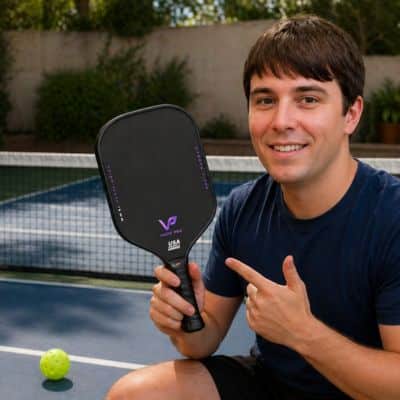
Dylan is a 4.5-rated pickleball player and gear writer who has tested 80+ paddles across 400+ hours on court. He rates spin, power, control, and forgiveness from real court time so you can buy smarter — no sponsored rankings, ever.