
Six Zero Black Opal Review: The Paddle I Keep Reaching For

Last Updated: October 2026 · 25+ hours court-tested · By Dylan, 4.5-rated tournament player
Disclosure: I bought this paddle with my own money, and no brand paid for this placement. As an Amazon Associate, I earn from qualifying purchases made through links on this page, at no extra cost to you, and commissions never change a score. See how I test paddles.
This Six Zero Black Opal review comes after more court time than almost anything else in my rotation this year: tiebreaker matches, drilling sessions, and the full profilometer testing I put every paddle through. It’s currently my #1 overall pick on BestPicklePad, and after 25+ hours with it, I still haven’t found a real reason to put it down. That doesn’t mean it’s for everyone (more on that below), but if you’re asking whether the Six Zero Black Opal lives up to the hype, the short answer is yes, with one real caveat on grip size.
Six Zero Black Opal Review: Quick Verdict
The Black Opal is the best all-court paddle I tested in 2026. The Diamond Tough carbon face held its grit longer than any standard raw carbon face I’ve run through my 25-hour profilometer test, and the 14mm G4 aerospace foam core gives you more kitchen dwell time than a core that thin has any right to deliver. The catch: it amplifies your swing, so players coming off a soft 16mm paddle will overhit for the first couple of sessions, and the 4.13″ grip circumference is narrow enough that big-handed players will want an overwrap from day one.
Who This Paddle Is For
This is a paddle for players who already have reasonably clean, consistent mechanics and want a single paddle that doesn’t force a trade-off between baseline pop and kitchen touch. If you’re a 3.5+ player who splits time between doubles and singles, or someone who’s outgrown a control-only paddle and wants more spin ceiling without giving up your soft game, the Black Opal is built for exactly that.
It’s not the right first paddle. If your depth control isn’t consistent yet, this paddle will expose that before it helps you. It rewards clean contact and doesn’t compensate for imprecise contact.
Six Zero Black Opal
Best All-Court Overall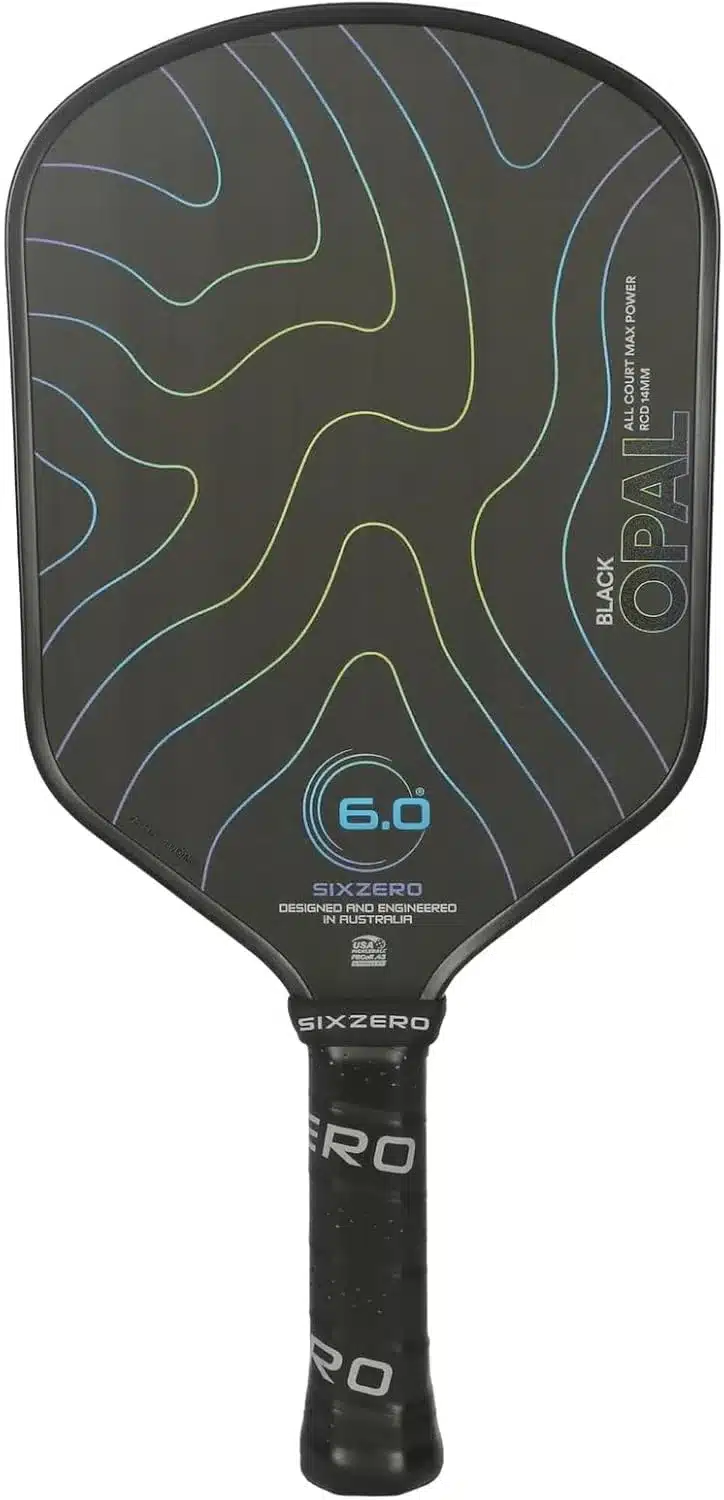
| Shape | Hybrid (16.3″ × 7.7″) |
| Weight | 8.0 oz |
| Grip Circumference | 4.13″ |
| Core Thickness | 14mm G4 Aerospace Floating Solid Foam |
| Face Material | Diamond Tough Raw Carbon Fiber |
| Spin Tier | Elite, highest grit retention I tested |
| Swing Feel | Balanced |
| Handle Length | 5.5″ Shock Shield Anti-Vibration |
| USAP Approved | Yes (Also UPA-A Approved) |
These are my ratings from on-court testing, not manufacturer numbers.
Dylan’s Rating (9.7) is the average of the four category scores above. Power 9.7, Control 9.5, Spin 9.8 and Forgiveness 9.7 add up to 38.7, which is 9.675 and rounds to 9.7 out of 10.
On-Court Performance
Dinks & Kitchen Play
This is where the 14mm core surprised me most. Floating solid foam construction gives you noticeably more dwell time at the net than a standard 14mm build. I wasn’t expecting a paddle this thin to hold up in extended dink rallies, but it did. Soft resets stayed low and predictable through my testing window.
Drives & Power Shots
Baseline drives come off this paddle with real pace. The G4 foam core delivers the explosive pop you’d expect from a thinner paddle, and it doesn’t feel like you’re sacrificing anything to get it. This is the half of the “all-court” promise that most paddles fail to deliver on. The Black Opal doesn’t.
Serves
Spin on serves is where the Diamond Tough face earns its name. It’s Six Zero’s proprietary surface treatment, and in my RPM testing it generated more consistent bite than any standard raw carbon face I measured this year, including paddles costing more.
Resets & Defense
Resets in the transition zone stayed controlled, which tracks with the dwell-time advantage from the foam core. I didn’t see the ball pop up under pressure the way it does on stiffer, more power-focused builds.
Feel, Pop & Power
The honest note here: this paddle amplifies your swing. Players coming from softer 16mm builds will overhit early. I did, for about two sessions, before I recalibrated my depth. Once you’ve adjusted, it’s hard to put down. This isn’t a flaw so much as a heads-up: budget a session or two before you judge the control ceiling.
Spin & Ball Contact
The Diamond Tough carbon face held its grit longer than any standard raw carbon face I’ve run through my 25-hour profilometer test. That matters more than it sounds. A standard raw carbon face loses 15–25% of its surface friction in the first 20–30 hours of hard play in my testing. If you’ve been frustrated by a paddle going slick after a month, this face construction is a real, measurable difference, not a marketing claim.
Swing Weight & Maneuverability
The balanced swing feel is what makes the all-court claim credible. It’s not head-heavy like the elongated power paddles I’ve tested, and it’s not so light that it feels underpowered on drives. It sits in a genuinely versatile middle, which is rarer than you’d think given how many paddles market themselves as “all-court.”
Grip & Comfort
This is the one real limitation. At 4.13″, the grip circumference is narrow. If you run large, budget for an overwrap before your first session. It’s a five-minute, low-cost fix, but it’s not optional for a lot of players. The 5.5″ Shock Shield handle does a good job dampening vibration on off-center contact, which helps offset the narrow grip somewhat.
Durability
I haven’t logged the year-plus hours it would take to speak to long-term durability with full confidence, but the Diamond Tough face showed no signs of the friction drop-off I’d expect from a standard carbon face at this point in testing. That’s a good early sign, not a guarantee.
Value for Money
This sits at flagship pricing, and it earns it, but it’s not the right paddle if budget is a real constraint. If you want a meaningful chunk of this paddle’s control profile without the price tag, the Vatic Pro Prism Flash gets you comparable control at a fraction of the cost. It won’t match the Black Opal’s spin ceiling or baseline pop, but it’s the honest budget alternative.
If you’re weighing this against other flagship-tier picks, I break down where it stands relative to the rest of the field in my guide to the best pickleball paddles for advanced players.
How It Compares
vs. Honolulu J2CR 16mm: The J2CR is the more forgiving, lower-cost all-court option, with a larger sweet spot from its 16mm foam core. The Black Opal has the higher spin ceiling and better long-term grit retention thanks to the Diamond Tough face, but it demands more consistent mechanics to unlock that advantage.
vs. CRBN TruFoam Genesis: Genesis is the better pick if you’re a pure control player who wants zero break-in period, and its honeycomb-free foam core is built for placement over pace. The Black Opal is the better all-court choice if you also want real baseline power without switching paddles for singles play.
Final Verdict
The short version of this Six Zero Black Opal review: if you want one paddle that genuinely does both ends of the court without forcing a compromise, this is the paddle I’d point you to first. It rewards players who already have some consistency in their swing, and it will expose the ones who don’t. That’s not a knock, it’s just who this paddle is built for. Skip it if you have large hands and don’t want to add an overwrap, or if you’re on a tight budget and don’t yet need the spin ceiling this paddle offers.
Buy if:
- You want elite spin with long-term grit retention, and the Diamond Tough face held its texture through 25+ hours of testing.
- You play both ends of the court and want genuine baseline pop alongside kitchen-level dwell time.
- You already commit fully to your swing, because clean, developing mechanics get rewarded with explosive pace and real net control.
Pass if:
- You have large hands, since the 4.13″ grip circumference is narrow; budget for an overwrap.
- You’re coming straight off a soft 16mm paddle, because this paddle amplifies your swing, and you’ll likely overhit for the first two sessions.
- Budget is a real constraint, so see the Vatic Pro Prism Flash for comparable control at a fraction of the price.
FAQs
Is the Six Zero Black Opal good for beginners?
No. This paddle rewards players who already have consistent mechanics, and beginners will find the swing amplification and narrow grip harder to manage than a widebody, forgiving beginner paddle.
What skill level is the Black Opal best for?
3.5 and up. It genuinely shines for 4.0+ players who want elite spin and all-court versatility without sacrificing baseline power.
Does the Black Opal come in different shapes?
The version tested here is the Hybrid shape (16.3″ × 7.7″), which is the configuration I’d recommend for most doubles-focused players.
How does the grip size compare to other paddles?
At 4.13″, it’s on the narrow side. Players with medium-to-large hands should plan on an aftermarket overwrap from the start rather than treating it as optional.
Is it worth the price over a budget alternative?
Only if you’re actually going to use the extra spin ceiling and baseline power. If you’re a control-first player on a budget, the Vatic Pro Prism Flash gets you most of the plush kitchen feel for a fraction of the cost.
What is Dylan’s Rating for the Six Zero Black Opal?
I rate it 9.7 out of 10, my highest score so far. That’s the average of four scores from my court testing: Power 9.7, Control 9.5, Spin 9.8 and Forgiveness 9.7. Control is the lowest of the four, mostly because the swing amplification takes a couple of sessions to settle.
Dylan is a 4.5-rated pickleball player and gear writer who has tested 80+ paddles across 400+ hours on court. He rates spin, power, control, and forgiveness from real court time so you can buy smarter — no sponsored rankings, ever.