
Diadem Warrior Edge vs. Warrior V2: Which Control Paddle Belongs in Your Bag?

If you ever played the original 19mm Diadem Warrior, you know the feeling — it soaked up heavy drives like a brick wall at the kitchen, but swinging it felt like lifting weights, and counter-attacks never had much snap to them. Diadem clearly heard the complaints, because they split the control paddle lineup in two: the Warrior Edge and the Warrior V2.
On paper, they look almost identical. Both come in an elongated 16.4-inch shape, both wear an etched raw carbon face, and both use the narrow 4.125-inch Taper Tech grip. But pick them up and rally with each for twenty minutes, and you’ll find they’re built for pretty different games — a reminder of just how much core thickness and paddle material can change the way two otherwise similar paddles feel in your hand.
Diadem Warrior Edge vs V2: The Short Answer
Grab the Warrior Edge if you want quick hands, standard 16mm feel, and a paddle that punches back with some pop when you get a ball to attack.
Grab the Warrior V2 if resets are your weak spot, you want drives to just die on your paddle face, you play a two-handed backhand, or your arm needs the extra cushion a 19mm core provides. If you’re still not sure which category fits your game, my breakdown of power vs. control paddles is a good place to start.
LAB BENCH BENCHMARKS


How They Actually Play
Touch, Dinks, and Resets
This is really where the two paddles part ways, and it comes down to the core.
The Edge runs a standard single 16mm polymer core, and it plays like it. Drop a dink or block a drive coming out of the transition zone and you feel it — sharp, honest feedback. Nothing about it does the work for you; you have to bring your own hands and control the pace yourself. In exchange, you get more say over exactly where the ball goes. If you lean toward 14mm and 16mm builds for that kind of feedback, the Edge will feel familiar fast.
The V2 is a different animal. It’s built around a thick 19mm sandwich core with an Aramid sheet tucked between layers of polypropylene honeycomb, and the ball practically sinks into the face on contact. Fire a hard drive at someone holding the V2, and it tends to drop dead just past the net rather than skipping through — the core just eats the pace. If resets have ever given you trouble, this is the paddle that quietly fixes a lot of that for you, and it’s worth checking out alongside my list of best control paddles if soft-game consistency is your main goal.
Speed at the Kitchen
Elongated shapes can get sluggish in a fast hands battle, and weight distribution is what saves — or sinks — a paddle here.
The Edge sits around 8.0 oz with an edged rim, and being a standard 16mm build, it cuts through the air with less resistance. The weight leans toward the handle, so resetting your paddle face between shots during a rapid-fire exchange feels almost effortless.
The V2 comes in a touch heavier, around 8.25 oz, and the 19mm profile is inherently bulkier. Diadem offsets that with a capped Liquid Carbon Fiber edgeless build to keep drag down, and it genuinely moves faster than the old V1 ever did. Still, in a true speed-up war at the net, the Edge gets there first.
Spin and Grip on the Ball
Neither paddle relies on spray-on grit — both use Diadem’s Etched Carbon Fiber surface, with the texture worked directly into the weave.
Drives, topspin rolls, heavy serves — both paddles hold their bite here, and neither seems to lose texture after weeks of regular play. Etched surfaces like this tend to be a big part of why certain paddles land on my best paddles for spin list, and they hold up better long-term than paint-on grit finishes.
Where the V2 edges ahead is on slice and soft dinks. The extra dwell time from that plush 19mm core, paired with the etched face, gives the ball just a fraction more time on the paddle — enough to shape a shot a little more deliberately. Pairing the right paddle with solid technique matters too — see my guide on increasing spin and control for more on that.
Handle Feel
The Edge keeps things classic with a 5.0-inch handle — great for a traditional one-handed grip, but two-handers will find themselves running out of real estate for the off-hand.
The V2 stretches that out to 5.3 inches, which is just enough room to get both hands on without your fingers crowding onto the throat.
Both share the same slim 4.125-inch Taper Tech grip circumference, which is worth noting — thick 19mm cores usually come with bulky, oversized handles, so keeping that slim feel on the V2 is a genuine win for Diadem.
Head-to-Head
| Metric | Warrior Edge | Warrior V2 | Winner |
|---|---|---|---|
| Absorbing hard drives | Firm, precise | Soaks up energy | V2 |
| Kitchen reload speed | Quick and nimble | Noticeably thicker in hand | Edge |
| Counter-attack pop | Clean exit speed | Pace gets dampened | Edge |
| Spin generation | Strong (etched carbon) | Strong, plus extra dwell time | Slight edge to V2 |
| Off-center stability | Standard sweet spot | Widened by the edgeless LCF rim | V2 |
| Two-handed backhand | Tight at 5.0″ | Roomier at 5.3″ | V2 |
So Which One Should You Buy?
Go with the Warrior Edge if you want a paddle that keeps up with fast hands at the net without slowing you down. You’ll feel every touch shot clearly, get back into position quickly, and have enough pop to put away a sitter when the chance comes. It’s a solid fit if you’re already comfortable at an intermediate or advanced level and want more feedback under your hand.
Go with the Warrior V2 if cutting down unforced errors matters more to you than raw speed. That 19mm multi-layer core takes the sting out of hard-hit balls, widens your margin for error off-center, and is noticeably easier on the joints. Two-handed backhand players and anyone chasing a plush, forgiving feel at the kitchen line will probably like this one better. Still weighing your options? My paddle decision matrix and general guide on how to choose a pickleball paddle can help narrow things down further.
FAQ
Is the Warrior V2 thermoformed?
No. It’s built with Diadem’s Liquid Carbon Fiber edge molding instead. The rim is reinforced for durability, but it plays soft and dampened rather than stiff and poppy the way thermoformed paddles usually do.
Does the V2 come with edge protection?
Yes — since it uses an edgeless perimeter, Diadem includes a strip of Paddle Armor tape to guard against court rash on low dinks. Keeping that edge tape intact is part of good paddle care and maintenance, especially if you play on rougher courts.
Which paddle is better if I’ve got elbow pain?
The Warrior V2. That 19mm core absorbs shock before it ever reaches your arm, which makes a real difference compared to a standard 14mm or 16mm setup.
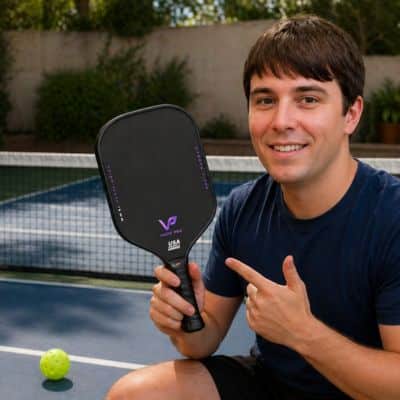
Dylan is a 4.5-rated pickleball player and gear writer who has tested 80+ paddles across 400+ hours on court. He rates spin, power, control, and forgiveness from real court time so you can buy smarter — no sponsored rankings, ever.