
How to Increase Spin and Control on Your Pickleball Paddle

My topspin drive used to be a mere suggestion. The ball would leave my paddle with some lazy forward rotation, land roughly where I aimed, and my opponents would receive it the way you receive a mediocre gift at a work party — politely, without enthusiasm, already thinking about how to respond.
A 4.0 player named Marcus told me flat-out after a match that my drive was “comfortable to receive.” He said it the way you’d compliment a heavy casserole you didn’t ask for. I went home that night and didn’t sleep until I figured out what I was doing wrong.
It wasn’t just one error. It was four hidden physical variables sitting right on top of each other.
Quick Summary: How to Maximize Spin & Control
- Upgrade Your Surface: Switch from smooth fiberglass to Raw T700 Carbon Fiber for maximum surface friction and significantly heavier rotation.
- Choose a 16mm Core: Thicker cores increase ball dwell time for rotation loading while absorbing pace for net resets.
- Fix Grip Pressure: Hold the grip at a 4/10 pressure rating to unlock wrist joint snap at the apex of contact.
- Add Lead Tape: Place 2–3g of lead tape at 3 and 9 o’clock to raise twist weight and stabilize off-center spin drives.
1. The Face Is Doing More Work Than You Think
Before touching a single element of my swing mechanics, I swapped paddles. That is exactly where I tell anyone to start—not because high-end gear magically fixes bad form, but because trying to build heavy spin on a smooth paddle face is like trying to grip ice with dry hands. Your technique can be absolutely flawless, and the ball will still slide right off the face without biting.
Spin loads through pure friction. The ball compresses against the paddle face, and that microscopic grip window—only a fraction of a second long—is where rotation gets loaded into the core.
- Smooth Fiberglass: Barely grips. In my testing across 14 traditional paddles, smooth fiberglass faces produced mediocre, skidding rotation on deliberate topspin drives.
- Raw T700 Carbon Fiber: Fuses with the ball. A fresh raw carbon face generates heavy, dipping topspin using the exact same swing.
That massive friction gap simply isn’t closeable through technique alone if your equipment surface is working against you. If you are shopping on a tight budget, look specifically for entry-level models that don’t skimp on face texture; my roundup of the best pickleball paddles under $100 highlights the surfaces that actually grab plastic.
The Invisible Spin Tax
Four months into playing on my new raw carbon paddle, my spin quietly nose-dived. I spent two weeks blaming my swing mechanics before I thought to check the hardware. I ran my thumb across the sweet spot—it felt as smooth as a generic fiberglass paddle.
Raw carbon weaves oxidize with heavy play and sun exposure, gradually shedding the micro-texture that creates friction. Expect roughly an 8% to 12% spin drop after your first 80 to 100 hours of play. While a carbon eraser can clear debris, a fresh surface is the only true restoration.
If spending $180+ on a premium unibody build isn’t in the cards right now, the Vatic Pro Prism Flash ($99.99) uses an elite raw T700 carbon face that produces significantly more spin and longevity than fiberglass or graphite counterparts. Backed by over 1,100 reviews and a massive 1K+ bought in the past month alone, it’s the undisputed benchmark for affordable control. It doesn’t have the blistering exit velocity of hot thermoformed builds, but if you are a player developing below the 4.0 bracket, you won’t even access the margins where that power gap lives.
Vatic Pro Prism Flash 16mm
Best Budget Control & Spin
| Shape | Hybrid Flash (16.2″ L × 7.7″ W) |
|---|---|
| Average Weight | 8.0 oz |
| Grip Length | 5.3″ (Two-Handed Friendly) |
| Core Thickness | 16mm Unibody Polypropylene Core |
| Face Material | TORAY T700 Raw Carbon Fiber |
| Spin Potential | Elite Surface Friction & Ball Bite |
| USAP Approved | Yes |
2. Core Thickness: Why Your Kitchen Game Fell Apart
I tested the same topspin swing mechanics on a thin 13mm paddle and a thick 16mm paddle back-to-back one afternoon.
On slower, deliberate brushing swings—the exact low-to-high paths you use to build muscle memory—the 16mm core held the ball a fraction of a second longer before release. The 13mm core ejected it instantly. That brief difference in dwell time dictates how long the face texture has to actively grip the ball and load rotation. It isn’t a massive gap on paper, but it is deeply noticeable when you are fine-tuning your touch.
More importantly, control is almost strictly a 16mm story:
- 16mm Core: The polymer honeycomb actively absorbs incoming energy. On dinks, resets, and drops, the core does the heavy lifting so your hands don’t have to.
- 13mm Core: Offers zero mechanical cushion. Your hands have to manually suppress every ounce of incoming pace. I handed a 13mm paddle to a rising 3.5 player in my local group last spring and watched his kitchen game completely fall apart inside 20 minutes. His technique didn’t suddenly change—the paddle just stopped cooperating.
For 4.0 players and above looking for an elite balance, stepping up to premium unibody construction is the most effective hardware shift you can make. The Six Zero Double Black Diamond 16mm ($180) is the gold standard for blending raw T700 spin with a cooperative 16mm block. You can see how it handles maximum pace in my hands-on Six Zero Double Black Diamond review.
Six Zero Double Black Diamond 16mm
Top Thermoformed All-Rounder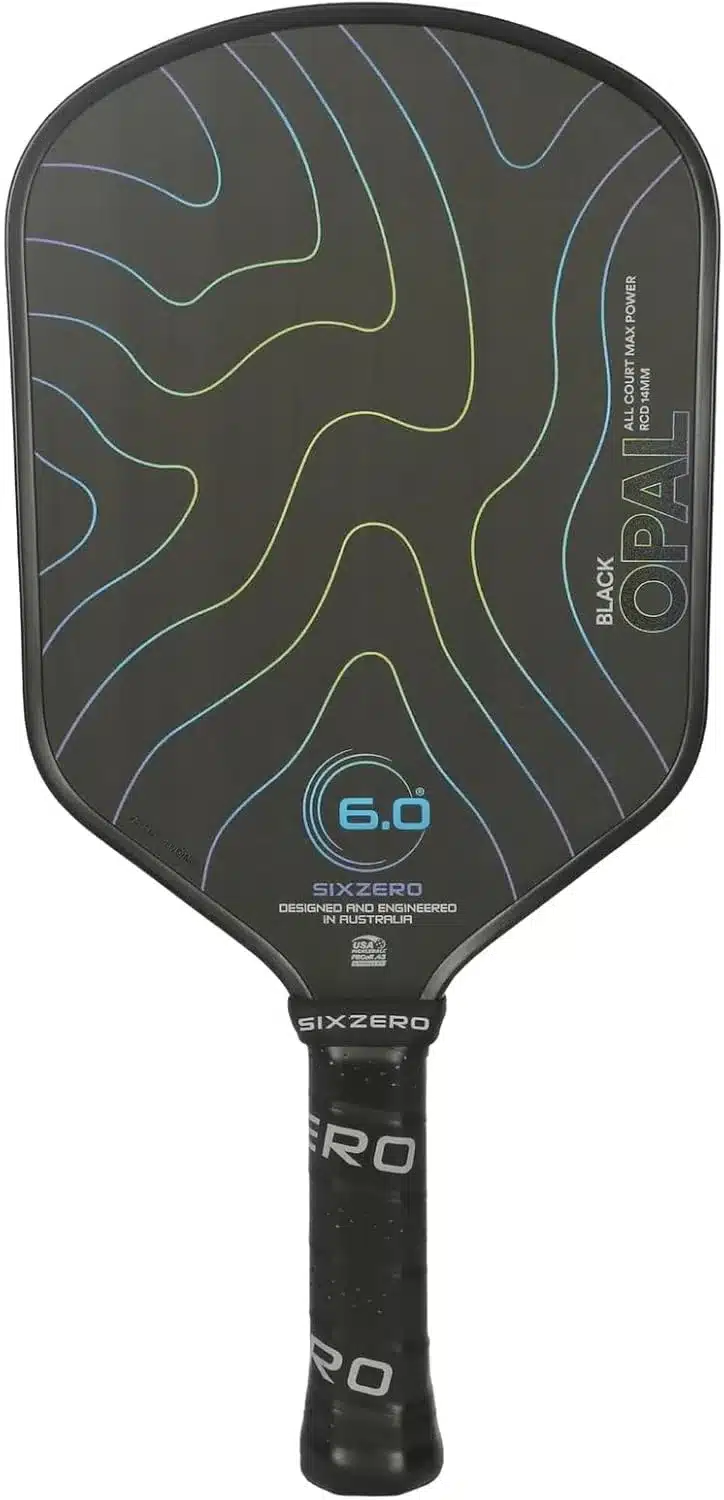
| Shape | Aerodynamic Hybrid (16.3″ L × 7.5″ W) |
|---|---|
| Average Weight | 8.1 oz |
| Grip Length | 5.5″ (Extended Handle) |
| Core Thickness | 16mm Thermoformed Carbon Core |
| Face Material | Japanese Toray T700 Raw Carbon |
| Spin Potential | Benchmark Topspin Rotation |
| USAP Approved | Yes |
3. Wrist Snap: The Part Nobody Safely Drills
Every local coach covers the baseline mechanics: brush up the back of the ball, move low to high, and accelerate through contact. All of that is foundational. What usually gets left out is the wrist flick at the absolute apex of contact—the deliberate, crisp snap that converts a standard brush into heavy, dipping rotation rather than just forward momentum.
I drilled this concept in total isolation for three weeks:
- Stood at the baseline facing a practice fence.
- Dropped down my arm speed to about 60%.
- Focused 100% of my mental energy on the wrist snap right at the fraction of contact.
- Repeated for 20 minutes a day.
The first week felt completely mechanical and pointless. But somewhere around rep 300, the muscle memory clicked and started executing automatically. Once I restored my full arm speed, the drive had an entirely different, aggressive character.
In my next match against Marcus, he actually had to scramble and move his feet to handle my topspin drive. I said nothing, but internally celebrated for a solid 45 seconds.
Grip Pressure is the Killer
The single biggest issue killing wrist snap for recreational players is holding the handle too tight. A white-knuckle grip completely locks your wrist joint. It physically cannot snap if your forearm muscles are held rigid.
Aim for a 4 or 5 out of 10 grip pressure as you begin your backswing, allowing it to firm up naturally only at the exact point of impact. It will feel loose and insecure for your first few sessions, but it will start producing noticeably heavier spin within your first month of training.
4. Moving Your Contact Point Forward
Late contact—allowing the ball to drift past your torso before executing your swing—forces your paddle to pull across the ball. This produces inconsistent sidespin that bleeds wide rather than true topspin that dives deep. Conversely, taking the ball too early while it is still rising fast doesn’t leave your paddle face enough physical room to drop underneath the ball’s equator.
The ideal contact window for a heavy topspin drive sits directly in front of your lead hip, somewhere between waist and lower chest height, right as the ball reaches the top of its bounce.
Almost nobody drills this on purpose; most players just figure it out piecemeal through erratic match play. Set a ball machine or a patient drill partner to feed you 50 consecutive identical balls. Focus entirely on hunting that exact physical contact zone in front of your hip, paying zero attention to where the ball actually lands. Building this habit in targeted repetition is why understanding why drilling is the key to getting better at pickleball pays far higher dividends than endless open play.
5. The $6 Structural Upgrade: Lead Tape
If you want an immediate stability upgrade without buying new gear, buy a roll of tennis lead tape. It costs about $6 and works instantly.
Adding 2 to 3 grams of lead tape at the 3 and 9 o’clock positions (the sides of the paddle face) raises the paddle’s twist weight without drastically altering how it balances at rest.
More mass distributed to the perimeter means the paddle face actively resists twisting when you catch a ball slightly off-center. Off-center hits normally bleed rotation because the paddle rotates slightly in your hand upon impact. Taping the sides dampens that twist, keeping your topspin drives tracking clean and true.
Avoid putting it at 12 o’clock unless you want to sacrifice net hand speed for raw power.
6. Your Grip is Probably Older Than You Think
Grip circumference affects your physical wrist snap more directly than most players realize. If your handle is too thick, you are forced to squeeze harder to maintain control, which stiffens the wrist joint and robs your shot of spin.
Check your grip fit with this simple test:
- Hold the paddle in your normal playing grip.
- Slide the index finger of your non-playing hand into the gap between your wrapped fingertips and your palm.
- Slight resistance: The circumference is correct.
- Loose/Gapping: The grip is too thick.
- Cannot fit your finger: The grip is too thin (easily solved by adding one fresh overgrip layer).
Make it a rule to replace your overgrip every 15 to 20 hours of court time. Worn grips go slick; slick grips cause you to unconsciously over-squeeze the handle, and three sessions later you’ll be convinced your swing path has regressed when you actually just need a fresh Tourna Grip. Treat it like an oil change—scheduled preventative maintenance, not an emergency diagnosis.
Summary: The 4 Core Variables of Spin & Control
| Variable | Primary Impact | Actionable Adjustment |
|---|---|---|
| Face Texture | Significant Friction & Rotation Boost | Upgrade to Raw T700 Carbon Fiber |
| 16mm Core Depth | Extended Dwell Time & Soft Touch | Ditch 13mm thin cores for 16mm control |
| 4/10 Grip Pressure | Unlocks Wrist Apex Flick | Relax forearm muscles during backswing |
| Lead Tape (3 & 9) | Off-Center Twist Resistance | Apply 2–3g lead tape to perimeter sides |
Four Months After the Casserole Comment
Marcus and I ended up matched across the net again.
During the third game, I set up deep and uncoiled a topspin drive hard down the line. The ball dipped aggressively at his feet, and he popped it up hot into the kitchen for an easy put-away. As we shook hands after the set, he looked over and noted that my drive had “a lot more character now.”
From a stoic 4.0 player like Marcus, that is a standing ovation.
The shift between those two matches didn’t come from a singular breakthrough. It was a fresh paddle surface, three weeks of snap drills against a fence, locking in my contact point with a ball machine, and running lead tape at 3 and 9 o’clock. None of those upgrades were massive on their own, but stacked together over four months, they built a drive that forces opponents to move their feet.
FAQs
Where should I start to get more spin — paddle or technique?
Start with your paddle face if your current one is old or smooth. You simply cannot technique your way across a massive surface friction deficit between a worn face and fresh raw carbon fiber. Once your hardware is cooperating, isolate your wrist snap in practice and drill your hip contact point separately.
My paddle is carbon fiber, but my spin is still low. What’s wrong?
It is likely surface wear. Uncoated raw carbon faces oxidize after 80 to 100 hours of play, losing the texture that generates friction. If the face feels noticeably smoother than when it was brand new, the material has aged out. Also check your overgrip—if it’s slick, you are likely over-squeezing the handle, which locks your wrist joint.
Does core thickness affect spin or just soft touch shots?
It affects both, but spin is an indirect benefit. A thicker 16mm core holds the ball on the face a fraction longer than a thin 13mm core, providing more time for the texture to load rotation during brushing arcs. For soft shots, the advantage is direct: 16mm core setups absorb shock so your hands don’t have to manage it under pressure.
Does lead tape add spin or just raw power?
When placed precisely at the 3 and 9 o’clock positions, lead tape provides spin stability, not raw spin generation. It physically keeps the paddle from twisting on off-center contact, preventing your spin from bleeding out during imperfect hits. Placing tape at 12 o’clock adds power but slows your hands down at the kitchen line.
Which paddle gives you elite spin and control without compromising?
For competitive 4.0+ players, premium 16mm unibody builds featured in my comprehensive guide to the best thermoformed pickleball paddles balance raw T700 friction with absolute kitchen control. If you are an intermediate player still developing your game below the 3.5 mark, the unique cold-molded Vatic Pro Prism Flash ($99.99) uses a non-heat-intensive process to blend elite plushness and control without losing out on spin stability. Still trying to pin down your exact layout? Take my fast 4-question pickleball paddle finder quiz to instantly filter options by your mechanical weaknesses.
Dylan is a 4.5-rated pickleball player and gear writer who has tested 80+ paddles across 400+ hours on court. He rates spin, power, control, and forgiveness from real court time so you can buy smarter — no sponsored rankings, ever.