
Best Six Zero Pickleball Paddles: Tested & Rated (2026)

Last Updated: October, 2026 · 400+ hours testing 80+ paddles · By Dylan, 4.5-rated player
Quick Answer: The best Six Zero pickleball paddle overall is the Six Zero Black Opal (rated 9.7/10) because its 14mm foam core provides the fastest ball acceleration in the lineup. However, the best Six Zero paddle for most players is the Double Black Diamond 16mm, which offers a massive sweet spot and elite spin for 3.5-4.5 players.
- Best Overall Power: Black Opal (14mm Foam Core)
- Best All-Court Spin: Double Black Diamond 16mm (Raw Carbon)
- Best for Arm Comfort: Six Zero Ruby (Kevlar Face)
- Best for Kitchen Speed: Infinity DBD (Edgeless)
- Best Value & Beginners: Six Zero Quartz (Widebody)
How I tested: 18+ hours of on-court play with these five Six Zero models across multiple sessions: dinks, drives, drops, serves, and kitchen exchanges. Every paddle here was bought at retail with my own money and put through rigorous wear-testing through late 2026. My ratings come from real match play cross-checked with 3.0–5.0 players. You can verify my level on my DUPR profile, and read the full method in how I test pickleball paddles.
Six Zero’s lineup looks simple until you’re the one choosing. This guide covers five models (six versions, counting both Double Black Diamond thicknesses), and the wrong pick means a frame that fights your swing. Every paddle here was bought at retail with my own money, with no samples, no sponsorships, and nothing back from Six Zero.
Still comparing brands? My guide to the best pickleball paddles covers the full field. This page assumes you’ve landed on Six Zero and need the right model.
The Double Black Diamond 16mm is my pick for most players, but it isn’t the only answer. If you drive the ball hard, deal with arm discomfort, or aren’t ready to spend on a first carbon fiber paddle, the rest of the lineup has a specific answer for each.
What Six Zero Gets Right, and What I’d Watch
- Shape: Six Zero lists a 16.3-inch length on its hybrid models. In my testing, that gave me extra reach over a standard wide-body without costing me hand speed at the kitchen line.
- Thermoformed build: The premium models fuse the face to the honeycomb core with heat. On my off-center edge hits, they stayed stable and kept balls in play. The Quartz is the one paddle here that skips thermoforming.
- Build quality, and what I’ve seen: I can only speak to my own units. Every paddle here was bought at retail in 2026, and none has shown face or core problems over regular play. If you’re buying used or older stock, check the face edges and tap for hollow spots.
How I Tested
I tested these paddles on indoor and outdoor courts with fresh Franklin X-40 balls, using real match play and drilling sessions instead of just warm-up rallies. Here is what I looked at for each one.
- Spin: I measure it with my spin-testing tool and report it as a tier (Elite or High) instead of a raw number, then confirm it on court with baseline drives and roll volleys.
- Swing Feel: Tested during fast kitchen hand battles and baseline rallies to judge maneuverability against driving leverage.
- Sweet Spot: Mapped across off-center edge contacts to see how much power and stability each paddle keeps on mishits.
Best Six Zero Pickleball Paddles: Quick Comparison
This table is ordered by who each paddle suits, not by rating.
The “View on Amazon” buttons on this page are affiliate links. I buy every paddle with my own money, and commissions never change a score. Prices change, so check the current price on Amazon. Details here.
| Product | Recommendation | Tech Specs | Dylan’s Rating | Shop |
|---|---|---|---|---|
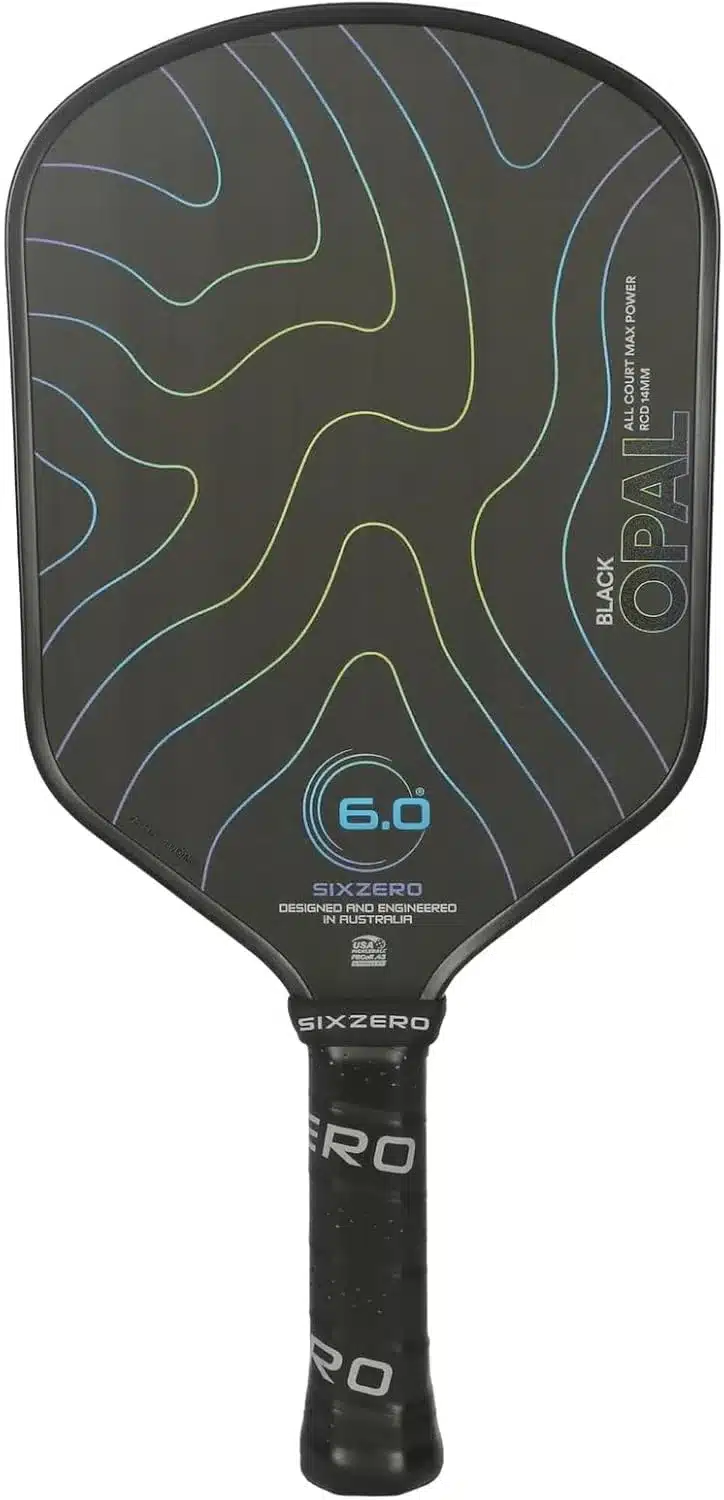 Black Opal (Foam Core) |
Best For Power Players | 14mm / 8.1 oz / G4 Foam Core Diamond Carbon + Shock Shield High-Velocity Energy Return Grip: 5.5″ / 4.125″ |
9.7 |
View on Amazon |
 Double Black Diamond (16mm) TOP PICK |
Best All-Court | Hybrid / 16mm / 8.1 oz Toray T700 Raw Carbon Elite Spin Tier · Expanded Sweet Spot Grip: 5.5″ / 4.5″ |
9.2 |
View on Amazon |
 Six Zero Ruby |
Best For Arm Comfort | Hybrid / 16mm / 8.2 oz 100% DuPont™ Kevlar® Face Elite Spin Tier · Plush Cushion Grip: 5.5″ / 4.25″ |
9.0 |
View on Amazon |
 Double Black Diamond (14mm) |
Best For Hand Speed | Hybrid / 14mm / 8.1 oz Toray T700 Raw Carbon Elite Spin Tier · Fast Net Speed Grip: 5.5″ / 4.5″ |
n/a |
View on Amazon |
 Infinity DBD (Edgeless) |
Best For Kitchen Speed | Edgeless / 16mm / 8.2 oz Toray Raw Composite Elite Spin Tier · Nimble Handling Grip: 5.5″ / 4.125–4.25″ |
8.8 |
View on Amazon |
 Quartz (Entry Premium) BEST VALUE |
Best Value / Beginners | Wide-Body / 15mm / 7.9 oz Japanese Raw Carbon Face Forgiving Sweet Spot · 5.0″ Grip |
8.6 |
View on Amazon |
Tech specs (face material, core, weight) are manufacturer-listed; ratings and spin tiers are from my court testing. Each overall rating is the average of the four category scores (power, control, spin, forgiveness) shown under each paddle below. The 14mm Double Black Diamond shares the 16mm’s card and isn’t scored separately.
How to Choose the Right Six Zero Paddle
- Thickness: 16mm is more forgiving and softer on touch shots. 14mm is quicker at the net but punishes mishits. Start with 16mm.
- Face: Raw carbon (Double Black Diamond, Infinity DBD) feels crisp. Kevlar (Ruby) feels softer and more muted. The Black Opal’s foam core is the most powerful paddle in the lineup, and it scored 9.7 for forgiveness in my testing.
- Handle: If you hit a two-handed backhand, the 5.5″ handles on the premium models give you room. The Quartz’s 5.0″ handle is tight.
- Level: Under 3.5, start with the Quartz. At 3.5–4.5 and want a plush 16mm feel, the Double Black Diamond 16mm. If you want the highest-rated Six Zero and can hit with pace, the Black Opal. If spin is your priority across brands, see my best pickleball paddles for spin, and for how Six Zero’s build compares with other brands, my best thermoformed pickleball paddles.
Best Six Zero Pickleball Paddles: A Closer Look
Six Zero Double Black Diamond 16mm (Control) vs. 14mm
Best All-Court · 16mm for most players · 14mm for 4.5+
| Specification | 16mm Version | 14mm Version |
|---|---|---|
| Face Material | Toray T700 Raw Carbon | Toray T700 Raw Carbon |
| Core | 16mm Honeycomb | 14mm Honeycomb |
| Swing Feel | Balanced Driving Feel | Nimble Handling |
| Sweet Spot | Noticeably Larger | Slightly Tighter |
| Mishit Forgiveness | High | Moderate |
| Static Weight | 8.1 oz (Standard Edition) | 8.1 oz (Standard Edition) |
| Grip Length | 5.5″ | 5.5″ |
| Spin Potential | Elite Tier | Elite Tier |
Same paddle, two thicknesses. Spin potential is identical and lands in the top Elite Spin Tier of everything I’ve run through my testing setup. The face is the same Toray T700, so what you’re actually choosing between is sweet spot size and swing feel.
For most people reading this, get the 16mm. It keeps more balls in play when contact isn’t perfect, which is the margin most 3.5–4.0 players still need on off-center edge hits.
The 5.5-inch handle is longer than most paddles I’ve tested, so two-handed backhand players have room to work. At 8.1 oz, it carries a balanced driving swing feel.
The 14mm is a different conversation. It’s faster and snappier at the net, and advanced 4.5+ players who hit the center of the face consistently often prefer it for kitchen exchanges. Players below 4.5 will find the tighter sweet spot more demanding.
For my long-term wear notes on this paddle, read my dedicated Six Zero Double Black Diamond review.
Buy if:
You are a 3.5–4.5 player who wants a “do-it-all” paddle that balances elite-tier raw carbon spin with controlled thermoformed power.
You need extra handle room; the 5.5″ elongated grip gives a two-handed backhand space to move.
You want the 16mm core’s larger sweet spot, which kept energy transfer and stability on my off-center edge hits.
Pass if:
You prioritize explosive put-away pop over a plush 16mm feel; the Black Opal offers higher exit velocity on drives.
You want an ultra-light setup; at 8.1 oz with a balanced swing feel, it may feel slightly head-heavy if you prefer sub-7.8 oz paddles.
You prefer a muted, cushioned impact; the Ruby’s Kevlar face feels softer at contact than the DBD’s crisp carbon response.
Six Zero Ruby
Best For Arm Comfort · Kevlar Face · Spin Longevity
| Attribute | Six Zero Ruby | DBD 16mm (vs) |
|---|---|---|
| Face Material | 100% DuPont Aramid (Kevlar) | Toray T700 Raw Carbon |
| Face Feel | Plush, muted — ball sinks in | Crisp, immediate feedback |
| Swing Feel | Nimble & Controlled | Balanced Driving Feel (16mm) |
| Sweet Spot Profile | Expanded / Joint-Friendly | Expanded Sweet Spot |
| Static Weight | 8.2 oz | 8.1 oz |
| Grip Specs | 5.5″ / 4.25″ | 5.5″ / 4.5″ |
| Spin Potential | Elite Spin Tier | Elite Spin Tier |
| Surface Wear Resistance | Very High (Kevlar) | High (Raw Carbon) |
The Ruby is the first paddle I mention when someone brings up tennis elbow. Its textured Kevlar face handles impact differently from raw carbon: the ball sinks into the surface before it leaves, and in my testing that took the harsh shock off the handle and out of my arm.
In my wear tracking, the aramid face held its surface texture without smoothing out quickly. Spin lands in the same Elite Spin Tier as the DBD.
The real difference is feel. Carbon gives a crisp, immediate ping, while Kevlar feels plush and muted with a longer dwell time. If joint comfort is a priority, the Ruby is the one I’d try first. I’m not a doctor and no paddle treats an injury, so if pain persists, see a professional.
You won’t know which camp you’re in until you try both. If arm discomfort is part of your game, the Ruby is worth trying over the DBD. If it isn’t, the DBD’s crisper feel is probably the better fit. Stuck between the two flagships? Read my Six Zero Double Black Diamond vs Ruby head-to-head.
Buy if:
You want a soft, cushioned feel at contact; the ball pockets into the face, which gave me clear feedback on delicate third-shot drops.
You deal with tennis elbow or joint sensitivity; in my testing the Kevlar face felt noticeably softer at contact than stiff carbon.
You want elite spin that lasts; the textured Kevlar kept its surface grit longer in my wear tracking.
Pass if:
You prefer a stiff, immediate ping off the face; the Ruby’s muted feel can seem disconnected if you’re used to carbon.
You want an ultra-light net weapon; the 8.2 oz static weight carries a solid, plush presence rather than a featherlight feel.
You don’t have arm or elbow issues; the DBD 16mm gives you similar all-court versatility with a crisper carbon feel.
Six Zero Infinity DBD (Edgeless)
Best For Kitchen Speed · 4.0+ Consistent Ball-Strikers
| Attribute | Infinity DBD | Standard DBD 16mm |
|---|---|---|
| Face Material | Japanese Toray Raw Composite | Toray T700 Raw Carbon |
| Edge Design | Edgeless (carbon layup perimeter) | Standard edge guard |
| Swing Feel | Ultra-Light & Nimble | Balanced Driving Feel |
| Kitchen Reaction Time | Enhanced Net Quickness | Baseline Standard |
| Sweet Spot Profile | Focused (Edgeless) | Expanded Sweet Spot |
| Perimeter Power Retention | High Energy Rebound | Maximum Stability |
| Static Weight | 8.2 oz | 8.1 oz |
| Grip Specs | 5.5″ / 4.125–4.25″ | 5.5″ / 4.5″ |
| Spin Potential | Elite Spin Tier | Elite Spin Tier |
Six Zero took the DBD, pulled the traditional edge guard off, and wrapped the perimeter in layered carbon fiber. The result is an ultra-light, aerodynamic swing that cut through the air noticeably faster during rapid non-volley zone exchanges.
That gives quick-twitch net players a real speed advantage in reflex battles. The trade-off is that removing the perimeter guard narrows the sweet spot compared to the standard 16mm DBD. Consistent ball-strikers won’t mind, but developing players will miss the edge stability.
Buy if:
You prioritize fast reaction time at the net; the edgeless perimeter gives an ultra-light, aerodynamic swing feel.
You are a 4.0+ player who hits the sweet spot consistently and wants precise maneuverability without edge guard bulk.
You like customizing paddle weight; the smooth edgeless perimeter makes placing lead tape at your exact balance points easy.
Pass if:
You are below the 4.0 level; the narrower sweet spot and lack of edge weighting make off-center hits noticeably more punishing.
You rely on heavy perimeter forgiveness to absorb hard drives; the standard DBD 16mm is more stable on resets.
You want the most forgiving all-court option; the standard DBD 16mm gives you a bigger sweet spot, so skip the edgeless build unless net quickness is what you’re buying.
Six Zero Black Opal
Best For Power Players · 4.5+ Only · Foam Core
| Attribute | Specification |
|---|---|
| Face Material | Diamond Tough Raw Carbon Fiber |
| Core | 14mm G4 Aerospace Foam + Power Gel layer |
| Handle | Shock Shield — silicone injection, reduces arm vibration |
| Static Weight | 8.1 oz (listed range 8.0–8.3 oz) |
| Grip (Length / Circumference) | 5.5″ / 4.125″ |
| Tournament Approval | Verify the exact model on the USA Pickleball approved list |
| Skip If | Still building consistency — the margin for error is small |
Instead of traditional polypropylene honeycomb, the Black Opal uses a solid G4 Aerospace foam core. The energy transfer feels dense and immediate, and ball acceleration on hard drives and overheads was the fastest of any paddle in this lineup.
The Diamond Tough carbon face held its surface texture well over extended play, and the silicone-injected Shock Shield handle took the edge off harsh frame feedback.
This is the highest-rated paddle in the lineup, and it fits players who win points on pace. I scored it 9.7 for forgiveness, so it isn’t as unforgiving as foam-core power paddles usually are. The trade-off is feel: the firm, dense response is less plush than the DBD 16mm on soft kitchen touch shots. For my full breakdown, read my Six Zero Black Opal review, and see my best pickleball paddles for advanced players for how it stacks up against other power paddles.
Buy if:
You want maximum ball acceleration; the G4 Aerospace Foam core and 14mm profile generate explosive put-away speed on drives.
You want a fast power paddle without arm strain; the Shock Shield handle’s silicone injection dampens frame shock.
You want elite spin that holds up over time; the Diamond Tough carbon face kept its raw surface friction through heavy play.
Pass if:
You prioritize long dink rallies; the energetic exit speed of the foam core can feel pop-heavy at the kitchen line.
You want a soft, cushioned feel on kitchen touch shots; the firm 14mm foam construction feels denser than the DBD 16mm.
You want the plushest possible feel while you build your game; the DBD 16mm is softer on touch shots.
Six Zero Quartz
Best Value · Real Carbon Face · 2.5–3.5
| Attribute | Specification |
|---|---|
| Face Material | Japanese Raw Carbon Fiber |
| Core | 15mm Polypropylene Honeycomb |
| Construction | Non-thermoformed |
| Shape | Wide Body — 16″ × 7.9″ |
| Static Weight | 7.9 oz ± 10g |
| Grip Length | 5.0″ (short — tight for two-handers) |
| Grip Size | 4.25″ |
| Colors | Amethyst, Rose, Smoky, Citrine, Prasiolite, White |
| Skip If | Above 4.0, drive-heavy, or use a two-handed backhand |
The Quartz surprised me for an entry-level paddle. It has a real Japanese raw carbon face, a forgiving 15mm honeycomb core, and a widebody shape that gives developing players more hitting surface.
At 7.9 oz, it swings light and comfortable. It skips thermoforming and the 5.5-inch handle of the premium models, and that’s the trade-off you feel on harder drives. For 2.5–3.5 players who want a forgiving, control-first paddle to build consistency, it’s strong value. Comparing starter options? See my best pickleball paddles for beginners and best budget pickleball paddles.
Buy if:
You want a quality first carbon paddle with a widebody shape and a forgiving 15mm core to build court consistency.
You prioritize dinks, drops, and resets; the generous hitting area and raw carbon face gave me clean feedback and soft touch.
You want genuine Japanese raw carbon without stepping up to the flagship models, plus multiple colorway options.
Pass if:
You use a two-handed grip; the 5.0″ handle is short next to the 5.5″ handle on the DBD series.
You rely on baseline pace and hard overheads; the non-thermoformed widebody build favors touch over raw pop.
You need maximum thermoformed stability and perimeter mass to handle high-velocity tournament exchanges.
Six Zero Spec Comparison
| Model | Spin Potential | Swing Feel | Sweet Spot Profile | Static Weight |
| DBD 16mm | Elite Spin Tier | Balanced Driving Feel | Expanded / Highly Forgiving | 8.1 oz |
| DBD 14mm | Elite Spin Tier | Nimble Handling | Focused / Fast Rebound | 8.1 oz |
| Ruby | Elite Spin Tier | Nimble & Controlled | Expanded / Joint-Friendly | 8.2 oz |
| Infinity DBD | Elite Spin Tier | Ultra-Light Net Speed | Precision / Low Drag | 8.2 oz |
| Black Opal | Elite Spin Tier | Firm Power Feel | Forgiving for a Power Paddle | 8.1 oz |
| Quartz | High Spin Tier | Light & Forgiving | Widebody / Generous | 7.9 oz |
DBD weights above are the Standard Edition. A lighter edition exists, and I cover it in my Six Zero Double Black Diamond review.
Who Gets What
- All-court 3.5–4.5 (want a paddle that handles the whole game): Double Black Diamond 16mm. Done.
- Arm or elbow issues: Ruby first. If you also want power and your concern is more handle feedback than face stiffness, look at the Black Opal’s Shock Shield handle.
- Net specialist (consistent contact, need every edge at the kitchen): Infinity DBD.
- 4.5+ drive-first player (want the best power weapon in the lineup): Black Opal. Expect a firmer, denser feel than the plush DBD 16mm on soft shots.
- New player or not ready to make a big investment yet: Quartz. It doesn’t feel like a budget paddle, it builds real spin habits, and when you outgrow it you’ll know exactly why.
- 4.5+ with solid fundamentals (want that faster snap at the net): DBD 14mm. But try the 16mm first. It’s rare for a player to step down in thickness and not miss the forgiveness.
Final Verdict
If you want the highest-rated Six Zero, buy the Black Opal: it scored 9.7/10 on my four-score average, with 9.8 for spin and 9.7 for both power and forgiveness. If you’d rather have a plush 16mm feel, the Six Zero Double Black Diamond 16mm is my pick for 3.5–4.5 players who want elite spin and a large sweet spot.
If joint health or arm fatigue is your main concern, try the Six Zero Ruby for its cushioned Kevlar feel. Net specialists will appreciate the speed of the edgeless Infinity DBD, and newer players can start with the Quartz. Pick the frame that matches your actual swing, not just its spec sheet.
Still weighing brands? See how the big two compare in my JOOLA vs Selkirk breakdown, or check my best pickleball paddles for advanced players if you’re a 4.5+ player comparing power options.
FAQs
Which Six Zero paddle is best?
The Black Opal is the highest-rated on my scores (9.7/10). If you prefer a plush 16mm feel, the Double Black Diamond 16mm pairs elite spin with a large, forgiving sweet spot and suits 3.5–4.5 players. Choose the Ruby for arm comfort and the Quartz if you’re new to the game.
Is the Six Zero Double Black Diamond worth it?
For 3.5–4.5 players who want one all-court paddle, yes. The 16mm gave me elite spin and a large sweet spot. If you’re below 3.5, the Quartz builds the same habits with a simpler paddle. My Six Zero Double Black Diamond review has the full breakdown.
Which Six Zero paddle is best for tennis elbow?
The Ruby is the one I’d try first. Its Kevlar face felt softer and more muted at contact than carbon. I’m not a doctor and no paddle treats an injury, so if pain persists, see a professional.
Which Six Zero paddle has the most spin?
The Black Opal scored highest for spin in my testing (9.8/10). The Double Black Diamond, Ruby, and Infinity DBD are close behind at 9.5/10. All four land in my top Elite Spin Tier. The Quartz sits one step lower, in the High Spin Tier.
14mm or 16mm core thickness?
16mm for most people. It’s softer, more forgiving, and gives better touch on soft kitchen shots. The 14mm offers a faster, snappier swing feel but punishes off-center contact harder. Start with 16mm, and step down to 14mm only if you’ve been playing a while and specifically want extra net quickness. For more on thickness, read my breakdown of whether pro pickleball players use 14mm or 16mm paddles.
How does Six Zero compare to JOOLA and Selkirk?
Six Zero competes in the same tour-level tier as JOOLA and Selkirk. In my testing the DBD 16mm held up well against the JOOLA Hyperion CFS, and you can read the details in my JOOLA Hyperion CFS 16mm review. Torn between the two big brands instead? See my JOOLA vs Selkirk comparison, or my ranking of the best pickleball paddles for the full field.
Are Six Zero paddles approved for tournaments?
Approval is listed model by model, and the list changes. Before a sanctioned tournament, check the exact paddle on the current USA Pickleball approved paddle list instead of assuming a whole product line is covered.
Black Diamond vs. Double Black Diamond — what’s the difference?
The original Black Diamond isn’t one of the paddles in this guide, so I won’t compare feel. The Double Black Diamond uses a pure Toray T700 raw carbon face, which is why its spin and control rate so highly in my testing. If put-away power is your priority, the Black Opal is the power option in this lineup.
What is the best Six Zero paddle for beginners?
The Six Zero Quartz. It has a real Japanese raw carbon face and a forgiving widebody shape at an entry-level price point. The DBD 16mm is the better paddle overall, but it’s more than most new players need. Start with the Quartz, build your rating up to 3.5, and upgrade when the paddle starts to feel like your limiting factor.
How do you rate Six Zero paddles?
I score each paddle out of 10 for power, control, spin, and forgiveness after multiple court sessions. The overall rating is the average of those four scores. Spin is also reported as a tier (Elite or High) from my spin-testing tool. Read the full process in how I test pickleball paddles.
Dylan is a 4.5-rated pickleball player and gear writer who has tested 80+ paddles across 400+ hours on court. He rates spin, power, control, and forgiveness from real court time so you can buy smarter — no sponsored rankings, ever.