
What Paddles Do the Best Pickleball Players Use?

Last Updated: October 2026 · 400+ hours court-tested · By Dylan, 4.5-rated tournament player
The quick summary: The best pickleball players use advanced thermoformed and foam-core setups like the JOOLA Perseus Pro IV, Six Zero Black Opal, and CRBN TruFoam Genesis 4 to maximize head speed and rotational spin potential on the court.
When you watch a PPA Tour final or an MLP championship match, you’re not just seeing elite athleticism—you’re seeing the most advanced paddle technology in action. But here’s the truth: what works for Ben Johns won’t necessarily work for you.
After 400+ hours testing 80+ paddles and consulting with players from 3.5 to 5.0, here’s what the best players actually use—and what it means for your game.
Why Pro Paddles Matter (And Why They Don’t)
What You Can Learn from Pros
| Lesson | Why It Matters |
| Technology trends | Foam cores, thermoforming, raw carbon—these aren’t marketing gimmicks |
| Performance ceiling | Pro paddles show what’s possible with perfect technique |
| Durability | Tournament-tested equipment undergoes extreme stress |
What Doesn’t Translate
| Misconception | Reality |
| “If Ben Johns uses it, I should too.” | Pros have brand contracts and years of technique development |
| “Pro paddles will improve my game.” | Advanced paddles magnify existing skills—and existing flaws |
| “Expensive means better for me.” | The right paddle for a 5.0 player is wrong for a 3.5 player |
A note on accuracy: Pro sponsorships change often — sometimes mid-season. I do my best to keep this table current as of the Last Updated date above, but if you spot an outdated pairing, let me know and I’ll fix it.
Current Pro Paddle Preferences (2026)
Based on tournament observations, pro partnerships, and equipment tracking:
JOOLA
| Pro Player | Paddle Model |
| Ben Johns | JOOLA Ben Johns Perseus Pro IV (16mm) |
| Anna Leigh Waters | JOOLA Anna Leigh Waters Perseus Pro IV |
| Collin Johns | JOOLA Collin Johns Perseus Pro IV |
| Hunter Johnson | JOOLA Perseus Pro IV |
- What makes it pro-level: The Pro IV series features added high-density foam in the bottom corners/throat area, allowing the paddle to flex more than prior models. This adds forgiveness and enhances feel, power, and dwell time—all while maintaining the crisp response advanced players demand.
- Technology: Foam-injected hybrid, raw carbon face, thermoformed construction.
Selkirk
| Pro Player | Paddle Model |
| James Ignatowich | Selkirk Labs Project 008 (previously) / Now RPM Friction Pro |
| Tyson McGuffin | Selkirk Power Air Invikta |
| Jade Kawamoto | Selkirk Amped Invikta |
| Riley Newman | Selkirk Labs Project 008 |
- What makes it pro-level: Selkirk’s Labs series represents their most experimental and advanced technology. The Project 008 featured a unique construction that maximized spin and power. The Power Air line uses a thinner core (13mm) for maximum pop.
- Technology: Various—Pro Air (thin core), Labs (experimental), Amped (traditional).
CRBN
| Pro Player | Paddle Model |
| Pablo Tellez | CRBN TruFoam Genesis 4 |
| Susannah Barr | CRBN TruFoam Genesis 4 |
| Stefan Auvergne | CRBN TruFoam Genesis 4 |
- What makes it pro-level: CRBN’s TruFoam Genesis series uses 100% foam core technology (Gen 4) that increases dwell time while delivering explosive power. The foam construction also improves durability—less core compression over time.
- Technology: 100% foam core, raw carbon face, elongated shape.
Six Zero
| Pro Player | Paddle Model |
| Zane Navratil | Six Zero Black Opal |
| Meghan Dizon | Six Zero Black Opal |
- What makes it pro-level: The Black Opal uses a 14mm foam core designed for players with shorter, whippy strokes. It offers an extremely high ceiling for advanced players willing to invest time in dialing in touch.
- Technology: 14mm foam core, raw carbon face, elongated shape.
Proton
| Pro Player | Paddle Model |
| Lauren Stratman | Proton Project Peacock |
| Morgan Evans | Proton Project Peacock |
- What makes it pro-level: Proton’s 100% foam core delivers exceptional dwell time and face engagement while maintaining top-end power. The gritty carbon fiber surface provides elite rotational spin potential.
- Technology: 100% foam core, raw carbon face, 16mm thickness.
Paddletek
| Pro Player | Paddle Model |
| Kyle Yates | Paddletek Bantam TKO-CX |
| Corrine Carr | Paddletek Bantam TKO-CX |
- What makes it pro-level: The TKO-CX features an extra-long handle (5.5″+) that allows for two-handed backhands and whippier strokes. Paddletek’s Reserve Honeyfoam line also introduces multi-foam floating core technology.
- Technology: Polymer core with extended handle, new Honeyfoam technology in Reserve line.
Gearbox
| Pro Player | Paddle Model |
| Matt Wright | Gearbox GX2 Power Hybrid 16mm |
| Amanda Hendry | Gearbox GX2 Power Hybrid 16mm |
- What makes it pro-level: Gearbox’s SST 2.0 CarbonRibCore technology suspends the carbon core to increase dwell time while maintaining the brand’s signature durability. The GX2 series offers consistent, efficient power with a soft touch on resets.
- Technology: Suspended carbon core, 3K raw carbon hitting surface.
Franklin
| Pro Player | Paddle Model |
| JW Johnson | Franklin C45 Dynasty (16mm) |
| Hayden Patriquin | Franklin C45 Dynasty (16mm) |
- What makes it pro-level: The C45 Dynasty‘s elongated shape generates extra power and spin—particularly valuable in singles play. The 16mm version offers more control than the thinner options while maintaining pro-level performance.
- Technology: Polymer core, carbon fiber face, elongated shape.
The Technology Behind Pro Paddles
1. Thermoformed Construction
Most pro-level paddles today use thermoforming—a unibody construction where the face and core are fused under heat and pressure.
Why pros use it: Creates a consistent response across the entire face. No dead spots. Maximum energy transfer.
Examples: JOOLA Pro IV, Vatic Pro Prism Flash, CRBN TruFoam Genesis.
2. Foam Cores (Gen 3/4)
Foam technology represents the cutting edge. Instead of traditional polymer honeycomb, these paddles use 100% foam or foam-injected cores.
Why pros use it: Increases dwell time (ball stays on face longer) while maintaining—or increasing—power. Creates larger effective sweet spots.
Examples: CRBN TruFoam Genesis, Proton Project Peacock, Six Zero Black Opal
3. Raw Carbon Fiber Faces
Painted faces are disappearing at the pro level. Raw, textured T700 carbon is now standard.
Why pros use it: Elite spin tier generation and consistent face bite across aggressive cuts. Consistent response across the face with gradual surface wear instead of sudden performance drops.
Examples: Almost every pro paddle listed above
4. Elongated Shapes
While hybrid shapes dominate recreational play, many pros favor elongated shapes for singles and baseline dominance.
Why pros use it: Extra leverage generates higher ball speeds. An extended reach helps in singles. Trade-off: smaller sweet spot.
Examples: CRBN TruFoam Genesis elongated, Franklin C45 Dynasty, Six Zero Black Opal
What Pros Look For (That You Might Not)
Consistency Across Samples
Pros often test multiple copies of the same paddle to find one that matches their exact specifications. Weight variance of 2-3 grams matters at their level.
Grip Length for Two-Handed Backhands
With two-handed backhands becoming more common, pros increasingly demand longer handles (5.3″ minimum). The Paddletek Bantam TKO-CX and CRBN TruFoam Genesis address this need.
Swing Weight Precision
Pros know their ideal swing weight within 2-3 points. They’ll add lead tape to fine-tune balance and power delivery.
Feel Over Marketing
Pros don’t care about “innovative” features that don’t translate to on-court performance. They test paddles for weeks before adopting them.
The Gap Between Pro and Recreational
What Pros Can Handle
| Attribute | Pro Response |
| Smaller sweet spot | Hit the center consistently |
| High swing weight | Generate head speed easily |
| Stiff face | Use spin to control power |
| Minimal forgiveness | Don’t need it |
What Recreational Players Need
| Attribute | Recreational Response |
| Larger sweet spot | Mishit frequently |
| Moderate swing weight | Need maneuverability |
| Forgiving face | Need help with off-center hits |
| Balance over specialization | Still developing style |
Should You Use a Pro’s Paddle?
Yes, If
- You’re 4.5+ with consistent technique
- You’ve identified your playing style
- You understand the trade-offs (smaller sweet spot, higher swing weight)
- You’re willing to invest time adjusting
No, If
- You’re 4.0 or below
- You still mishit regularly
- You’re still developing your style
- You prioritize forgiveness over specialization
Pro-Inspired Alternatives for Recreational Players
| Pro Paddle | Why Pros Use It | Recreational Alternative | Why It Works |
| JOOLA Perseus Pro IV | Thermoformed, foam-injected | Vatic Pro Flash | Same thermoformed tech at a lower price |
| CRBN TruFoam Genesis | 100% foam core | Proton Project Peacock | Similar foam technology |
| Six Zero Black Opal | 14mm foam for power | Vatic Pro Prism Flash | More forgiving, lower price |
| Franklin C45 Dynasty | Elongated for singles | Vatic Pro Prism V7 | Elongated shape, accessible price |
| Paddletek TKO-CX | Long handle, two-handed backhands | Vatic Pro Flash (elongated) | 5.3″ grip, thermoformed response |
Final Verdict
Elite players favor paddles with cutting-edge thermoformed or foam-core construction, raw carbon fiber surfaces for spin and consistency, and specialized, fine-tuned designs tailored to their exact preferences. However, the more crucial takeaway is that their skill transcends their gear, as they could win with almost any paddle. Rather than copying a pro’s setup, you should focus on equipment that matches your current game, using pro trends only to understand technology, and ultimately buying what fits your skill level.
Do all pros use the same paddle?
No. While JOOLA has many top players under contract, others use CRBN, Selkirk, Six Zero, Proton, Paddletek, Gearbox, and Franklin. Brand relationships influence choices as much as performance.
Do pros customize their paddles?
Yes, extensively. Pros add lead tape, change grips, and sometimes test multiple samples to find the exact weight and balance they prefer. The paddle you buy off the shelf may differ slightly from what a pro actually uses.
How often do pros change paddles?
Frequently. As new technology emerges, pros switch. James Ignatowich moved from Selkirk to his own RPM Friction Pro. Many pros test new models continuously.
Can I buy the exact paddle a pro uses?
Often yes. Most pro-endorsed paddles are available for retail. The JOOLA Perseus Pro IV, CRBN TruFoam Genesis, and Franklin C45 Dynasty are all commercially available.
Will a pro paddle make me play like a pro?
No. Technique, athleticism, and thousands of hours of practice matter far more than equipment. A pro with a $50 beginner paddle will still beat most amateurs with $250 equipment.
Ready to Find Your Match?
Take my Paddle Finder Quiz —answer 3 questions and get personalized recommendations based on your skill level, playing style, and budget.
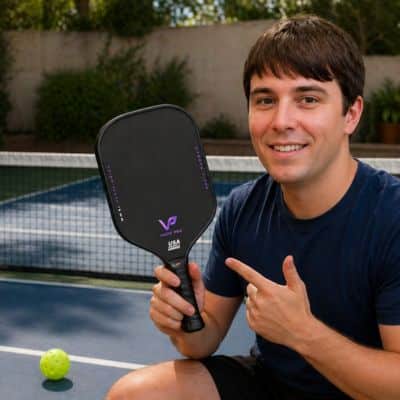
Dylan is a 4.5-rated pickleball player and gear writer who has tested 80+ paddles across 400+ hours on court. He rates spin, power, control, and forgiveness from real court time so you can buy smarter — no sponsored rankings, ever.