
Which City Banned Pickleball? (It’s Not Who You’d Expect)

A California beach town with no street addresses, no parking meters, and an actual law banning high heels permanently banned pickleball. And as someone who tests paddles for a living, I can’t even be mad about it.
Carmel-by-the-Sea — population 3,200, zero streetlights, and apparently infinite patience until it ran out — became the first California city to ban pickleball at public facilities. First came a temporary ban, followed by a permanent city council vote. Done. Courts closed. No appeal.
Quick Key Takeaways
- First City to Ban: Carmel-by-the-Sea, CA permanently banned public court play at Forest Hill Park following two years of unresolvable noise disputes.
- Other Restricted Cities: Lake Oswego (OR) enacted court closures, while Laguna Beach, Saratoga, and Denver implemented equipment or sound-mitigation mandates.
- The Physics Problem: Hard paddle impacts generate up to 20 dB higher sound pressure than tennis—translating to roughly 100 times more acoustic intensity.
- Gear Solutions: 16mm polymer cores and fiberglass faces produce significantly quieter pops than stiff 13mm raw carbon fiber paddles.
Two years of city council drama, noise complaints, foam ball experiments, and frustrated residents led to one conclusion: pickleball lost. When I first read this story, I wanted to take the players’ side automatically. Then I looked at the actual meeting transcripts.
The Backstory: Why Carmel-by-the-Sea Banned Pickleball
Carmel-by-the-Sea yanked pickleball from Forest Hill Park, shutting down its single public court. No negotiation, no compromise—just silence. As of now, it remains the most comprehensive public pickleball ban in California, and one that municipalities across the country are watching closely.
Lake Oswego in Oregon reached the same conclusion, closing courts at George Rogers Park after residents cited severe acoustic disruption to their daily lives.
The Timeline of a Public Park Dispute
Forest Hill Park had just one court. The amount of governmental energy spent on a single court in a town smaller than most suburban apartment complexes is wild—but Carmel genuinely tried every alternative first:
- They capped playable hours to limit early morning and late evening noise.
- They evaluated sound barrier walls (which yielded mixed results in neighboring towns).
- They floated requiring “librarian foam” balls—softer, quieter variants that sparked heated city council debate over enforceability.
Resident Kimberly Edwards put the enforcement dilemma plainly: “Am I going to have to hear a noise and then call the police? Is an officer going to sit there supervising them?”
After two years of friction, Mayor Dale Byrne noted that consistent enforcement proved impossible and consumed excessive municipal staff time. The council voted to terminate play. (Keep in mind, this is a town that passed a law in 1963 banning high heels over two inches tall to prevent tree-root trip lawsuits. Carmel does not hesitate when enforcing local ordinances.)
Why Pickleball Is So Loud (The Physics of Sound)
A pickleball striking a hard paddle face generates sound levels roughly 20 decibels higher than a standard tennis racket hit. Because the decibel scale is logarithmic rather than linear, a 20 dB increase represents approximately 100 times more acoustic energy reaching your ears.
Why Pickleball Sound Penetrates Neighborhoods
Acoustic experts classify pickleball noise as an impulsive sound—a sharp, high-frequency spike similar to a cap gun or car backfire rather than a continuous hum like traffic or lawn mowers.
When multiple courts operate simultaneously, these sharp acoustic frequency spikes stack rather than blend, amplifying perceived noise in surrounding residential structures.
Gear construction plays a primary role in acoustic output. A stiff T700 raw carbon fiber face—found on high-performance paddles like the JOOLA Hyperion or Selkirk Power Air—hits harder and creates a sharper pop than a flexible fiberglass face. If you want to understand how surface materials influence ball dwell time and trajectory, explore our detailed analysis of the best pickleball paddles for spin.
Additionally, a thin 13mm core produces significantly higher acoustic resonance than a 16mm polymer honeycomb core, which absorbs more vibration upon impact. Selecting a thicker, quieter setup can make a substantial difference in sound-sensitive communities. To find high-performing 16mm options, check out our full guide to the best pickleball paddles.
How Other Cities Handle Pickleball Noise
Municipal Pickleball Noise Strategies
| City | Strategy Implemented | Status / Result |
|---|---|---|
| Carmel-by-the-Sea, CA | Permanent public court closure at Forest Hill Park. | Total Ban |
| Lake Oswego, OR | Closed courts at George Rogers Park due to resident complaints. | Park Closure |
| Laguna Beach, CA | Passed an ordinance requiring certified quiet paddles or fines. | Equipment Enforcement |
| Saratoga, CA | Approved $100,000 for specialized acoustic barrier soundproofing. | Sound Mitigation |
| Denver, CO | Introduced mandatory sound-dampening foam balls at public courts. | Quiet Ball Mandate |
Actionable Solutions for Pickleball Players
Rather than viewing noise disputes as an attack on the sport, players can take proactive steps to protect court access in residential areas:
- Use Low-Noise Gear Near Homes: Switch to a 16mm polymer core paddle with a fiberglass face when playing near residential properties.
- Adopt Foam or Quiet Balls: Specialty foam balls reduce decibel output by 30% to 40% compared to standard outdoor plastic balls.
- Advocate for Smarter Zoning: Work with local parks departments to build dedicated complexes away from residential property lines rather than converting single neighborhood tennis courts.
- Self-Impose Quiet Hours: Establish voluntary play schedules in rec groups before city councils step in with formal restrictions.
FAQs
Which city banned pickleball?
Carmel-by-the-Sea, California became the first city in the state to permanently ban public court pickleball at Forest Hill Park. Lake Oswego, Oregon, also closed public courts at George Rogers Park due to similar noise concerns.
Why did Carmel ban pickleball?
Following two years of persistent noise complaints, the city attempted play limits, sound wall evaluations, and quiet-ball requirements. Ultimately, the city council determined consistent enforcement was unmanageable and voted for a complete public court ban.
What other cities have restricted pickleball?
Laguna Beach mandates quiet paddles, Saratoga invested $100,000 in acoustic barriers, and Denver introduced sound-dampening balls at public facilities.
Which paddles produce less noise?
Paddles featuring 16mm polymer core construction and fiberglass faces emit lower decibel levels and softer sound profiles than thin 13mm raw carbon fiber models.
Will more cities ban pickleball?
City-wide bans remain rare, but court closures, equipment mandates, and restricted operating hours will continue to expand as municipal infrastructure catches up with player growth.
Conclusion: Finding Common Ground
Pickleball’s rapid expansion isn’t slowing down, but player growth must balance community consideration. Homeowners living adjacent to courts deserve quiet hours, and players deserve dedicated, well-planned facilities.
The sport will easily survive isolated bans like Carmel’s. However, maintaining long-term access to public parks depends on players making smart gear choices, respecting local hours, and supporting proper municipal zoning.
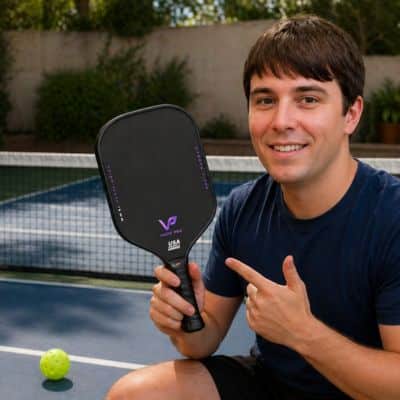
Dylan is a 4.5-rated pickleball player and gear writer who has tested 80+ paddles across 400+ hours on court. He rates spin, power, control, and forgiveness from real court time so you can buy smarter — no sponsored rankings, ever.