
Best Pickleball Paddles for Intermediate Players 2026

Last Updated: October, 2026 · 400+ hours testing 80+ paddles · By Dylan, 4.5-rated player
Jump to: Top Picks Quick Comparison By Rating All 7 Paddles By Situation Final Verdict FAQs
Somewhere in the 3.0–4.0 range, your beginner paddle stops doing what you’re asking. The dink you tried to keep low pops up. The topspin drive doesn’t bite. The reset you shaped correctly doesn’t sit. You know the problem isn’t entirely your technique — you’ve hit that shot right before — but the paddle isn’t giving you back what your hands put in.
I’ve tested 80+ paddles across 400+ hours of court time, running sessions with players from 3.0 to 5.0. The choices below are the ones I put directly in a 3.0–4.0 player’s hands based on real on-court performance. If you want to see my full testing roster across every category, start with my ranking of the best pickleball paddles of 2026.
Transparency: Some links on this page are affiliate links. I earn a small commission if you buy through them, at no extra cost to you, and it never changes a score. I buy every paddle myself, and no brand has paid to appear on this list.
My Top Picks at a Glance
JOOLA Hyperion CFS 16mm
The best overall all-court option at this level. Features a crisp Carbon-Flex5 surface paired with a stable Hyperfoam Edge Wall to expand the sweet spot and stabilize off-center baseline drops.
View JOOLA Hyperion CFS on Amazon Read My Full JOOLA Hyperion CFS Review →Vatic Pro Prism Flash
Performs way above its sub-hundred-dollar price point using high-grade raw Toray T700 carbon fiber and specialized non-heat cold molding. Delivers a very plush, soft touch for control-focused kitchen resets.
View Vatic Pro Prism Flash on Amazon Read My Full Prism Flash Review →How I Tested These Intermediate Pickleball Paddles
I bought every paddle on this list at retail — no review units, no brand relationships, nothing that would change what I say about them. I’ve been doing this long enough to know that companies attach invisible strings to free paddles. (For the full breakdown of my testing process across every category, see how I test pickleball paddles.)
Testing for this guide ran across multiple sessions with ten players in the 3.0–4.0 range this guide targets. Not all in the same session — different players across different courts, different times, different match contexts. The reason that matters: a paddle that works great in a casual rally session sometimes falls apart in a real match under pressure, and vice versa. I don’t publish findings from one session.
For each paddle, I evaluated:
- Spin Potential: I measure spin with my testing tools and report it as a tier, then confirm it on court with serve and drive drills using a consistent swing path.
- Swing Feel: Tested in fast kitchen exchanges and baseline drives to judge maneuverability vs. plow-through.
- Spin Longevity: On my top picks, I tracked how much surface grit wore down over 25+ hours of match play.
- 3.0–4.0 Playability: Tracked how effectively each paddle compensated for off-center contact and supported mechanical development, based specifically on how 3.0–4.0 players performed with it — not just how it felt in my own 4.5 game.
- Blind Comparisons: I handed the Prism Flash to 4.0 players alongside premium paddles and asked which one they thought cost more.
A few things I specifically don’t do: I don’t take manufacturer specs at face value because they’re often rounded, sometimes wrong, and occasionally measure something different from what they claim. I don’t give significant weight to Amazon ratings because sponsored review programs and incentivized feedback distort them. And I don’t list paddles because a brand has good PR or because they sent a press release.
The rankings can change. New paddles come out. Brands redesign their models. The “Last Updated” date at the top of this page reflects when I last tested or verified each entry.
How Do You Know You’ve Outgrown Your Beginner Paddle?
You’ve outgrown your starter paddle if you are hitting drops, resets, and topspin with intent, but the ball consistently pops up or flies long. Beginner paddles lack the face grit to bite for spin and the core depth to cushion soft dinks. To understand how core thickness and surface composite work together, review my guide on what makes a good pickleball paddle before upgrading, or see my best pickleball paddles for beginners if you’re not there yet.
How to Choose the Best Intermediate Pickleball Paddle
- Swing Feel (Light vs. Driving): Dictates how the paddle moves through the air. A light, nimble swing feel gives you faster hands for rapid kitchen exchanges, while a head-heavy or driving swing feel offers maximum baseline plow-through and stability. If you’re not sure which matters more for your game, see power vs. control paddles explained.
- Raw Carbon Fiber (T700): Generates heavy spin via surface texture — it’s the material behind most top picks on this list. Options like the Vatic Pro offer real raw carbon at an accessible price.
- 16mm Core Thickness: Offers the soft dwell time needed for control. While 14mm cores provide more power, they punish off-center hits ruthlessly.
- Expanded Sweet Spot: Intermediate players mishit more than they realize. A wider, stable hitting zone keeps you in rallies while your accuracy improves.
- Grip Length (5.3″+ for Two-Handers): Crucial if you hit a two-handed backhand. The JOOLA Hyperion and Six Zero DBD (both 5.5″) and the Franklin (5.6″) give you plenty of room. The Vatic Pro (5.3″) is workable but on the short side, so try it before committing if you hit with two hands.
- Thermoformed vs. Non-Thermoformed: Thermoformed designs are stiff and powerful for aggressive players. Non-thermoformed options (like the Vatic Pro) are plushier and softer — ideal for building kitchen confidence.
Best Intermediate Pickleball Paddles: Quick Comparison
If you’re in a hurry, here’s the short version. Below is a snapshot of the seven best intermediate pickleball paddles of 2026, what they’re best for, and why they made the list. Use this table to narrow down your options, then dive into the full reviews for the details.
| Product | Recommendation | Tech Specs | Dylan’s Rating | Shop |
|---|---|---|---|---|
| Best All-Court | Hybrid / 16mm / 5.5″ Grip Carbon-Flex5 (CFS) Face |
9.4 |
View on Amazon | |
| Best Under $100 | Hybrid / 16mm / 5.3″ Grip Raw Toray T700 Carbon Fiber |
9.6 |
View on Amazon | |
| Best Spin + Sweet Spot | Hybrid / 16mm / 5.5″ Grip Toray T700 Raw Carbon |
9.5 |
View on Amazon | |

Selkirk Vanguard S2
|
Best Wide-Body Forgiveness | Wide-Body / 16mm / 4.5″ Handle QuadCarbon Fiber Face |
8.0 |
View on Amazon |
| Best Spin Longevity | Elongated / 16mm / 5.25″ Grip Unidirectional Carbon Weave |
9.4 |
View on Amazon | |

Franklin Sports Pro 16mm
|
Best Budget Pick | Elongated / 16mm / 5.6″ Grip Fiberglass MaxGrit Surface |
8.1 |
View on Amazon |

HEAD Radical Tour EX Raw
|
Best for Arm Sensitivity | Elongated / 15mm / 4-1/8″ Grip Circumference Raw Carbon Fiber / Comfort Grip |
8.3 |
View on Amazon |
Best Pickleball Paddles for 3.0, 3.5 and 4.0 Players
- 3.0: Start with the Vatic Pro Prism Flash for plush control, or the Selkirk Vanguard S2 if mishits are what’s costing you points. The CRBN 3X is more paddle than you need yet.
- 3.5: The Vatic Pro Prism Flash. Real raw carbon spin and a soft touch while your kitchen game develops.
- 4.0: The JOOLA Hyperion CFS 16mm if your soft game is solid and you want all-court pop, or the Six Zero DBD 16mm if spin is the plan.
The 7 Best Pickleball Paddles for Intermediate Players
JOOLA Hyperion CFS 16mm
Who should skip this: Skip if you want a soft, quiet paddle — the Hyperion is firm and loud.
Best All-Court
| Shape | Hybrid |
| Weight | ~8 oz |
| Grip Length | 5.5″ |
| Core Thickness | 16mm Reactive Polypropylene Honeycomb |
| Face Material | Carbon-Flex5 (CFS) Textured Carbon |
| Thermoformed | Yes |
More 3.5–4.5 players are using this paddle at my regular courts than anything else — not because of Ben Johns marketing, but because players who’ve tried multiple paddles keep ending up here. That tells you something real about what it does for that level.
It’s not raw T700 the way the Vatic Pro and Six Zero are, but in practice, it generates noticeably more spin than standard carbon faces and holds its texture longer. The Hyperfoam Edge Wall adds weight to the perimeter, which is what gives you the sweet spot coverage — mishits that would spray on a standard carbon paddle stay in play. In sessions where I handed the Hyperion to 3.5–4.0 players alongside two or three other options, this one produced the most obvious improvement in third-shot drops.
The feel is crisp, not plush — it’s a fully thermoformed build, and that construction is exactly why it feels stiffer than paddles like the Vatic Pro. Players coming from soft beginner paddles sometimes need a session or two to adjust.
It’s the highest-priced non-premium option on this list — if you want to see where it sits against paddles above and below this price bracket, check my best pickleball paddles under $200 guide. If the budget allows one paddle, this is what I’d tell most people to buy. Read my full JOOLA Hyperion CFS 16mm review for my full spin and sweet-spot notes, or check out how it holds up against the flagship model in my JOOLA Pro V review.
Vatic Pro Prism Flash
Who should skip this: Skip if you need maximum power — the Flash prioritizes control over pop.
Best Under $100
| Shape | Hybrid |
| Weight | 8 oz |
| Grip Length | 5.3″ |
| Core Thickness | 16mm, Non-Thermoformed + Foam-Injected Walls |
| Face Material | Raw Toray T700 Carbon Fiber |
| Thermoformed | No (cold-molding process) |
I’ve handed the Prism Flash to 4.0 players alongside premium paddles costing multiples more in blind tests and asked which one they think costs more. The split is roughly even. That’s the clearest thing I can say about what this paddle does.
Vatic sells direct-to-consumer and spends almost nothing on marketing. What you get: Toray T700 carbon — same face material used on paddles costing significantly more — foam-injected walls despite not using thermoforming heat, polyurethane inserts for feel, and spin that’s genuinely competitive with paddles well above this price point. If you’re at all skeptical you’d get a real “T700” face at this price, my breakdown of T300 vs. T700 pickleball paddles explains exactly what to look for.
The cold-molding approach Vatic uses produces a softer, plushier response than thermoformed paddles. Drops sit. Resets land where you intended them.
What it doesn’t do: power. Drives aren’t electric here, the way they are on thermoformed paddles. But for most intermediate players who need to build their kitchen game first, the Vatic Pro is the smarter starting point — and one of the strongest picks in my best pickleball paddles under $100 guide. Includes a paddle cover, a nice touch at this tier. Read my full Vatic Pro Prism Flash review for the details. If control is your top priority, see my guide to the best pickleball paddles for control for options built specifically around touch and placement.
If you’re deciding between the two body shapes, read my full Vatic Pro Prism V7 review to see how the elongated shape alters swing weight, or view the head-to-head Vatic Pro Prism Flash vs V7 comparison.
Six Zero Double Black Diamond 16mm
Who should skip this: Skip if you’re on a tight budget — premium performance at a premium price.
Best Spin + Sweet Spot
| Shape | Hybrid (16.3″ flared) |
| Weight | 8.1 oz |
| Grip Length | 5.5″ |
| Core Thickness | 16mm Thermoformed Honeycomb |
| Face Material | Toray T700 Raw Carbon |
| Thermoformed | Yes |
Ranks among the best I’ve tested for spin potential, and the sweet spot is noticeably wider than on standard hybrid shapes. The flared aerodynamic shape is 16.3 inches — longer than standard but not fully elongated.
For intermediate players specifically, this suits someone who has identified spin as what they want to build their game around. If you are specifically building a spin-heavy system, compare this alongside my rankings for the best pickleball paddles for spin.
The 5.5-inch grip is one of the longer options at any price. Three players in my group picked up a two-handed backhand for the first time, specifically because this handle finally gave them room. Players wanting maximum baseline pop can look toward 14mm builds or competitive choices in my advanced pickleball paddles guide.
The kitchen feel on the DBD is the best I’ve found at this price. That said, it’s not a power paddle — the 16mm is plush and prioritizes touch over punch. If you want more pop, see my guide to the best power pickleball paddles for the hardest-hitting options I’ve tested.
I’ve tested both the 16mm and 14mm extensively — read the full Six Zero Double Black Diamond review for my long-term wear notes, the 14mm vs 16mm breakdown, and how it compares to the CRBN 3X. Also see the best Six Zero paddle guide for where the DBD fits in the full lineup.
Selkirk Vanguard S2
Who should skip this: Skip if you want an elongated shape — the S2 is a widebody.
Best Wide-Body Forgiveness
| Shape | S2 Wide-Body |
| Weight | ~8.4 oz |
| Grip Length | 4.5″ (Short Handle) |
| Grip Circumference | 4.25″ |
| Core Thickness | X5 Polypropylene Honeycomb |
| Face Material | QuadCarbon Fiber Face |
| Thermoformed | No |
The Selkirk name carries heavy marketing, which makes evaluating their paddles harder. I’ve tested another Selkirk model in depth too — see my Selkirk Boomstik review if you’re comparing across their lineup. The Vanguard S2 earns its place here on what it actually does, not the brand.
The S2 shape is the widest in Selkirk’s lineup — maximum surface area, largest sweet spot, and shorter handle than their standard Epic model. The QuadCarbon face gives more dwell time than standard carbon, and the X5 core absorbs vibration well.
One thing to know upfront: the handle is only about 4.5 inches, well short of the 5.25–5.6 inches on most paddles here. Two-handers will feel cramped.
It’s a real value if the S2’s wide-body forgiveness is what you need. Curious how it stacks up against a non-Selkirk paddle head-to-head? My JOOLA vs. Selkirk comparison covers that directly.
CRBN 3X 16mm
Who should skip this: Skip if you’re still developing touch — the 3X rewards aggressive play.
Best Spin Longevity
| Shape | Fully Elongated (16.5″ x 7.5″) |
| Weight | 7.8–8.1 oz |
| Grip Length | 5.25″ |
| Core Thickness | 16mm Thermoformed Unibody |
| Face Material | Unidirectional Carbon Weave |
| Thermoformed | Yes |
Most brands won’t tell you how fast their carbon faces wear out. The grit that generates spin wears down with hard play on most paddles. The CRBN 3X held onto most of its original spin through my longest testing window — the unidirectional carbon weave resists smoothing better than standard carbon faces. If you play four or five times a week and keep paddles for more than one season, that durability compounds into real value — see my full guide on paddle care and maintenance for how to protect that investment further.
The unibody construction is worth mentioning — CRBN runs carbon from the face through the handle as one piece rather than bonding a separate handle on.
This is the most expensive paddle on this list. For a 3.0–3.5 player still developing fundamentals, it’s more paddle than you need right now. Read my breakdown of what makes the CRBN 3X different from other paddles.
Franklin Sports Pro 16mm
Who should skip this: Skip if you want tour-level spin — great value, but the face isn’t raw carbon.
Best Budget Pick
| Shape | Elongated (16.5″ x 7.5″) |
| Weight | 7.9–8.3 oz |
| Grip Length | 5.6″ (Excellent for Two-Handers) |
| Grip Circumference | 4.5″ (Thicker Profile) |
| Core Thickness | 16mm Polypropylene Honeycomb |
| Face Material | Fiberglass MaxGrit Surface |
| Thermoformed | No |
While its spray-on MaxGrit texture provides effortless, heavy spin right out of the box, fiberglass faces don’t retain their texture long-term.
Where this paddle shines is its shape and price point — it’s one of the strongest picks in my best budget pickleball paddle guide. The long 5.6-inch handle offers real estate for two-handed backhand players developing their reach.
The compromise here is longevity — see my paddle care and maintenance guide for how to slow that wear down. After 2 to 4 months of heavy use, the face texture wears smooth, and your spin drops off noticeably. I’ve also tested a different Franklin model — read my Franklin C45 Dynasty review if you want to see how it compares within the same brand.
Bottom line: If you catch it on a big Amazon sale or specifically need a long handle, it’s a highly accessible midrange bargain.
HEAD Radical Tour EX Raw
Who should skip this: Skip if you have a two-handed backhand — the handle runs short.
Best for Arm Sensitivity
| Shape | Elongated |
| Weight | 8.1 oz |
| Grip Circumference | 4-1/8″ |
| Core Thickness | 15mm Polypropylene |
| Face Material | Carbon Fiber (Raw) |
| Thermoformed | No |
This paddle is here for one reason: arm and elbow comfort. I’m not a doctor, so see one if pain persists, but HEAD comes from a tennis background where vibration-dampening technology matters, and it shows.
At 15mm (not 16mm), it’s slightly thinner than most paddles on this list, which produces a livelier feel. The raw carbon face generates solid topspin — I haven’t put it through the same head-to-head spin testing as my carbon-focused picks, so I’m comparing it on feel here rather than ranking it directly.
The grip circumference is 4-1/8 inches — the narrowest on this list, so players with larger hands will want to build it up with an overgrip or grip tape.
If your arm is fine, the Hyperion or Vatic Pro is the better performance pick. If arm discomfort is cutting your sessions short, the Radical Tour is the most targeted solution on this list.
Which Paddle Fits Your Situation
- Need a long handle for two hands: Franklin Sports Pro or Six Zero DBD 16mm — both give two-handed backhand players real room to work with.
- Forgiveness is the priority: Selkirk Vanguard S2. Widest sweet spot on this list, built for players who lose points to mishits more than tactics.
- Dealing with arm or elbow discomfort: HEAD Radical Tour EX Raw. The only reason to choose it over the Vatic Pro is genuine arm sensitivity.
- Want the strongest all-around value: Vatic Pro Prism Flash. Genuine T700 carbon face, 16mm plush core, spin that holds up against paddles costing far more — the benchmark pick on this list.
- Want the best all-court performance: JOOLA Hyperion CFS. If your game touches every zone of the court and you’re ready to invest in it, this is worth stretching for.
- Spin is the whole plan: Six Zero DBD 16mm. Best spin potential on this list, wide sweet spot, long handle for two-handers.
- High-volume player who wants multi-season durability: CRBN 3X. Only makes sense if you’re playing often enough to actually wear out a paddle’s grit.
Still not sure which of these actually matches your game? My pickleball paddle decision matrix walks through the tradeoffs in more depth than a quick-pick list can.
Final Verdict
Vatic Pro Prism Flash is where most people should start — raw T700 carbon, 16mm core, strong spin for the price, and I can’t get 4.0 players to reliably beat it in blind tests against paddles costing far more.
If your budget stretches that far, get the JOOLA Hyperion CFS and stop researching. The Six Zero DBD has the best spin on this list, but the Hyperion is the specific option most all-court intermediate players land on after testing multiple paddles on the court.
Is spin the priority, and are you ready to commit to that investment? Six Zero DBD 16mm. Best spin on this list, wide sweet spot, long handle for two-handers. Read the full Six Zero Double Black Diamond review before deciding — it covers the 14mm vs 16mm question in detail.
The others fill specific gaps: Selkirk S2 for forgiveness on a budget, CRBN 3X for high-volume durability, HEAD Radical Tour for arm pain, and Franklin for the longest handle at the lowest price.
Pick the one that fits your budget and biggest weakness. Any of the seven beats a beginner paddle — if you’re still on one and want to know exactly when to move on, see my best pickleball paddles for beginners. Already a 4.0+ player ready to go all in? See my best pickleball paddles for advanced players for options built around 4.5+ mechanics. My top overall pick is the Six Zero Black Opal, and you can see how every category stacks up in my full ranking of the best pickleball paddles of 2026.
More guides: best pickleball paddles for spin · under $100 · under $200 · advanced players · women
FAQs
What is the best pickleball paddle for a 3.5 or 4.0 player?
For most 3.5 players, the Vatic Pro Prism Flash is the best starting point — plush control and real raw carbon spin for the money. For a 4.0 player with solid soft-game touch, the JOOLA Hyperion CFS 16mm adds all-court pop and a bigger sweet spot. See my picks by rating for 3.0 players too.
14mm or 16mm as an intermediate player?
16mm for almost everyone. The extra dwell time gives you better control over soft shots while your game develops. 14mm cores are punchier but punish off-center contact harder. Start with 16mm, then consider 14mm once you reach a consistent 4.0 to 4.5. Read my 14mm vs 16mm core thickness breakdown for full details.
What swing feel should an intermediate pickleball player look for?
Balanced-to-light. A lighter, nimble swing feel gives you quick hands during rapid NVZ exchanges, while a slightly head-heavy feel adds drive power from the baseline. I evaluate swing feel across dynamic kitchen and drive drills to ensure optimal maneuverability for intermediate mechanics.
Is carbon fiber worth it at the intermediate level?
Yes. Raw T700 carbon fiber generates real topspin, provides better feedback, and holds surface grit far longer than fiberglass — see my T300 vs. T700 breakdown if you want to know exactly what that spec number means. With genuinely affordable options like the Vatic Pro available, carbon fiber is accessible no matter your budget.
Do I need a thermoformed paddle?
Not necessarily. Thermoformed paddles offer stiffer pop and higher power, which suits players with an already established soft game. Non-thermoformed options are plushier and forgiving — ideal if you are still building kitchen control and third-shot drops.
How much should I spend on a paddle at this level?
For most 3.0–4.0 players, a mid-range paddle is enough. My best pickleball paddles under $100 and under $200 guides show where the performance gains flatten out. Past that tier, you need 4.0+ mechanics to notice the difference.
When have I actually outgrown my beginner paddle?
When you execute drops or spin with correct form, but the paddle consistently fails to deliver expected depth or bite.
Does paddle brand matter?
Less than marketing suggests. Top-tier brands have massive visibility, but direct-to-consumer options can deliver comparable build materials (like raw T700 carbon) for much less money. My guide on who actually makes the best pickleball paddle goes deeper on this. Focus on transparent specs over brand names.
Hybrid vs. elongated vs. wide-body — which shape for intermediate?
Hybrid for most intermediate players. It balances reach and sweet spot forgiveness. Elongated paddles like the CRBN 3X, Franklin, and HEAD give more reach but punish mishits harder, and wide-body shapes like the Selkirk S2 trade some court coverage at the net for forgiveness.
Can I use an intermediate paddle if I’m still a beginner?
Yes, provided it features a forgiving 16mm core (like the Vatic Pro or Selkirk Vanguard S2). Avoid stiff 14mm thermoformed paddles, as they reveal timing errors and hinder fundamental development.
What’s the difference between the JOOLA Hyperion and the JOOLA Pro V?
The JOOLA Pro V is JOOLA’s flagship tour paddle featuring KineticFrame technology built for heavy baseline pop. The JOOLA Hyperion CFS 16mm is their mid-tier all-court build, with a crisp, firm feel and a wider sweet spot than its shape suggests. For a 3.0–4.0 player looking for an intermediate pickleball paddle, the Hyperion offers significantly better value without paying a premium for tour-level power you won’t fully utilize.
Are there different best paddles for men and women at the intermediate level?
No. Choose by swing feel, grip size, and how forgiving you need the paddle to be, not by gender. If you want lighter or smaller-grip options, my best pickleball paddles for women guide covers them.
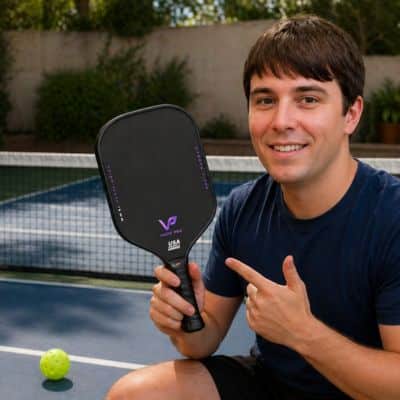
Dylan is a 4.5-rated pickleball player and gear writer who has tested 80+ paddles across 400+ hours on court. He rates spin, power, control, and forgiveness from real court time so you can buy smarter — no sponsored rankings, ever.